Anker-Hansen Christian, Pirouzifard MirNabi, Sundquist Jan, Sundquist Kristina, Zöller Bengt
Center for Primary Health Care Research, Lund University/Region Skåne, Malmö, Sweden.
Osteoarthr Cartil Open. 2025 May 30;7(3):100637. doi: 10.1016/j.ocarto.2025.100637. eCollection 2025 Sep.
Osteoarthritis (OA) is a common degenerative disease with a genetic contribution. However, no large nationwide family study concerning the heredity of OA has been published. This first nationwide study aimed to determine the familial risks of the main types of OA in twins, full-siblings, half-siblings, and cousins in Sweden.
The Swedish Multigeneration register was linked to the National Patient Register (NPR) to investigate the heredity of OA (poly-, hip-, knee-, first carpometacarpal joint-, and other-OA) between 1997 and 2018. Offspring born by Swedish parents were included. The adjusted familial hazard ratios (HRs) with 95 % confidence interval (CI) were determined for OA among twins, full-siblings, half-siblings, and cousins. Adjustments were made for birth year, sex, educational level, and comorbidities (chronic obstructive pulmonary disease, alcoholism, and obesity).
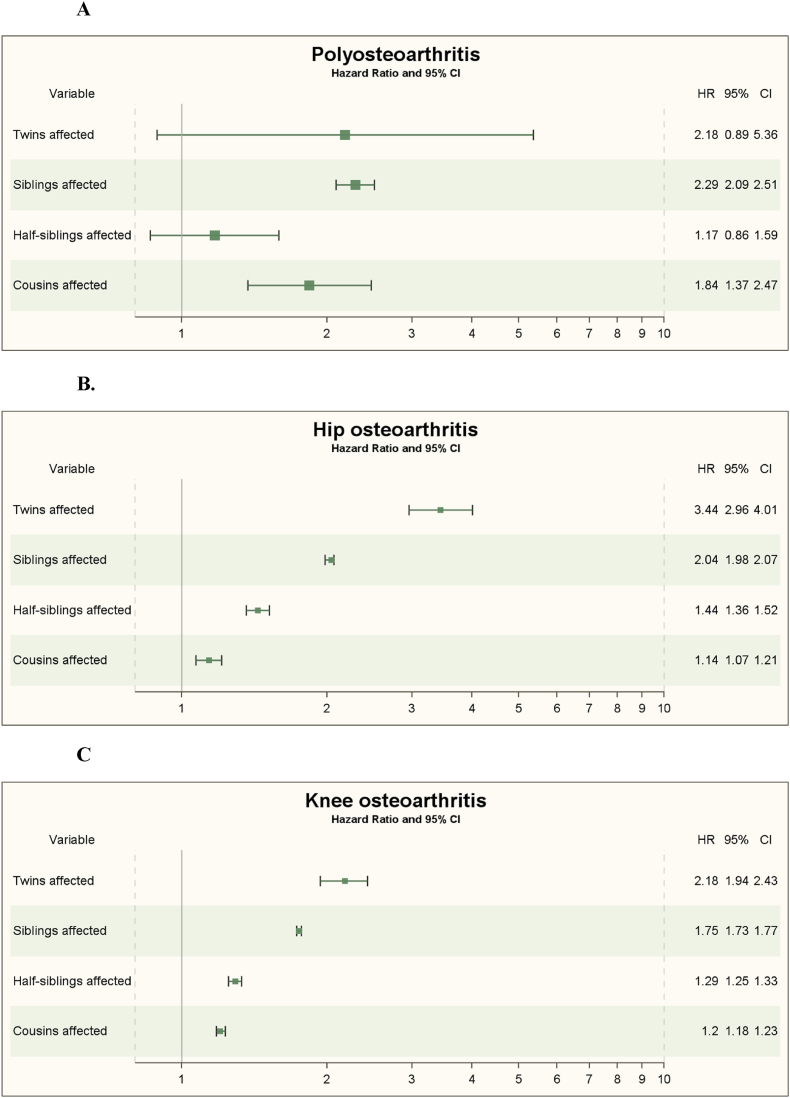
A total of 6 547 966 individuals (48.77 % women) were included with mean age 41.44 years (range 0-86.96 years) at end of follow-up. Familial HRs were increased for all five types of OA (even in cousins) and correlated to degree of genetic resemblance between relatives. For instance, adjusted HRs among full-siblings were for poly-OA 2.29 (95 % CI 2.09-2.51), hip-OA 2.04 (95 % CI 1.98-2.07), knee-OA 1.75 (95 % CI 1.73-1.77), thumb-OA 2.60 (95 % CI 2.45-2.76), and other-OA 1.52 (95 % CI 1.48-1.56).
Heredity is an important predictor of future risk of OA for all five types of OA in the Swedish population. Strongest heredity was observed for first carpometacarpal joint -OA followed by poly-OA and hip-OA. Weakest heredity was observed for knee-OA and other-OA.
骨关节炎(OA)是一种常见的具有遗传因素的退行性疾病。然而,尚未发表过关于OA遗传的大规模全国性家族研究。这项首次全国性研究旨在确定瑞典双胞胎、全同胞、半同胞和堂兄弟姐妹中主要类型OA的家族风险。
瑞典多代登记册与国家患者登记册(NPR)相链接,以调查1997年至2018年间OA(多关节型、髋关节、膝关节、第一腕掌关节和其他类型OA)的遗传情况。纳入瑞典父母生育的后代。确定双胞胎、全同胞、半同胞和堂兄弟姐妹中OA的调整后家族风险比(HRs)及95%置信区间(CI)。对出生年份、性别、教育水平和合并症(慢性阻塞性肺疾病、酗酒和肥胖)进行了调整。
共纳入6547966人(48.77%为女性),随访结束时平均年龄41.44岁(范围0 - 86.96岁)。所有五种类型的OA家族HRs均升高(即使在堂兄弟姐妹中),且与亲属间的遗传相似程度相关。例如,全同胞中多关节型OA的调整后HRs为2.29(95%CI 2.09 - 2.51),髋关节OA为2.04(95%CI 1.98 - 2.07),膝关节OA为1.75(95%CI 1.73 - 1.77),拇指OA为2.60(95%CI 2.45 - 2.76),其他类型OA为1.52(95%CI 1.48 - 1.56)。
在瑞典人群中,遗传是所有五种类型OA未来发病风险的重要预测因素。第一腕掌关节OA的遗传倾向最强,其次是多关节型OA和髋关节OA。膝关节OA和其他类型OA的遗传倾向最弱。