You Wenpeng, Sevastidis Jacob, Donnelly Frank
School of Biomedicine, The University of Adelaide, Adelaide, Australia.
Adelaide Nursing School, The University of Adelaide, Adelaide, Australia.
Int J Cardiol Cardiovasc Risk Prev. 2025 May 22;26:200437. doi: 10.1016/j.ijcrp.2025.200437. eCollection 2025 Sep.
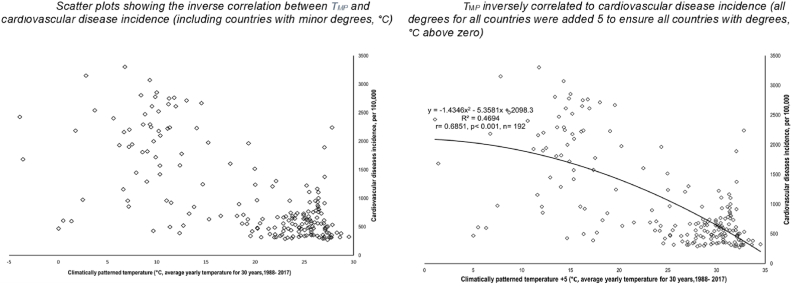
Short-term cold spells and heat events are commonly considered risk factors for cardiovascular disease (CVD). This study quantitatively examined the effects of country-specific "climate-patterned temperature" (T), measured as long-term mean temperature, on global CVD incidence.
Recently published country-specific data on CVD incidence and T were analysed for statistical correlations at the population level using Microsoft Excel and SPSS. Confounding effects of humidity, aging, GDP PPP, obesity prevalence, and urbanization were controlled. Fisher r-to-z transformation compared correlation coefficients.
Pearson's r and nonparametric analyses revealed a significant inverse correlation between T and CVD incidence worldwide (r = -0.646 and -0.574, respectively, p < 0.001). This relationship remained significant after controlling for confounders in a partial correlation model (r = -0.584, p < 0.001). Multiple linear regression showed T as a significant and independent predictor of CVD incidence (Beta = -0.384, p < 0.001). Stepwise regression identified aging as the most influential factor (R = 0.591), with T and GDP PPP following, increasing R to 0.731 and 0.747, respectively. Humidity, obesity prevalence, and urbanization were not significant predictors. T had a stronger predictive effect on CVD incidence in high-income countries compared to low- and middle-income countries (z = 1.96 and 2.28 in Pearson's r and nonparametric models, respectively, p < 0.05).
Long-term lower mean temperature (T) is a significant and independent risk factor for CVD worldwide, particularly in developed countries. T should be considered in epidemiological studies of CVD.
短期寒潮和高温事件通常被认为是心血管疾病(CVD)的危险因素。本研究定量考察了以长期平均温度衡量的特定国家“气候模式温度”(T)对全球CVD发病率的影响。
使用Microsoft Excel和SPSS对最近公布的特定国家CVD发病率和T的数据进行分析,以在人群水平上进行统计相关性分析。控制了湿度、老龄化、GDP购买力平价、肥胖患病率和城市化的混杂效应。采用Fisher r到z变换比较相关系数。
Pearson相关系数r和非参数分析显示,全球范围内T与CVD发病率之间存在显著负相关(r分别为-0.646和-0.574,p<0.001)。在偏相关模型中控制混杂因素后,这种关系仍然显著(r=-0.584,p<0.001)。多元线性回归显示T是CVD发病率的显著且独立预测因子(β=-0.384,p<0.001)。逐步回归确定老龄化是最有影响的因素(R=0.591),其次是T和GDP购买力平价,R分别增加到0.731和0.747。湿度、肥胖患病率和城市化不是显著预测因子。与低收入和中等收入国家相比,T对高收入国家CVD发病率的预测作用更强(Pearson相关系数r和非参数模型中z分别为1.96和2.28,p<0.05)。
长期较低的平均温度(T)是全球CVD的一个显著且独立的危险因素,尤其是在发达国家。在CVD的流行病学研究中应考虑T。