Wu Yuze, Li Fengling, Shu Huilan, Li Siyuan, Cui Lijun, Tan Min, Luo Lanjun, Wei Xuemei
Nursing Department, Affiliated Hospital of North Sichuan Medical College, Nanchong, China.
School of Management, North Sichuan Medical College, Nanchong, China.
Int J Nurs Sci. 2025 Apr 15;12(3):253-260. doi: 10.1016/j.ijnss.2025.04.008. eCollection 2025 May.
Accurately identifying the key influencing factors of psychological birth trauma in primiparous women is crucial for implementing effective preventive and intervention measures. This study aimed to develop and validate an interpretable machine learning prediction model for identifying the key influencing factors of psychological birth trauma in primiparous women.
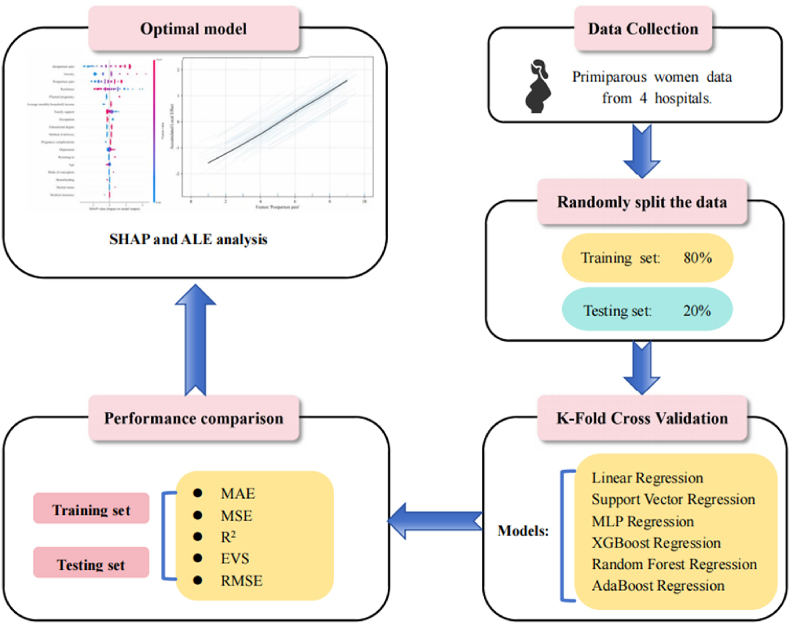
A multicenter cross-sectional study was conducted on primiparous women in four tertiary hospitals in Sichuan Province, southwestern China, from December 2023 to March 2024. The Childbirth Trauma Index was used in assessing psychological birth trauma in primiparous women. Data were collected and randomly divided into a training set (80 %, = 289) and a testing set (20 %, = 73). Six different machine learning models were trained and tested. Training and prediction were conducted using six machine learning models included Linear Regression, Support Vector Regression, Multilayer Perceptron Regression, eXtreme Gradient Boosting Regression, Random Forest Regression, and Adaptive Boosting Regression. The optimal model was selected based on various performance metrics, and its predictive results were interpreted using SHapley Additive exPlanations (SHAP) and accumulated local effects (ALE).
Among the six machine learning models, the Multilayer Perceptron Regression model exhibited the best overall performance in the testing set (MAE = 3.977, MSE = 24.832, = 0.507, EVS = 0.524, RMSE = 4.983). In the testing set, the and EVS of the Multilayer Perceptron Regression model increased by 8.3 % and 1.2 %, respectively, compared to the traditional linear regression model. Meanwhile, the MAE, MSE, and RMSE decreased by 0.4 %, 7.3 %, and 3.7 %, respectively, compared to the traditional linear regression model. The SHAP analysis indicated that intrapartum pain, anxiety, postpartum pain, resilience, and planned pregnancy are the most critical influencing factors of psychological birth trauma in primiparous women. The ALE analysis indicated that higher intrapartum pain, anxiety, and postpartum pain scores are risk factors, while higher resilience scores are protective factors.
Interpretable machine learning prediction models can identify the key influencing factors of psychological birth trauma in primiparous women. SHAP and ALE analyses based on the Multilayer Perceptron Regression model can help healthcare providers understand the complex decision-making logic within a prediction model. This study provides a scientific basis for the early prevention and personalized intervention of psychological birth trauma in primiparous women.
准确识别初产妇心理分娩创伤的关键影响因素对于实施有效的预防和干预措施至关重要。本研究旨在开发并验证一种可解释的机器学习预测模型,用于识别初产妇心理分娩创伤的关键影响因素。
于2023年12月至2024年3月在中国西南部四川省的四家三级医院对初产妇进行了一项多中心横断面研究。采用分娩创伤指数评估初产妇的心理分娩创伤。收集数据并随机分为训练集(80%,n = 289)和测试集(20%,n = 73)。对六种不同的机器学习模型进行了训练和测试。使用六种机器学习模型进行训练和预测,包括线性回归、支持向量回归、多层感知器回归、极端梯度提升回归、随机森林回归和自适应提升回归。根据各种性能指标选择最佳模型,并使用SHapley加性解释(SHAP)和累积局部效应(ALE)对其预测结果进行解释。
在六种机器学习模型中,多层感知器回归模型在测试集中表现出最佳的整体性能(平均绝对误差 = 3.977,均方误差 = 24.832,R = 0.507,解释方差得分 = 0.524,均方根误差 = 4.983)。在测试集中,与传统线性回归模型相比,多层感知器回归模型的R和解释方差得分分别提高了8.3%和1.2%。同时,平均绝对误差、均方误差和均方根误差分别比传统线性回归模型降低了0.4%、7.3%和3.7%。SHAP分析表明,产时疼痛、焦虑、产后疼痛、心理弹性和计划妊娠是初产妇心理分娩创伤最关键的影响因素。ALE分析表明,产时疼痛、焦虑和产后疼痛得分较高是危险因素,而心理弹性得分较高是保护因素。
可解释的机器学习预测模型可以识别初产妇心理分娩创伤的关键影响因素。基于多层感知器回归模型的SHAP和ALE分析可以帮助医疗保健提供者理解预测模型中的复杂决策逻辑。本研究为初产妇心理分娩创伤的早期预防和个性化干预提供了科学依据。