Takahashi Kyo, Tanaka Tomoki, Yoshizawa Yasuyo, Fujisaki-Sueda-Sakai Mahiro, Iijima Katsuya
Institute of Gerontology, The University of Tokyo, Tokyo, JPN.
Institute of Integrated Research, Institute of Science Tokyo, Tokyo, JPN.
Cureus. 2025 May 17;17(5):e84302. doi: 10.7759/cureus.84302. eCollection 2025 May.
Early interventions for nocturia and frailty are increasingly emphasized to extend healthy life expectancy. These interventions may lead to an increase in the number of drugs administered, potentially resulting in polypharmacy. This study examined the association between nocturia, coexisting frailty, and polypharmacy in community-dwelling older adults.
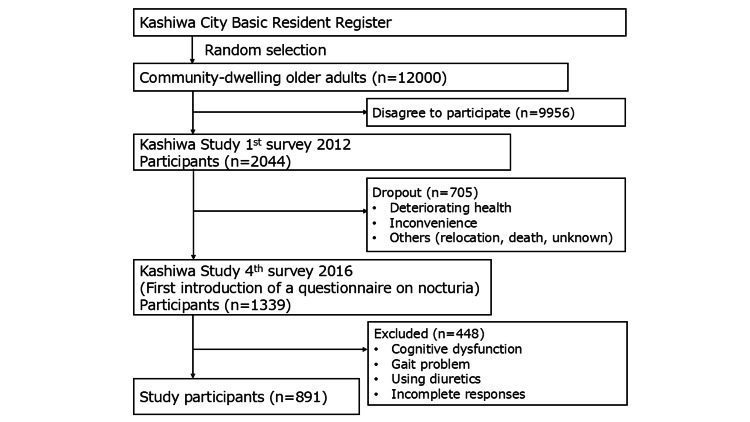
We selected 891 older adults without cognitive dysfunction (470 men, 421 women) from a population-based study conducted in 2016 in Kashiwa City, Japan. The association between nocturia, frailty, and polypharmacy was evaluated using sex-stratified logistic regression analysis.
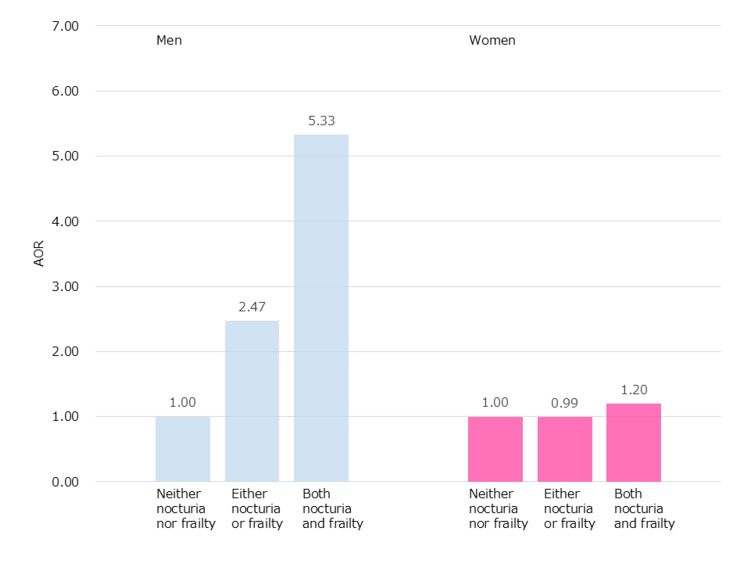
The prevalence of nocturia, frailty, and their coexistence was 56.4%, 6.2%, and 4.0% in men, and 35.2%, 3.8%, and 2.6% in women, respectively. Polypharmacy was observed in 19.4% of men and 13.1% of women. Compared to the group without nocturia or frailty, the adjusted odds ratio (AOR) for polypharmacy was 2.47 (95% confidence interval (CI): 1.29-4.71) in men and 0.99 (95% CI: 0.50-1.95) in women in the group with either nocturia or frailty. The AORs for the group with both nocturia and frailty were 5.33 (95% CI: 1.56-18.17) in men and 1.20 (95% CI: 0.23-6.17) in women.
Polypharmacy is more likely in older men when nocturia and frailty coexist. It is important to ensure that the treatment of nocturia and frailty does not result in a significant increase in the number of medications prescribed.
越来越强调对夜尿症和虚弱进行早期干预以延长健康预期寿命。这些干预措施可能会导致用药数量增加,从而可能导致多重用药。本研究调查了社区居住的老年人中夜尿症、并存的虚弱与多重用药之间的关联。
我们从2016年在日本柏市进行的一项基于人群的研究中选取了891名无认知功能障碍的老年人(470名男性,421名女性)。使用按性别分层的逻辑回归分析评估夜尿症、虚弱与多重用药之间的关联。
男性夜尿症、虚弱及其并存的患病率分别为56.4%、6.2%和4.0%,女性分别为35.2%、3.8%和2.6%。男性和女性中多重用药的发生率分别为19.4%和13.1%。与无夜尿症或虚弱的组相比,在患有夜尿症或虚弱的组中,男性多重用药的调整优势比(AOR)为2.47(95%置信区间(CI):1.29 - 4.71),女性为0.99(95%CI:0.50 - 1.95)。患有夜尿症和虚弱的组中,男性的AOR为5.33(95%CI:1.56 - 18.17),女性为1.20(95%CI:0.23 - 6.17)。
当夜尿症和虚弱并存时,老年男性更易发生多重用药。确保夜尿症和虚弱的治疗不会导致所开药物数量显著增加很重要。