Tian Zhenyu, Yang Lu, Li Yifei, Huang Yueqing, Yang Jianmin, Xue Fei
State Key Laboratory for Innovation and Transformation of Luobing Theory, Key Laboratory of Cardiovascular Remodeling and Function Research of MOE, NHC, CAMS and Shandong Province, Department of Cardiology, Qilu Hospital of Shandong University, Jinan, 250012, China.
Second Clinical Medical College, Guangzhou University of Chinese Medicine, Guangzhou, 510120, Guangdong, China.
Cardiovasc Diabetol. 2025 Jun 18;24(1):257. doi: 10.1186/s12933-025-02819-0.
Despite established associations between insulin resistance (IR)-related indices and cardiometabolic diseases (CMDs), most studies are limited to single CMD outcomes. The study aimed to examine the influence of IR-related indices on the incidence, predictive value, and progression trajectory of cardiometabolic multimorbidity (CMM), as well as potential biological mechanisms.
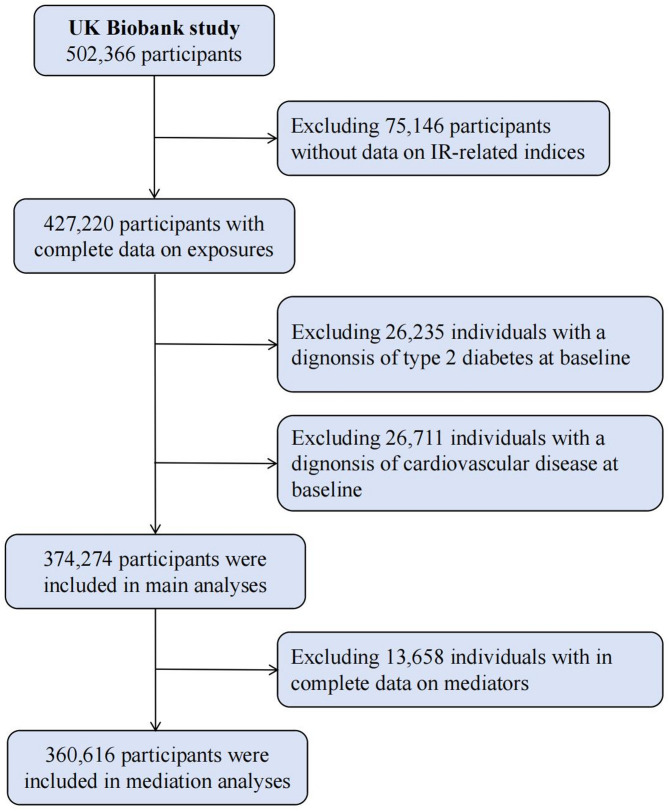
This prospective study included 374,274 individuals from the UK Biobank who were free of CMDs at baseline. CMM was defined as the presence of two or more CMDs, including type 2 diabetes (T2D), coronary heart disease (CHD), and stroke. Five indices were developed to assess IR levels: triglyceride-glucose (TyG) index, TyG-body mass index (TyG-BMI), TyG-waist circumference (TyG-WC), TyG-waist-height ratio (TyG-WHtR), and triglyceride to high-density lipoprotein cholesterol (TG/HDL-C) ratio. Cox proportional hazards and multi-state models were utilized to examine the associations between IR-related indices and CMM incidence and transition, respectively, with results expressed as hazard ratios (HRs) and 95% confidence intervals (CIs). The predictive utility of these indices was assessed using the net reclassification index (NRI) and integrated discrimination improvement index (IDI). Mediation analyses were conducted to quantify the potential mediating roles of biomarkers.
During a mean follow-up period of 13.7 years, 5048 (1.3%) individuals developed CMM. Elevated baseline IR-related indices were associated with higher risks of incident CMM. The HRs (95% CIs) for each 1-standard deviation increase were as follows: 1.30 (1.26-1.34) for the TyG index, 1.42 (1.39-1.46) for the TyG-BMI, 1.54 (1.49-1.59) for the TyG-WC, 1.52 (1.48-1.57) for the TyG-WHtR, and 1.19 (1.17-1.21) for the TG/HDL-C ratio. Besides, TyG-WHtR and TyG-WC exhibited significantly higher NRI and IDI, indicating superior predictive performance for CMM risk. These indices played critical yet distinct roles in the progression of CMM. For transitions from being free of CMDs to single CMDs, these indices had the strongest impact on T2D (all P < 0.001). Participants initially diagnosed with CHD were more likely to progress to CMM when exposed to higher IR-related indices (all P < 0.001). The effect sizes for TyG-WC and TyG-WHtR were greater than those of other indices across all transitions. Mediation analyses revealed that biomarkers associated with liver function, renal function, and inflammation collectively mediated approximately one-third of the associations of the TyG-WHtR and TyG-WC indices with incident CMM.
Our findings highlight the critical role of IR-related indices, particularly TyG-WHtR and TyG-WC, in the incidence, progression, and prevention of CMM. The mediation effects of biomarkers indicate the potential for targeted interventions to reduce CMM risk in high-IR individuals.
尽管胰岛素抵抗(IR)相关指标与心脏代谢疾病(CMD)之间的关联已得到证实,但大多数研究仅限于单一的CMD结局。本研究旨在探讨IR相关指标对心脏代谢多发病(CMM)的发病率、预测价值和进展轨迹的影响,以及潜在的生物学机制。
这项前瞻性研究纳入了英国生物银行的374274名个体,他们在基线时无CMD。CMM被定义为存在两种或更多种CMD,包括2型糖尿病(T2D)、冠心病(CHD)和中风。开发了五个指标来评估IR水平:甘油三酯-葡萄糖(TyG)指数、TyG-体重指数(TyG-BMI)、TyG-腰围(TyG-WC)、TyG-腰高比(TyG-WHtR)和甘油三酯与高密度脂蛋白胆固醇(TG/HDL-C)比值。分别使用Cox比例风险模型和多状态模型来检验IR相关指标与CMM发病率和转变之间的关联,结果以风险比(HR)和95%置信区间(CI)表示。使用净重新分类指数(NRI)和综合判别改善指数(IDI)评估这些指标的预测效用。进行中介分析以量化生物标志物的潜在中介作用。
在平均13.7年的随访期内,5048名(1.3%)个体发生了CMM。基线IR相关指标升高与CMM发病风险较高相关。每增加1个标准差的HR(95%CI)如下:TyG指数为1.30(1.26 - 1.34),TyG-BMI为1.42(1.39 - 1.46),TyG-WC为1.54(1.49 - 1.59),TyG-WHtR为1.52(1.48 - 1.57),TG/HDL-C比值为1.19(1.17 - 1.21)。此外,TyG-WHtR和TyG-WC表现出显著更高的NRI和IDI,表明对CMM风险具有卓越的预测性能。这些指标在CMM的进展中发挥了关键但不同的作用。对于从无CMD到单一CMD的转变,这些指标对T2D的影响最强(所有P < 0.001)。最初被诊断为CHD的参与者在暴露于较高的IR相关指标时更有可能进展为CMM(所有P < 0.001)。在所有转变中,TyG-WC和TyG-WHtR的效应大小大于其他指标。中介分析表明,与肝功能、肾功能和炎症相关的生物标志物共同介导了TyG-WHtR和TyG-WC指数与CMM发病之间约三分之一的关联。
我们的研究结果突出了IR相关指标,特别是TyG-WHtR和TyG-WC,在CMM的发病率、进展和预防中的关键作用。生物标志物的中介作用表明了针对高IR个体进行靶向干预以降低CMM风险的潜力。