Zhang Hongqiang, Tu Zhixin, Liu Sihua, Wang Jumei, Shi Jie, Li Xingyu, Shi Rongdongqing, Chen Minghui, Yue Tong, Luo Sihui, Ding Yu, Zheng Xueying
Department of Endocrinology, Division of Life Sciences and Medicine, The First Affiliated Hospital of USTC, University of Science and Technology of China, Hefei, 230001, China.
Pan-Vascular Management Center, Division of Life Sciences and Medicine, The First Affiliated Hospital of USTC, University of Science and Technology of China, Hefei, China.
Cardiovasc Diabetol. 2025 Jan 22;24(1):33. doi: 10.1186/s12933-025-02576-0.
The coexistence of cardiometabolic diseases (CMDs), defined as cardiometabolic multimorbidity (CMM), has been shown to significantly elevate mortality risk. Insulin resistance (IR) is one of the main contributing factors to the pathogenesis of CMM. Although several surrogates for IR are employed in clinical evaluations, their relationship with mortality in individuals with CMM remains unclear. This study aimed to investigate the associations between various IR surrogates and mortality in individuals with CMM, and to evaluate their prognostic value.
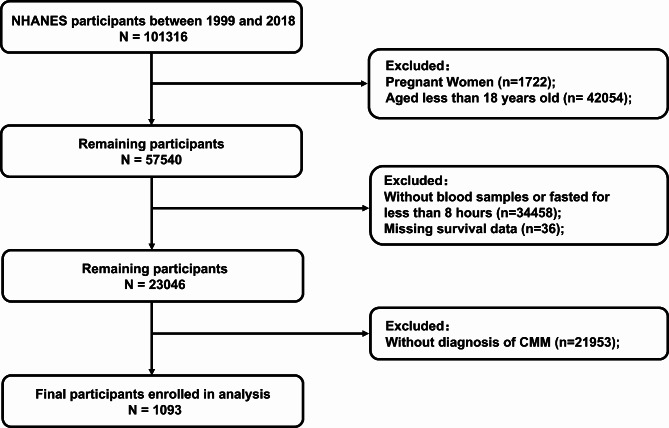
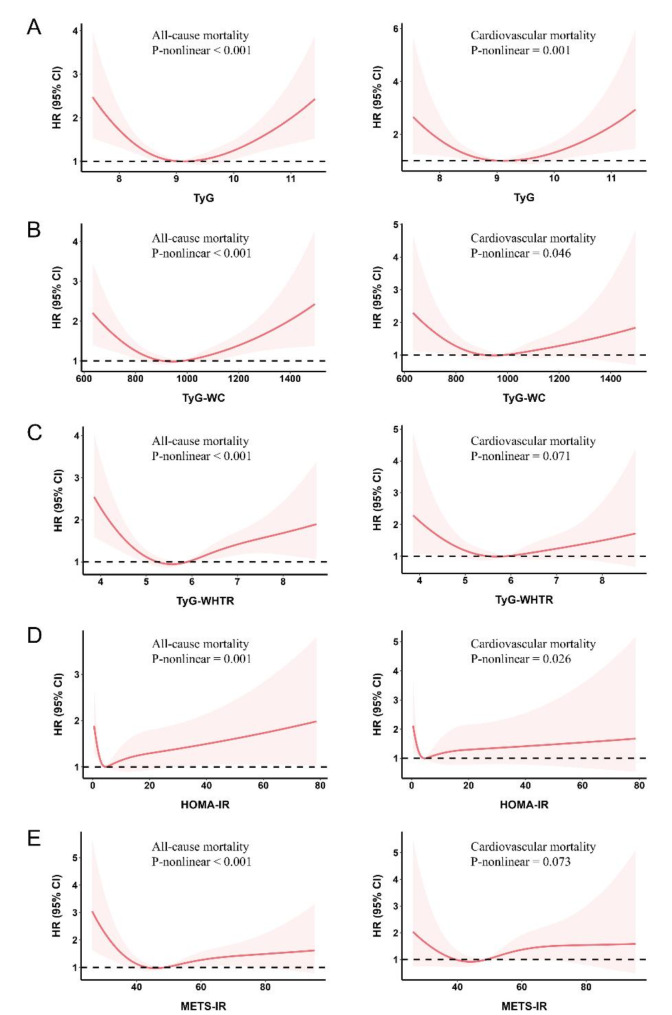
This study enrolled 1093 patients diagnosed with CMM. We developed five surrogate markers to assess IR levels: triglyceride-glucose (TyG) index, TyG-waist circumference (TyG-WC), TyG-waist height ratio (TyG-WHtR), homeostatic model assessment of insulin resistance (HOMA-IR), and metabolic score for insulin resistance (METS-IR). To investigate the associations between different IR surrogates and both all-cause and cardiovascular mortality, multivariable Cox proportional hazards models were applied. We employed restricted cubic splines to examine non-linear associations, and Cox models were developed on either side of the inflection point for additional investigation. Meanwhile, the predictive values of five IR surrogates were further assessed.
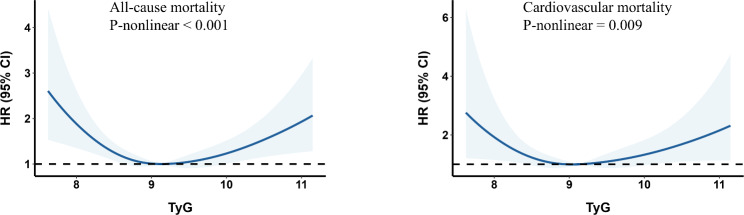
Of the 477 all-cause deaths that occurred during a median follow-up of 5.8 years, 197 were related to cardiovascular disease. Among five surrogate markers of IR, the TyG index was the only one that significantly correlates with both all-cause and cardiovascular mortality. The threshold value for both types of mortality was 8.85. A TyG index beneath the inflection point exhibits an inverse correlation with cardiovascular mortality (HR 0.483; 95% CI = 0.281-0.831) and all-cause mortality (HR 0.519; 95% CI = 0.368-0.732). On the other hand, when the TyG index surpassed the inflection point, it demonstrated a positive correlation with cardiovascular mortality (HR 1.413; 95% CI = 1.075-1.857) and all-cause mortality (HR 1.279; 95% CI = 1.070-1.529). Based on the analysis of receiver operating characteristics, the TyG index has been recognized as a dependable predictor of survival outcomes.
This study emphasizes the prognostic significance of IR surrogates, particularly the TyG index, in predicting mortality among individuals with CMM. The TyG index constitutes a crucial element in the development of management and intervention strategies for these patients.
心脏代谢疾病(CMD)并存,即心脏代谢共病(CMM),已被证明会显著提高死亡风险。胰岛素抵抗(IR)是CMM发病机制的主要促成因素之一。尽管临床评估中使用了几种IR替代指标,但它们与CMM患者死亡率之间的关系仍不明确。本研究旨在探讨各种IR替代指标与CMM患者死亡率之间的关联,并评估其预后价值。
本研究纳入了1093例诊断为CMM的患者。我们开发了五个替代指标来评估IR水平:甘油三酯-葡萄糖(TyG)指数、TyG-腰围(TyG-WC)、TyG-腰高比(TyG-WHtR)、胰岛素抵抗稳态模型评估(HOMA-IR)和胰岛素抵抗代谢评分(METS-IR)。为了研究不同IR替代指标与全因死亡率和心血管死亡率之间的关联,应用了多变量Cox比例风险模型。我们采用受限立方样条来检验非线性关联,并在拐点两侧建立Cox模型进行进一步研究。同时,进一步评估了五个IR替代指标的预测价值。
在中位随访5.8年期间发生的477例全因死亡中,197例与心血管疾病有关。在IR的五个替代指标中,TyG指数是唯一与全因死亡率和心血管死亡率均显著相关的指标。两种死亡率的阈值均为8.85。低于拐点的TyG指数与心血管死亡率(HR 0.483;95%CI = 0.281-0.831)和全因死亡率(HR 0.519;95%CI = 0.368-0.732)呈负相关。另一方面,当TyG指数超过拐点时,它与心血管死亡率(HR 1.413;95%CI = 1.075-1.857)和全因死亡率(HR 1.279;95%CI = 1.070-1.529)呈正相关。基于受试者工作特征分析,TyG指数被认为是生存结局的可靠预测指标。
本研究强调了IR替代指标,特别是TyG指数,在预测CMM患者死亡率方面的预后意义。TyG指数是制定这些患者管理和干预策略的关键要素。