Zhang Tianyi, Li Xiang, Zhang Kainan, Liu Jian, Maimaitiyiming Abudukeyoumu, Wang Weiming, Huang Mengjun, Li Jianxin, Hou Sujun, Zhang Feng, Yin Mengmeng, Zheng Nan, Fu Jianfeng, Meng Xiangxiang
Department of Clinical Laboratory, Rizhao Hospital of Traditional Chinese Medicine, Rizhao, 276800, China.
Department of Clinical Laboratory, Xinjiang Production and Construction Corps 13th Division Red Star Hospital, Hami, 839000, China.
World J Surg Oncol. 2025 Jun 18;23(1):239. doi: 10.1186/s12957-025-03893-0.
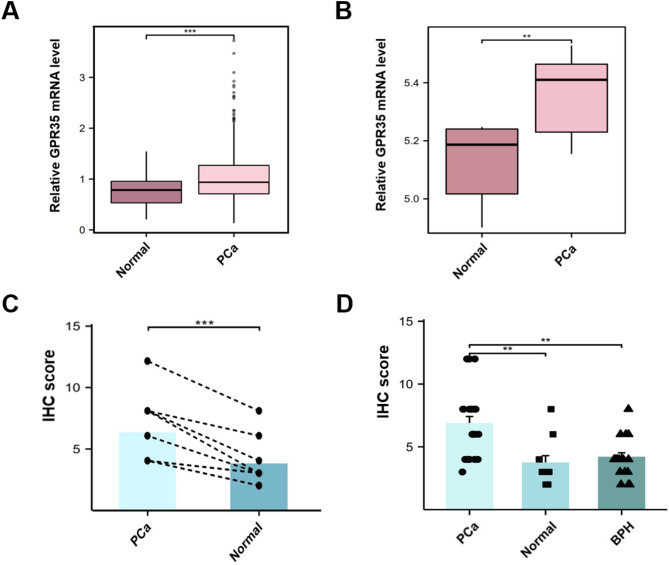
G-protein-coupled receptor 35 (GPR35) has been reported to be overexpressed in several types of human cancers, playing essential roles in tumorigenesis and development. However, its expression and prognostic value in Prostate cancer (PCa) remain unclear. This study aims to investigate the expression of GPR35 and its prognostic value in PCa.
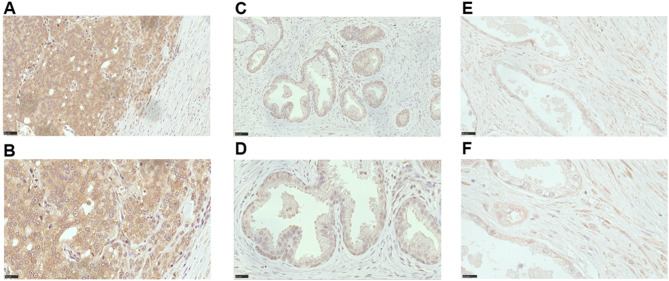
The expression of GPR35 was analyzed using the public database and validated by immunohistochemistry (IHC) in PCa tissues. Subsequently, the correlation between GPR35 expression and the clinical characteristics was evaluated using the Chi-squared test. Kaplan-Meier and Cox proportional hazards regression models were used to analyze the data. Hazard Ratios (HR) and 95% confidence intervals (CI) were calculated for each factor.
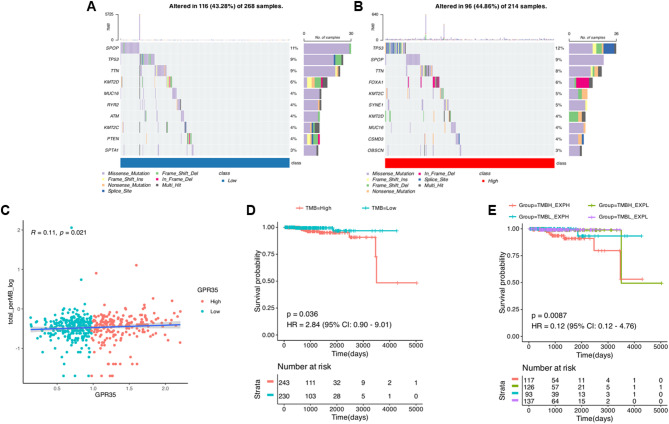
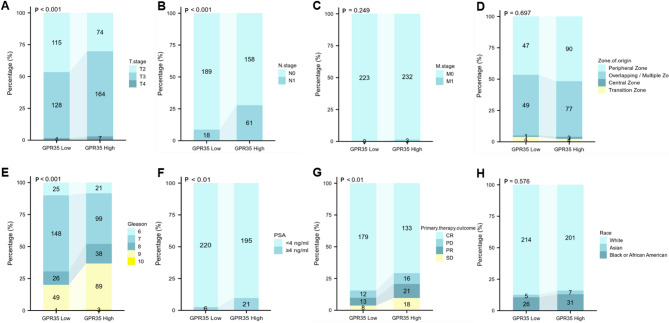
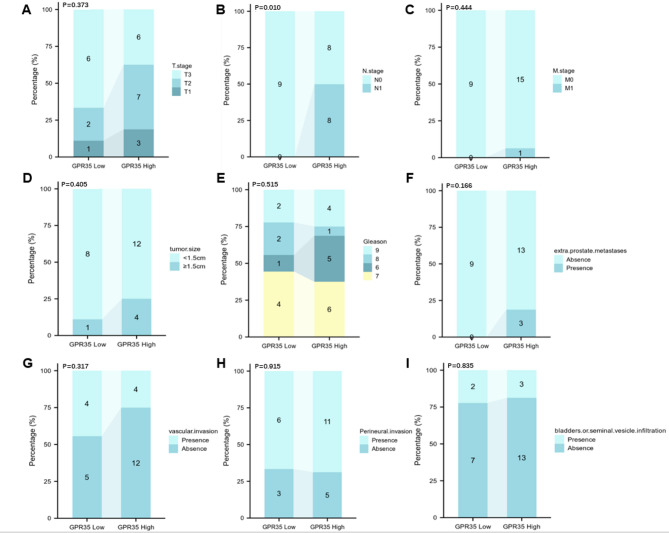
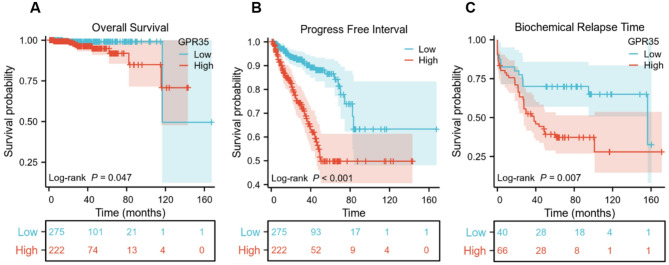
GPR35 messenger RNA (mRNA) and protein expression were confirmed to be overexpressed in PCa tissue samples. Furthermore, high GPR35 mRNA expression was correlated with clinical tumor stage (T stage) (P < 0.001), lymph node metastasis (P < 0.001), primary therapy outcome (P = 0.009), residual tumor (P < 0.001), prostate-specific antigen (PSA) levels (P = 0.004), and Gleason score (P < 0.001). IHC analysis also confirmed that GPR35 overexpression was associated with lymph node metastasis (P = 0.010). Additionally, Kaplan-Meier analysis showed that PCa patients with high expression of GPR35 were associated with shorter overall survival (OS) (HR: 3.370, 95% CI: 1.085-10.470, P = 0.047), progress free interval (PFI) (HR: 3.385, 95% CI: 2.234-5.131, P < 0.001), and biochemical relapse time (BCR) (HR: 2.229, 95% CI: 1.308-3.801, P = 0.007). Moreover, univariate Cox regression analyses suggested that T stage (P < 0.001), lymph node involvement (P = 0.046), serum PSA levels (P = 0.013), Gleason score (P < 0.001), and GPR35 expression (P < 0.001) were unfavorable prognostic factors for PCA patients. Multivariate Cox regression analysis showed that GPR35 was an independent poor prognostic factor of PCa patients (HR: 1.915, 95%CI: 1.368-2.682).
Overexpression of GPR35 is associated with poor clinical prognosis, suggesting that GPR35 may serve as a potential prognostic biomarker for PCa.
Not applicable.
据报道,G蛋白偶联受体35(GPR35)在多种人类癌症中过表达,在肿瘤发生和发展中起重要作用。然而,其在前列腺癌(PCa)中的表达及预后价值仍不清楚。本研究旨在探讨GPR35在PCa中的表达及其预后价值。
利用公共数据库分析GPR35的表达,并在PCa组织中通过免疫组织化学(IHC)进行验证。随后,采用卡方检验评估GPR35表达与临床特征之间的相关性。使用Kaplan-Meier和Cox比例风险回归模型分析数据。计算每个因素的风险比(HR)和95%置信区间(CI)。
证实GPR35信使核糖核酸(mRNA)和蛋白表达在PCa组织样本中过表达。此外,高GPR35 mRNA表达与临床肿瘤分期(T分期)(P<0.001)、淋巴结转移(P<0.001)、初始治疗结果(P = 0.009)、残留肿瘤(P<0.001)、前列腺特异性抗原(PSA)水平(P = 0.004)和Gleason评分(P<0.001)相关。IHC分析也证实GPR35过表达与淋巴结转移相关(P = 0.010)。此外,Kaplan-Meier分析显示,GPR35高表达的PCa患者总生存期(OS)较短(HR:3.370,95%CI:1.085 - 10.470,P = 0.047)、无进展生存期(PFI)较短(HR:3.385,95%CI:2.234 - 5.131,P<0.001)和生化复发时间(BCR)较短(HR:2.229,95%CI:1.308 - 3.801,P = 0.007)。此外,单因素Cox回归分析表明,T分期(P<0.001)、淋巴结受累(P = 0.046)、血清PSA水平(P = 0.013)、Gleason评分(P<0.001)和GPR35表达(P<0.001)是PCA患者的不良预后因素。多因素Cox回归分析显示,GPR35是PCa患者独立的不良预后因素(HR:1.915,95%CI:1.368 - 2.682)。
GPR35过表达与不良临床预后相关,提示GPR35可能作为PCa的潜在预后生物标志物。
不适用。