Nakazawa Yusuke, Miyata Takeshi, Mitani Koki, Hamamoto Ryo, Nagahori Takashi, Yoshizaki Wataru, Morita Takao, Agawa Yuji, Ogura Takenori, Abekura Yu, Inamori Yukiko, Shiraishi Wataru, Hatano Taketo
Department of Neurosurgery, Kokura Memorial Hospital, Kitakyushu, Fukuoka, Japan.
Department of Neurology, Kokura Memorial Hospital, Kitakyushu, Fukuoka, Japan.
J Neuroendovasc Ther. 2025;19(1). doi: 10.5797/jnet.oa.2025-0018. Epub 2025 Jun 17.
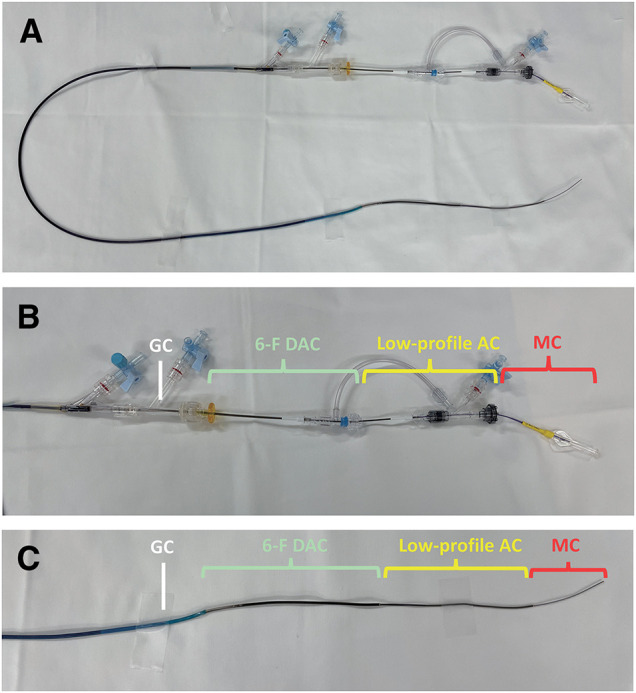
Medium vessel occlusions (MeVOs) during acute ischemic stroke present challenges due to their distal occlusion sites. Furthermore, MeVO cases with tortuous extracranial vessels are complex, and effective management techniques are lacking. This study reports the utility of combining a 6-French distal access catheter with a low-profile aspiration catheter, guiding catheter, and microcatheter to establish a quadruple coaxial system for treating MeVOs with tortuous extracranial vessels.
We retrospectively reviewed data from mechanical thrombectomy cases with MeVO at our institution between March 2022 and February 2024. A total of 81 patients were enrolled, and 5 patients were treated using the quadruple coaxial system. The primary efficacy outcome was the first pass effect (FPE), and the rate of successful recanalization, determined by the expanded thrombolysis in cerebral infarction (eTICI 2b/3) at the end of treatment. The safety assessment included hemorrhagic and procedure-related complications.
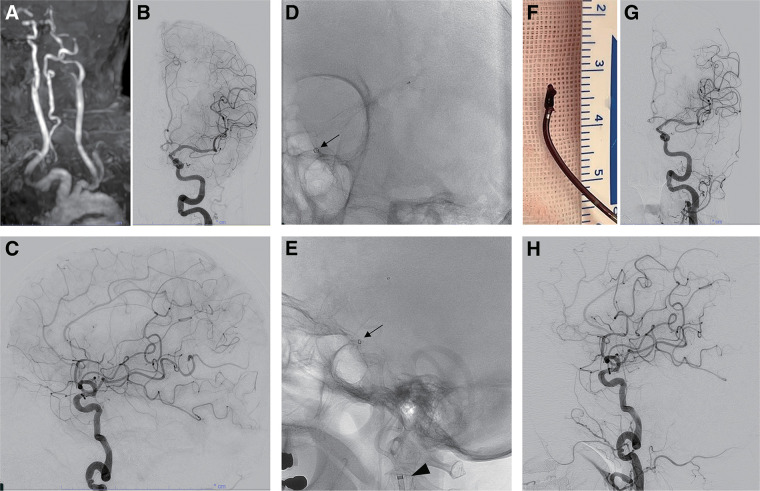
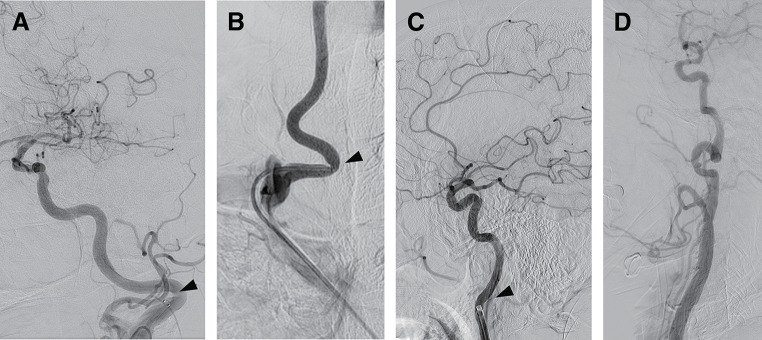
Of the 81 enrolled patients, 5 patients were treated using the quadruple coaxial system. Three men and 2 women, with a mean age of 77 years, were included in this study. The median baseline National Institutes of Health Stroke Scale score was 10 points, and a tissue plasminogen activator was administered to 2 patients. Four patients had M2 occlusions, and 1 patient had a P2 occlusion. In 4 cases, the guiding system could not be advanced distally because of extracranial vessel tortuosity. The quadruple coaxial system achieved a significantly higher rate of FPE (80% vs. 30%; P = 0.0401) than the standard coaxial system, with no postoperative intracerebral hemorrhage or procedure-related complications.
The quadruple coaxial system is a valuable approach for treating MeVOs with severe extracranial vessel tortuosity. This system offers a reliable and safe treatment modality when a guiding system cannot be advanced distally.
急性缺血性卒中期间的中型血管闭塞(MeVO)因其远端闭塞部位而带来挑战。此外,伴有颅外血管迂曲的MeVO病例较为复杂,且缺乏有效的处理技术。本研究报告了将6F远端通路导管与低轮廓抽吸导管、引导导管和微导管相结合,建立四重同轴系统用于治疗伴有颅外血管迂曲的MeVO的效用。
我们回顾性分析了2022年3月至2024年2月在我院进行的MeVO机械取栓病例的数据。共纳入81例患者,其中5例采用四重同轴系统进行治疗。主要疗效指标是首次通过效应(FPE),以及治疗结束时通过脑梗死扩展溶栓(eTICI 2b/3)确定的成功再通率。安全性评估包括出血和与手术相关的并发症。
在81例纳入患者中,5例采用四重同轴系统进行治疗。本研究纳入了3名男性和2名女性,平均年龄为77岁。基线美国国立卫生研究院卒中量表评分中位数为10分,2例患者接受了组织纤溶酶原激活剂治疗。4例患者为M2段闭塞,1例患者为P2段闭塞。在4例病例中,由于颅外血管迂曲,引导系统无法向远端推进。四重同轴系统的FPE率显著高于标准同轴系统(80%对30%;P = 0.0401),且术后无脑出血或与手术相关的并发症。
四重同轴系统是治疗伴有严重颅外血管迂曲的MeVO的一种有价值的方法。当引导系统无法向远端推进时,该系统提供了一种可靠且安全的治疗方式。