Park Jong-Ho, Lim Jihye
Department of Health and Medical Information, Daegu University, Gyeongsan, Gyeongbuk, Korea.
Department of Health Care and Science, Dong-A University, Busan, Korea.
Digit Health. 2025 Jun 16;11:20552076251351467. doi: 10.1177/20552076251351467. eCollection 2025 Jan-Dec.
This study aims to develop a customized severity adjustment tool for hospital deaths in pneumonia patients considering characteristics of Korean discharged patients using representative data from the Korea Disease Control and Prevention Agency's Korea National Hospital Discharge In-Depth Injury Survey (KNHDIS).
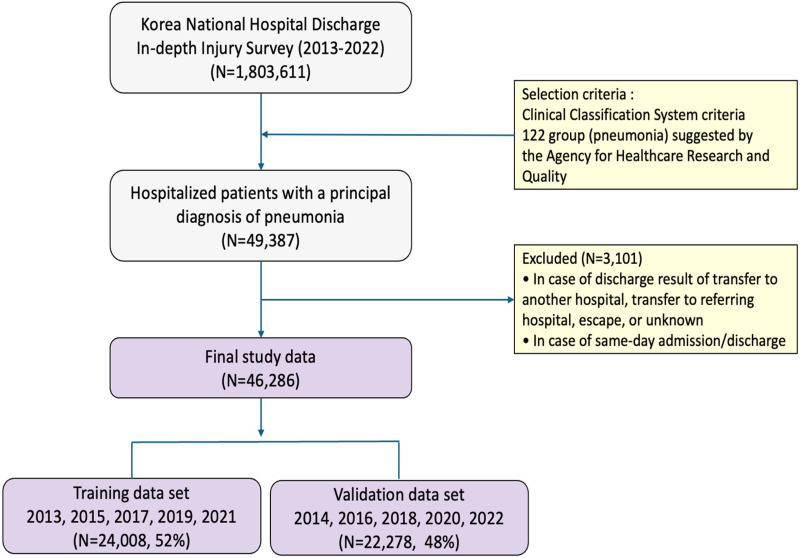
We analyzed 46,286 cases of pneumonia hospitalization among KNHDIS data from 2013 to 2022 and developed a model after adjusting for the severity of comorbidities using SAS and Python programs.
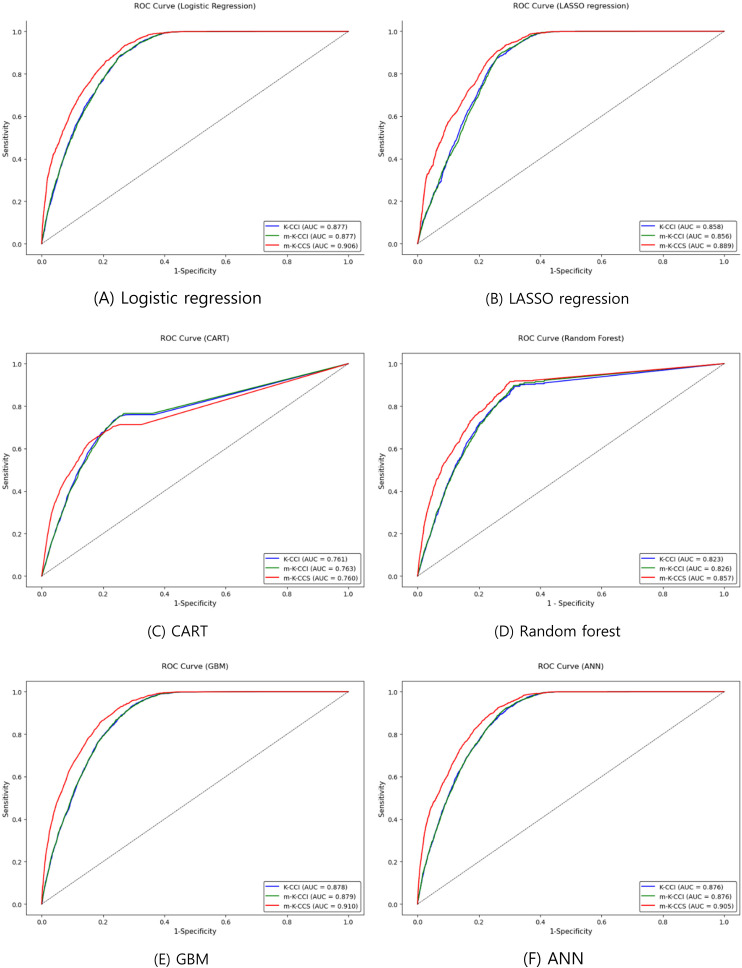
Analysis results showed that among three complication adjustment tools, including the existing complication index K-CCI (Korean-Charlson Comorbidity Index) and newly developed m-K-CCI (modified-Korean-Charlson Comorbidity Index) and m-K-CCS (modified-Korean-Clinical Classification Software), m-K-CCS was the best. For model development and evaluation, least absolute shrinkage and selection operator (LASSO), logistic regression, classification and regression tree (CART), random forests, gradient-boosted model (GBM), and artificial neural network (ANN) analyses were performed. Analysis of the validation dataset showed that GBM's m-K-CCS had the highest AUC value of 0.910.
These results suggest that further research is needed on models that adjust for the severity of comorbidities for each diagnosis to more accurately predict health outcomes.
本研究旨在利用韩国疾病控制与预防机构的韩国全国医院出院深度伤害调查(KNHDIS)的代表性数据,针对韩国出院患者的特征,开发一种针对肺炎患者医院死亡情况的定制严重程度调整工具。
我们分析了2013年至2022年KNHDIS数据中的46286例肺炎住院病例,并使用SAS和Python程序在调整合并症严重程度后开发了一个模型。
分析结果显示,在三种并发症调整工具中,包括现有的并发症指数K-CCI(韩国-查尔森合并症指数)、新开发的m-K-CCI(改良-韩国-查尔森合并症指数)和m-K-CCS(改良-韩国-临床分类软件),m-K-CCS是最佳的。为了进行模型开发和评估,我们进行了最小绝对收缩和选择算子(LASSO)、逻辑回归、分类与回归树(CART)、随机森林、梯度提升模型(GBM)和人工神经网络(ANN)分析。对验证数据集的分析表明,GBM的m-K-CCS的AUC值最高,为0.910。
这些结果表明,需要对针对每种诊断调整合并症严重程度的模型进行进一步研究,以更准确地预测健康结果。