Yasuda Hiroki, Ueda Masaya, Ueno Keita, Naito Yasuo, Ishii Ryouhei, Takebayashi Takashi
Department of Occupational Therapy, Osaka Metropolitan University Graduate School of Rehabilitation Science, Habikino, Japan.
Therapy Department, Takarazuka Rehabilitation Hospital, Takarazuka, Japan.
Front Hum Neurosci. 2025 Jun 4;19:1571386. doi: 10.3389/fnhum.2025.1571386. eCollection 2025.
Previous research has suggested that mu-event-related desynchronization (mu-ERD) reflects neural activity associated with motor observation and execution, primarily within the sensorimotor cortex. This study aimed to investigate the effects of combining robotic full-assist therapy with motor imagery on mu-ERD in healthy adults for potential application in stroke patients with severe upper limb paralysis.
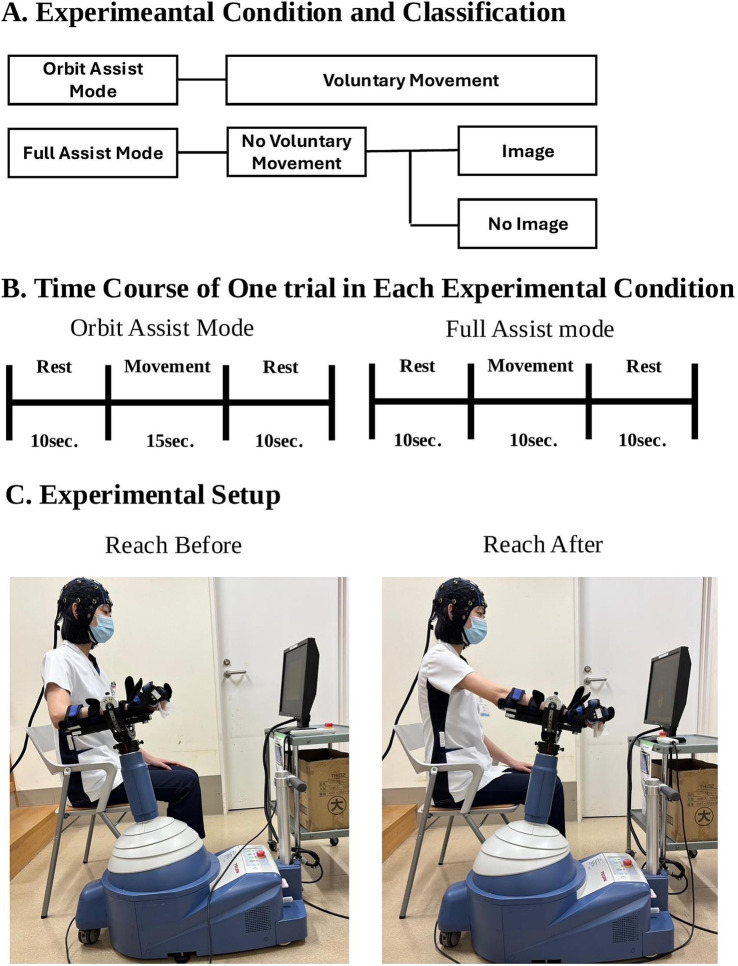
Fifteen healthy adults were included in this study. Each participant performed three conditions using the ReoGo-J® robotic system: voluntary movement, full-assist robotic therapy without motor imagery, and full-assist robotic therapy with motor imagery. Electroencephalography (EEG) was used to measure mu-ERD, focusing on the 8-10 Hz and 10-13 Hz frequency bands at the C3, C4, Cz, and Pz electrodes.
Significant differences in mu-ERD occurrence were observed at C3 (8-10 Hz) and C4 (10-13 Hz) between the conditions. The combination of motor imagery and robotic therapy demonstrated a higher frequency of mu-ERD occurrence than the other conditions, with moderate effect sizes. However, no significant differences in mu-ERD attenuation rates were found between the conditions. This suggests variability in individual responses.
These findings highlight the potential of robotic full-assist therapy combined with motor imagery to stimulate neural mechanisms associated with motor recovery. Future studies should include a larger sample size and patients with stroke to validate these findings and explore their clinical applications.
先前的研究表明,μ事件相关去同步化(mu-ERD)反映了与运动观察和执行相关的神经活动,主要发生在感觉运动皮层内。本研究旨在调查将机器人全辅助治疗与运动想象相结合对健康成年人mu-ERD的影响,以便在患有严重上肢瘫痪的中风患者中进行潜在应用。
本研究纳入了15名健康成年人。每位参与者使用ReoGo-J®机器人系统进行三种情况的测试:自主运动、无运动想象的全辅助机器人治疗以及有运动想象的全辅助机器人治疗。使用脑电图(EEG)来测量mu-ERD,重点关注C3、C4、Cz和Pz电极处8-10Hz和10-13Hz频段。
在不同情况之间,观察到C3(8-10Hz)和C4(10-13Hz)处mu-ERD出现情况存在显著差异。运动想象与机器人治疗相结合时,mu-ERD出现的频率高于其他情况,效应量中等。然而,不同情况之间在mu-ERD衰减率方面未发现显著差异。这表明个体反应存在变异性。
这些发现突出了机器人全辅助治疗与运动想象相结合刺激与运动恢复相关神经机制的潜力。未来的研究应纳入更大样本量以及中风患者,以验证这些发现并探索其临床应用。