Ngo Nguyen Yen Nhi, Villavaso Chloé Davidson, Orakwue Chisom Joan, Rowalt William Zachary, Roberts Madhur, Ferdinand Keith C
Tulane School of Medicine, 1430 Tulane Ave, New Orleans, LA 70112, United States of America.
Am Heart J Plus. 2025 Jun 1;56:100560. doi: 10.1016/j.ahjo.2025.100560. eCollection 2025 Aug.
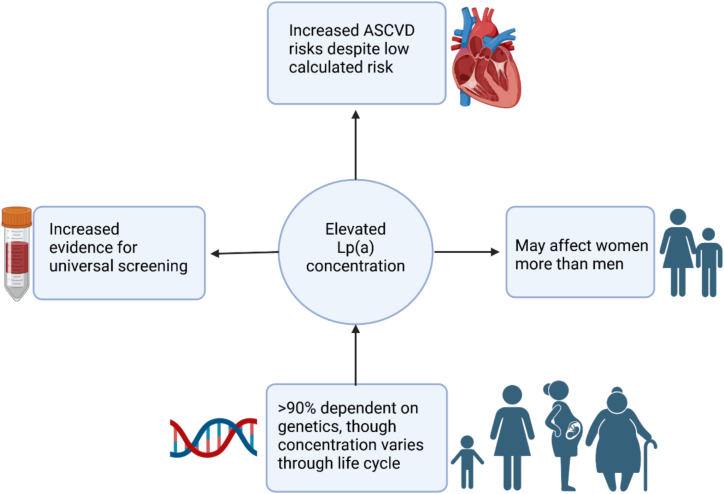
Atherosclerosis cardiovascular disease (ASCVD), especially coronary artery disease (CAD), remains the leading cause of death worldwide, with several well-identified risk factors. This case report presents a premenopausal female with low calculated ASCVD risk, hypertension, elevated lipoprotein(a) [Lp(a)], and clinically significant CAD.
A 44-year-old premenopausal White female with controlled stage 2 hypertension, and overall low calculated 10-year ASCVD risk, was found to have severe CAD. She presented to the clinic with worsening chest discomfort during exertion and was diagnosed with a heavily calcified proximal left anterior descending artery stenosis, necessitating percutaneous coronary intervention.
The global prevalence of elevated Lp(a) >50 mg/dL is around 1.43 billion. Elevated lipoprotein(a) is now recognized, based on the preponderance of the evidence, by several international scientific statements as an independent risk factor for ASCVD, including CAD. Nevertheless, the current 2018 American College of Cardiology (ACC) and American Heart Association (AHA) multi-society guideline on the Management of Blood Cholesterol only classifies Lp(a) as a risk enhancer. This recommendation, along with the lack of approved pharmacotherapy has contributed to limited testing in current United States clinical practice (<1 % for the general population). Furthermore, the inadequate assessment of Lp(a) may lead to an underestimation of ASCVD risk.
This case highlights the shortcomings of inadequate assessment of Lp(a) leading to the underestimation of cardiovascular risk. Accordingly, with multiple recent international scientific statements, clinicians should universally screen for elevated Lp(a). In the future, investigational therapies for lowering Lp(a) may be crucial for improving patient outcomes.
动脉粥样硬化性心血管疾病(ASCVD),尤其是冠状动脉疾病(CAD),仍然是全球主要的死亡原因,存在多种已明确的危险因素。本病例报告介绍了一位绝经前女性,其计算得出的ASCVD风险较低,但患有高血压、脂蛋白(a)[Lp(a)]升高以及具有临床意义的CAD。
一名44岁的绝经前白人女性,患有已得到控制的2期高血压,总体计算得出的10年ASCVD风险较低,却被发现患有严重的CAD。她因运动时胸部不适加重前来就诊,被诊断为左前降支近端严重钙化狭窄,需要进行经皮冠状动脉介入治疗。
全球Lp(a)>50mg/dL升高的患病率约为14.3亿。基于大量证据,目前一些国际科学声明已将升高的脂蛋白(a)认定为ASCVD(包括CAD)的独立危险因素。然而,2018年美国心脏病学会(ACC)和美国心脏协会(AHA)关于血脂管理的多学会指南仅将Lp(a)列为风险增强因素。这一建议,再加上缺乏获批的药物治疗,导致美国目前的临床实践中检测受限(普通人群中<1%)。此外,对Lp(a)评估不足可能导致对ASCVD风险的低估。
本病例凸显了对Lp(a)评估不足导致心血管风险低估的缺点。因此,鉴于近期多项国际科学声明,临床医生应普遍筛查升高的Lp(a)。未来,降低Lp(a)的研究性疗法可能对改善患者预后至关重要。