Su Yongjian, Su Zhengqin, Huang Zixiu, Yang Shan, Li Zhongyou, Li Hai
School of Public Health and Management, Guangxi University of Chinese Medicine, Nanning, China.
Ruikang Hospital Affiliated with Guangxi University of Chinese Medicine, Nanning, China.
Front Public Health. 2025 Jun 4;13:1566999. doi: 10.3389/fpubh.2025.1566999. eCollection 2025.
Rubella remains a global public health concern due to the risk of congenital rubella syndrome (CRS). Despite ongoing control measures, China-along with 85% of WHO Western Pacific countries-failed to achieve the 2020 elimination target. This study aimed to analyze temporal trends in rubella incidence across regions and age groups in China to inform and refine national elimination strategies.
This descriptive study employed a joinpoint regression model to analyze trends in rubella incidence across different regions and age groups in China. The Spearman rank correlation coefficient test was used to examine the correlation between RCV1 coverage and incidence.
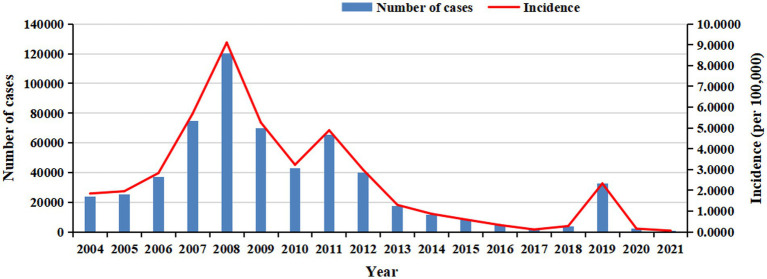
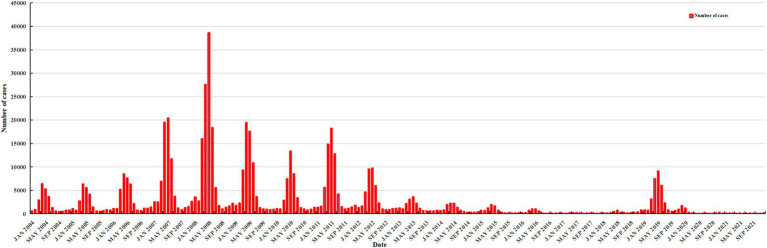
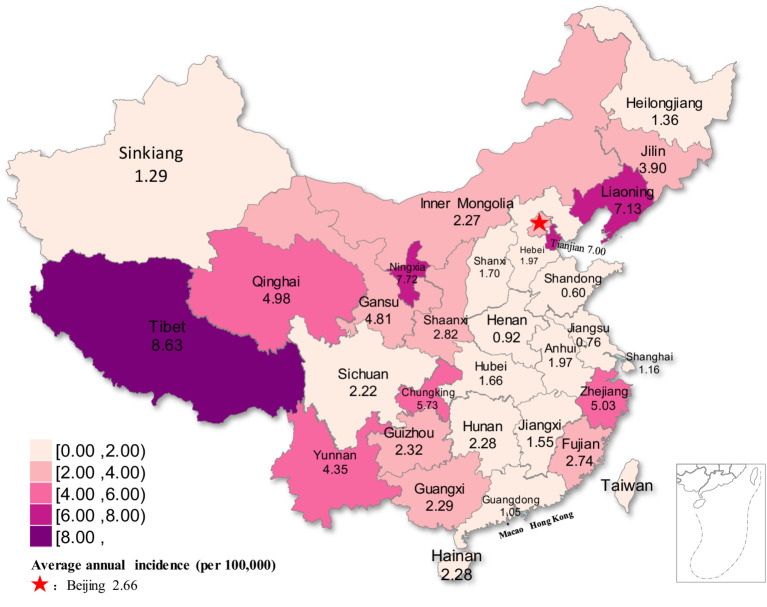
From 2004 to 2021, a total of 583,418 rubella cases were reported in China, with an average annual incidence of 2.3994 cases per 100,000 population. Monthly cases peaked in April and May. The overall trend in rubella incidence remained stable, with an average annual percent change (AAPC) of -6.36% ( = 0.291). However, from 2008 to 2021, the annual percent change (APC) was -18.41% ( 0.002), demonstrating a significant downward trend. Regions with an average annual incidence exceeding 5 cases per 100,000 population were mainly located in western and eastern China. Significant decreasing trends in rubella incidence were observed in five regions (all < 0.05). Age groups with average annual incidence rates above 4 cases per 100,000 population were primarily among children and teenagers. Thirteen age groups showed decreasing trends (all < 0.05). From 2010 to 2021, annual rubella incidence decreased as RCV1 coverage increased, indicating a statistically significant negative correlation ( = -0.793, = 0.002).
From 2004 to 2021, China's rubella incidence significantly decreased due to enhanced surveillance and high vaccination coverage, particularly among children aged 0-9 years and in one-sixth of the country's regions. Key recommendations include (1) increasing healthcare investment in underdeveloped regions to improve immunization access, (2) strengthening surveillance and vaccine management in areas with large migrant populations, and (3) implementing supplementary immunization activities (SIAs) targeting teenagers and adults to further reduce the disease burden.
由于先天性风疹综合征(CRS)的风险,风疹仍然是全球公共卫生关注的问题。尽管采取了持续的控制措施,但中国以及85%的世卫组织西太平洋国家未能实现2020年消除目标。本研究旨在分析中国各地区和年龄组风疹发病率的时间趋势,为国家消除战略提供信息并加以完善。
本描述性研究采用连接点回归模型分析中国不同地区和年龄组风疹发病率的趋势。使用Spearman等级相关系数检验来检验风疹疫苗第一剂(RCV1)接种率与发病率之间的相关性。
2004年至2021年,中国共报告风疹病例583418例,平均年发病率为每10万人2.3994例。每月病例数在[此处原文可能缺失月份信息]达到峰值。风疹发病率的总体趋势保持稳定,平均年变化百分比(AAPC)为-6.36%(P = 0.291)。然而,2008年至2021年,年变化百分比(APC)为-18.41%(P < 0.002),呈现出显著的下降趋势。年平均发病率超过每10万人5例的地区主要位于中国西部和东部。在五个地区观察到风疹发病率有显著下降趋势(均P < 0.05)。年平均发病率高于每10万人4例的年龄组主要是儿童和青少年。13个年龄组呈现下降趋势(均P < 0.05)。2010年至2021年,随着RCV1接种率的提高,风疹年发病率下降,表明存在统计学上的显著负相关(r = -0.793,P = 0.002)。
2004年至2021年,由于加强监测和高疫苗接种率,中国的风疹发病率显著下降,特别是在0至9岁儿童和全国六分之一的地区。主要建议包括:(1)增加对欠发达地区的医疗保健投资,以改善免疫接种可及性;(2)加强对有大量流动人口地区的监测和疫苗管理;(3)针对青少年和成年人开展补充免疫活动(SIAs),以进一步减轻疾病负担。