Rennison Andrew Philip, Fernandez-Macgregor Jaime, Melot Julie, Durbesson Fabien, Tandrup Tobias, Westh Peter, Vincentelli Renaud, Møller Marie Sofie
Department of Biotechnology and Biomedicine, The Technical University of Denmark, Søltofts Plads, Building 221, DK-2800, Kgs. Lyngby, Denmark.
Laboratory Architecture et Fonction des Macromolecules Biologiques, Aix-Marseille University, Luminy Campus, 13288, Marseille, France.
ChemSusChem. 2025 Aug 6;18(16):e202500468. doi: 10.1002/cssc.202500468. Epub 2025 Jul 14.
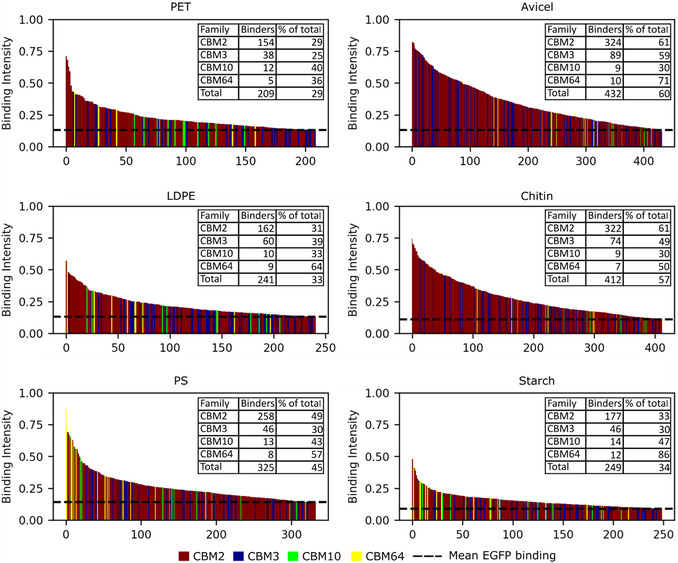
Carbohydrate-binding modules (CBMs) are noncatalytic domains that enhance enzyme binding to substrates. Type A CBMs show potential for engineering plastic-degrading enzymes due to their affinity for synthetic polymers. This study presents a high-throughput screening pipeline for characterizing the affinity and specificity of type A CBMs towards the synthetic polymers polyethylene terephthalate (PET), polystyrene (PS), and polyethylene (PE), and the polysaccharides cellulose, chitin, and starch. ≈800 CBMs from the families CBM2, CBM3, CBM10, and CBM64 are expressed as green fluorescent protein (GFP)-fusion proteins and tested for binding using a modified holdup assay, which produced up to 10 000 data points per day. The screening identifies ≈150 binders for PET and PE, around 250 for PS, and demonstrates family-specific binding patterns for avicel, chitin, and starch. To demonstrate practical utility, four CBMs with high PET affinity are fused to the PET hydrolase LCC, enhancing activity on PET powder by around 5-fold. These CBM-enzyme fusions mitigate competitive binding to plastic impurities, improving performance in mixed plastic assays. This work significantly expands the repertoire of CBMs binding to synthetic polymers, advances our understanding of CBM-substrate interactions, and provides knowledge for engineering enzymes to tackle plastic pollution, particularly where mixed plastics pose significant challenges.
碳水化合物结合模块(CBMs)是增强酶与底物结合的非催化结构域。A型CBMs因其对合成聚合物的亲和力而显示出工程化塑料降解酶的潜力。本研究提出了一种高通量筛选流程,用于表征A型CBMs对合成聚合物聚对苯二甲酸乙二酯(PET)、聚苯乙烯(PS)和聚乙烯(PE),以及多糖纤维素、几丁质和淀粉的亲和力和特异性。来自CBM2、CBM3、CBM10和CBM64家族的约800个CBMs被表达为绿色荧光蛋白(GFP)融合蛋白,并使用改良的滞留测定法测试其结合情况,该方法每天可产生多达10000个数据点。筛选确定了约150个与PET和PE结合的蛋白,约250个与PS结合的蛋白,并展示了对微晶纤维素、几丁质和淀粉的家族特异性结合模式。为了证明实际效用,将四个对PET具有高亲和力的CBMs与PET水解酶LCC融合,使PET粉末的活性提高了约5倍。这些CBM-酶融合物减少了与塑料杂质的竞争性结合,提高了在混合塑料测定中的性能。这项工作显著扩展了与合成聚合物结合的CBMs的种类,推进了我们对CBM-底物相互作用的理解,并为工程化酶处理塑料污染提供了知识,特别是在混合塑料带来重大挑战的情况下。