Shah Nakul M, Meric-Bernstam Funda
Division of Cancer Medicine, The University of Texas MD Anderson Cancer Center, Houston, TX 77030, United States.
Department of Investigational Cancer Therapeutics, The University of Texas MD Anderson Cancer Center, Houston, TX 77030,United States.
Oncologist. 2025 Jun 4;30(6). doi: 10.1093/oncolo/oyaf152.
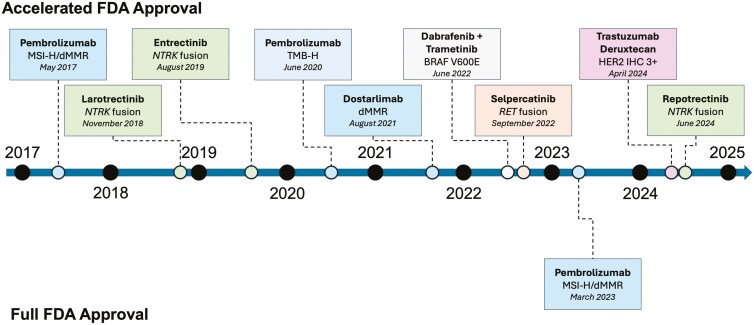
Precision oncology has transformed the treatment landscape for patients with advanced solid tumors. Tumor-agnostic therapies, those that have been approved based on genetic mutations or biomarkers across tumor histology types, are important examples of how the implementation of precision oncology can expand therapeutic options for patients, especially those with rare cancer types and treatment-refractory disease. In this review, we first discuss how advances in next-generation sequencing and molecular profiling have enabled the identification of shared actionable alterations. Subsequently, we explore the current landscape of tumor-agnostic therapies that have received approval from the Food and Drug Administration. We discuss the strengths and limitations of these therapies and evaluate the clinical trial data leading to their approval. In addition, we detail updated results from these clinical trials and additional observational studies reported after the approval. Several factors such as tumor histology, specific alteration types, and the presence of co-alterations are associated with the efficacy of these therapies. Also, challenges remain in understanding resistance mechanisms and predicting response. Looking ahead, we discuss how improved diagnostic tools, novel experimental strategies, and innovative trial designs may further advance the field of precision oncology and improve therapeutic options for patients.
精准肿瘤学已经改变了晚期实体瘤患者的治疗格局。不考虑肿瘤组织学类型的疗法,即那些基于基因突变或生物标志物而获批的疗法,是精准肿瘤学的实施如何能够为患者,尤其是那些患有罕见癌症类型和难治性疾病的患者扩大治疗选择的重要例证。在本综述中,我们首先讨论下一代测序和分子谱分析的进展如何促成了可共享的可操作改变的识别。随后,我们探讨已获得美国食品药品监督管理局批准的不考虑肿瘤组织学类型的疗法的当前格局。我们讨论这些疗法的优势和局限性,并评估导致其获批的临床试验数据。此外,我们详细介绍这些临床试验的最新结果以及获批后报道的其他观察性研究。诸如肿瘤组织学、特定改变类型和共改变的存在等几个因素与这些疗法的疗效相关。而且,在理解耐药机制和预测反应方面仍然存在挑战。展望未来,我们讨论改进的诊断工具、新颖的实验策略和创新的试验设计如何可能进一步推动精准肿瘤学领域的发展并改善患者的治疗选择。