Sheel Meru, Patel Cyra, Saravanos Gemma, Lynch Michelle, Tinessia Adeline, Chanlivong Niramonh, Thongseng Mathida, Gunaratnam Praveena, Pathammavong Chansay, Phounphenghack Kongxay, Park Yongjoon, Norasingh Sisouveth, Bhatt Dheeraj, Batmunkh Nyambat, Contreras Marcela, Danovaro-Holliday M Carolina
Sydney Infectious Disease Institute, Faculty of Medicine and Health, University of Sydney, Sydney, Australia.
School of Public Health, Faculty of Medicine and Health, University of Sydney, Sydney, Australia.
JMIR Res Protoc. 2025 Jun 19;14:e65663. doi: 10.2196/65663.
Electronic immunization registers (EIRs) can strengthen immunization systems and, if used effectively, can lead to greater efficiency and improvements in vaccination coverage. Several low- and middle-income countries introduced EIRs for COVID-19 vaccination and are now integrating them for routine immunization.
This study aims to describe the protocol used to evaluate the implementation of an EIR in the Lao People's Democratic Republic in 2022. In addition, it seeks to identify opportunities to improve implementation, scale-up, and sustainability in the country.
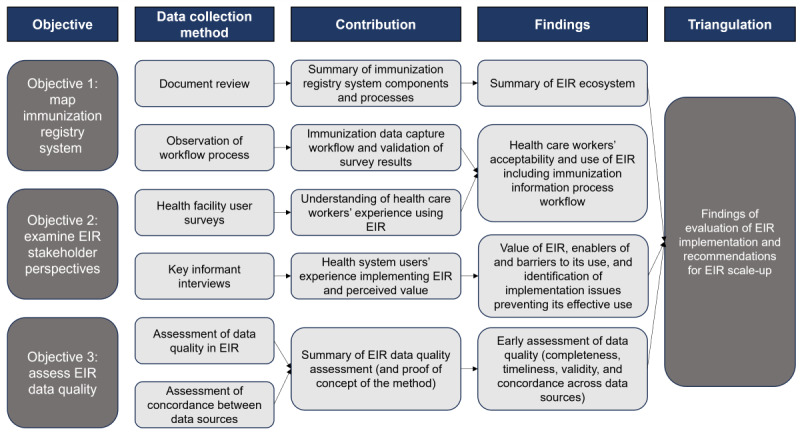
To evaluate the implementation of the EIR in the Lao People's Democratic Republic, we will (1) map the EIR workflow process, (2) examine EIR user and stakeholder perspectives, and (3) assess the EIR data quality. Data will be collected and analyzed through a mixed methods approach. This evaluation will involve a document review, observation of workflows in health facilities, health facility user surveys, key informant interviews with decision makers, and an assessment of immunization data quality. This protocol details the methods for each of these components. The evidence generated will be triangulated to identify the strengths and weaknesses of the early implementation phase of the EIR, facilitators of and barriers to the implementation, and whether the introduction of the EIR has improved immunization data processes and quality compared with paper-based processes.
Data collection took place between April 2024 and August 2024. Data analysis is currently ongoing, with results expected to be shared with study stakeholders in October 2024.
This early evaluation will contribute to developing a road map for the nationwide strengthening and sustainability of the EIR based on challenges and lessons learned, potentially streamlining further implementation efforts and enabling more effective use of the EIR. This paper presents a methodology for evaluating EIR implementation that can be replicated in other low- and middle-income countries implementing EIRs.
INTERNATIONAL REGISTERED REPORT IDENTIFIER (IRRID): DERR1-10.2196/65663.
电子免疫登记册(EIR)可以加强免疫接种系统,如果有效使用,可提高效率并提升疫苗接种覆盖率。一些低收入和中等收入国家引入了用于新冠疫苗接种的EIR,目前正在将其整合到常规免疫接种中。
本研究旨在描述2022年在老挝人民民主共和国评估EIR实施情况所采用的方案。此外,还旨在确定该国改善实施、扩大规模和可持续性的机会。
为评估老挝人民民主共和国EIR的实施情况,我们将:(1)绘制EIR工作流程;(2)考察EIR用户和利益相关者的观点;(3)评估EIR数据质量。将通过混合方法收集和分析数据。该评估将包括文件审查、观察卫生机构的工作流程、对卫生机构用户进行调查、与决策者进行关键信息访谈以及评估免疫接种数据质量。本方案详细说明了这些组成部分各自的方法。所产生的证据将进行三角互证,以确定EIR早期实施阶段的优势和劣势、实施的促进因素和障碍,以及与纸质流程相比,EIR的引入是否改善了免疫接种数据流程和质量。
数据收集于2024年4月至8月进行。目前正在进行数据分析,预计结果将于2024年10月与研究利益相关者分享。
这项早期评估将有助于根据所面临的挑战和吸取的经验教训,制定一份在全国范围内加强EIR并使其可持续发展的路线图,有可能简化进一步的实施工作,并使EIR得到更有效的利用。本文介绍了一种评估EIR实施情况的方法,可在其他实施EIR的低收入和中等收入国家复制。
国际注册报告识别号(IRRID):DERR1-10.2196/65663