Doyle Jeff J, Ren Jian, Pawlowski Katharina, James Euan K, Gao Yingzhi
School of Integrative Plant Science, Section of Plant Biology and Section of Plant Breeding & Genetics, Cornell University, Ithaca, NY, USA.
Institute of Grassland Science, Key Laboratory of Vegetation Ecology of the Ministry of Education, Jilin Songnen Grassland Ecosystem National Observation and Research Station, State Environmental Protection Key Laboratory of Wetland Ecology and Vegetation Restoration, Northeast Normal University, Changchun, China.
Nat Commun. 2025 Jun 19;16(1):5345. doi: 10.1038/s41467-025-60433-w.
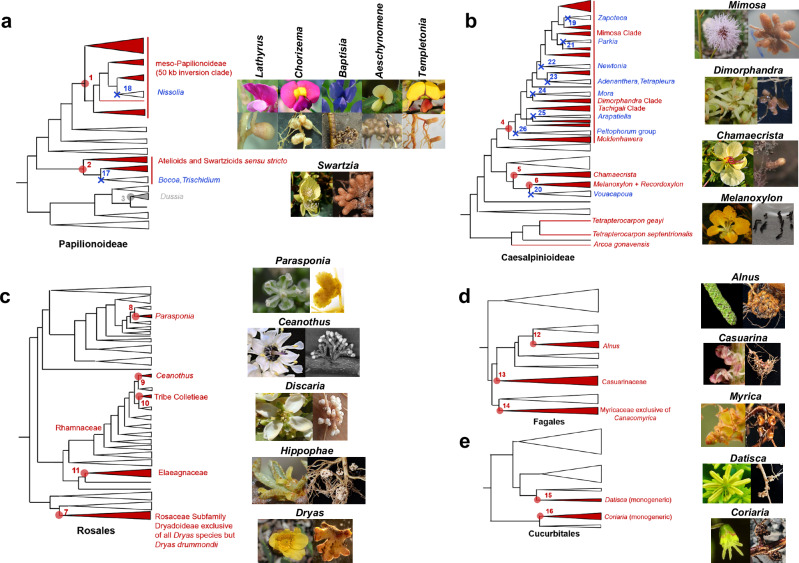
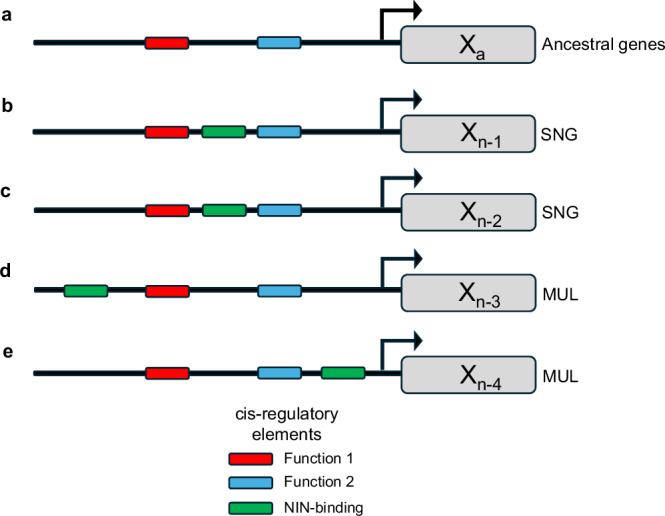
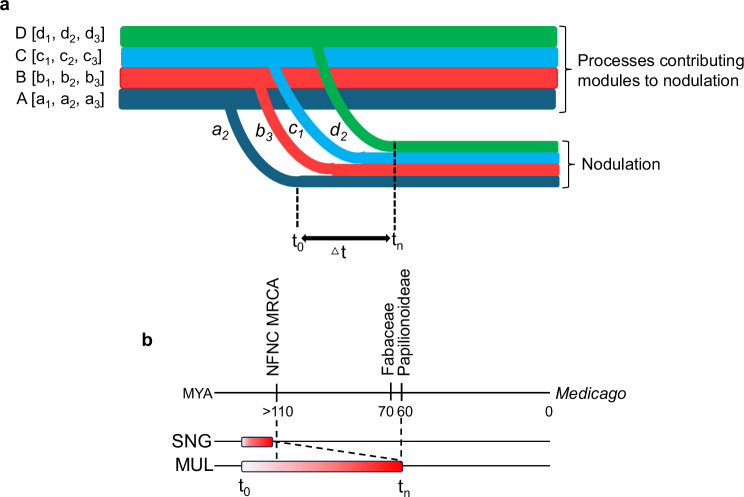
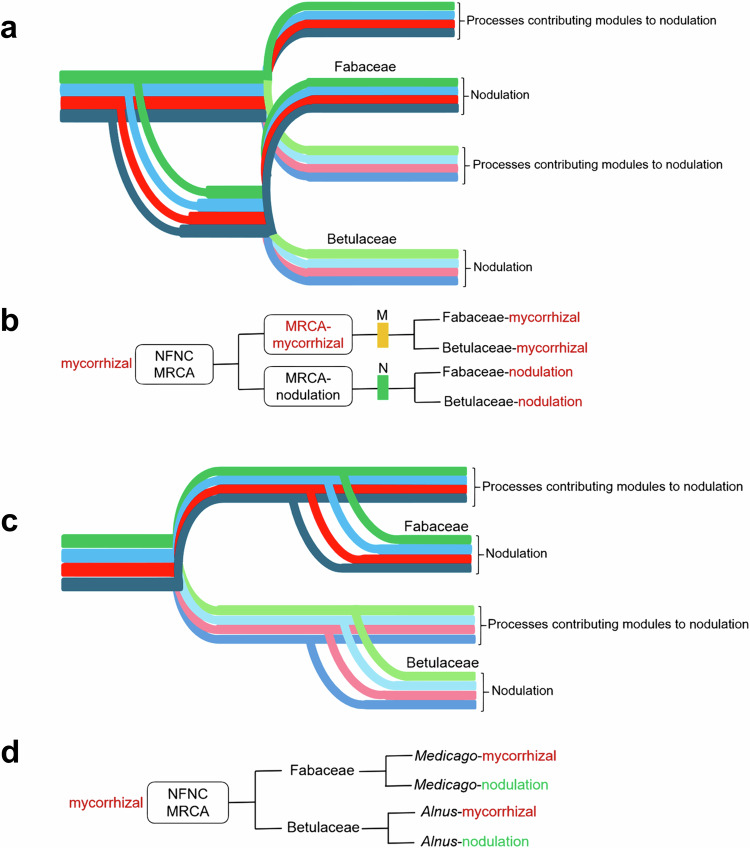
Some species of legumes and nine other flowering plant families form symbioses with bacteria that fix atmospheric nitrogen within specialized plant structures called nodules. How and how often nodulation symbiosis originated has implications for engineering symbiotic nitrogen fixation in non-legume crops. The prevailing hypothesis of a single origin with massive parallel losses has been challenged in a phylogenomic study favoring 16 origins and 10 losses. Nodulation has been assembled once or many times from existing processes (e.g., mycorrhizal symbiosis) and therefore almost nothing about it is truly novel. Because any feature of nodulation can be explained either as divergence from a common origin or as convergence in unrelated taxa, tests are needed that can distinguish whether assembly of homologous components has occurred uniquely or convergently. Much needs to be learned about nodulation symbioses across the proposed independent origins, especially involving the master nodulation transcription factor, Nodule Inception (NIN).
一些豆科植物物种以及其他九个开花植物科与细菌形成共生关系,这些细菌在称为根瘤的特殊植物结构内固定大气中的氮。根瘤共生起源的方式和频率对非豆科作物共生固氮工程具有重要意义。在一项支持16次起源和10次丧失的系统基因组学研究中,单一起源且伴有大量平行丧失的主流假说受到了挑战。根瘤形成是从现有过程(如菌根共生)中组装了一次或多次,因此关于它几乎没有什么是真正新颖的。由于根瘤形成的任何特征都可以解释为来自共同起源的分化或无关分类群中的趋同,因此需要能够区分同源成分的组装是独特发生还是趋同发生的测试。关于所提出的独立起源的根瘤共生,还有很多需要了解的,特别是涉及主根瘤转录因子“根瘤起始”(NIN)的情况。