Song Yingjie, Hu Qiang, Han Yao, Liu Hongbo, Huang Zhenyang, Niu Mengwei, Dong Xue, Yan Kuocheng, Jin Li, Li Hao, Sun Yansong
State Key Laboratory of Pathogen and Biosecurity, Academy of Military Medical Sciences, Beijing, China.
Chinese PLA Center for Disease Control and Prevention, Beijing, China.
Front Cell Infect Microbiol. 2025 Jun 5;15:1553681. doi: 10.3389/fcimb.2025.1553681. eCollection 2025.
Polymyxins are reserved as an ultimate defense against multidrug-resistant bacteria. The emergence of the polymyxin resistance gene poses a potential risk for the treatment of severe infections caused by Gram-negative bacteria. Timely detection and monitoring the gene are essential for guiding anti-infective therapy and controlling the spread of polymyxin resistance. Quantitative real-time PCR (qPCR) is one of the common methods for detecting resistance genes. However, qPCR has equipment dependency, and is not feasible in primary healthcare settings. Currently, there remains a lack of a highly sensitive and portable method for detecting the gene.
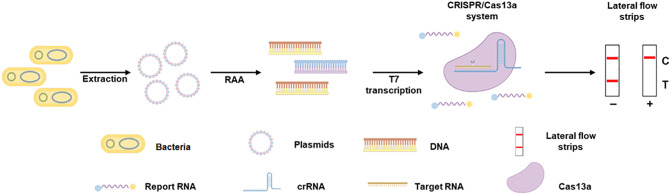
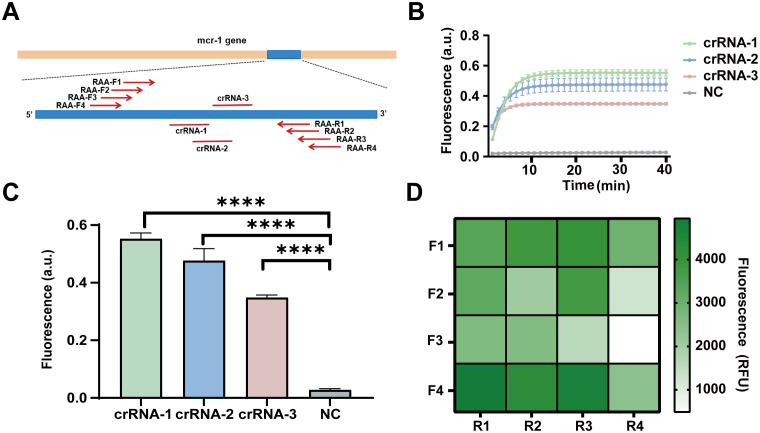
We established and optimized detection assays of the gene based on CRISPR/Cas13a system and lateral flow strips. The detection method was preliminarily evaluated using clinical isolates from , compared with qPCR.
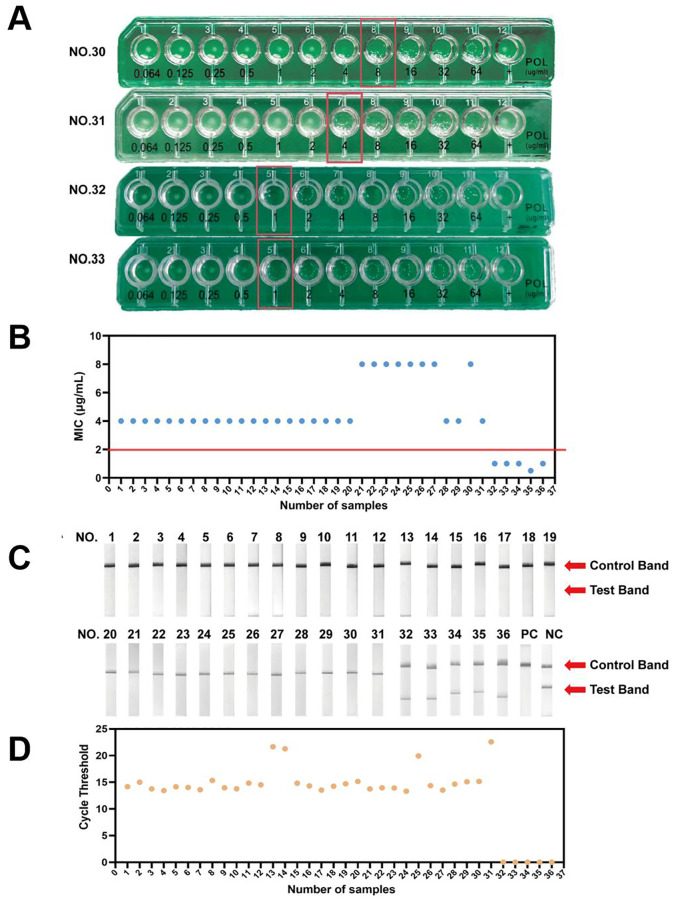
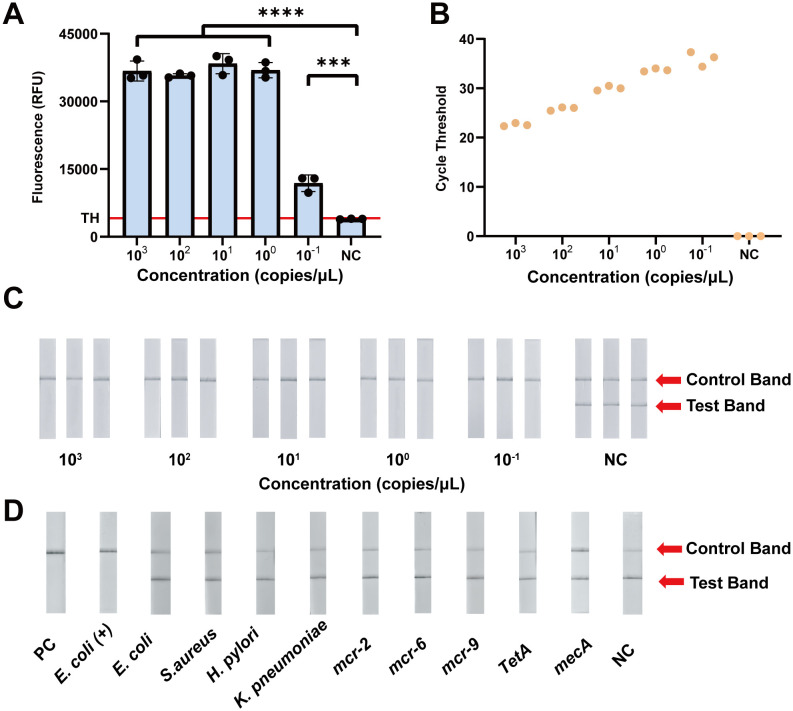
The method for detecting the gene based on the CRISPR/Cas13a system and lateral flow strips was established, with a detection limit of 100 copies/mL. This method demonstrated high analytical specificity, with no cross-reactivity detected in non- and non-resistant strains. Among 36 clinical isolates, the method identified 31 strains as positive for the gene, and had a 100% concordance rate with the results of qPCR.
We established a detection method for the polymyxin resistance gene based on the CRISPR/Cas13a system. This method enables visual readouts without instruments, making it potentially applicable to primary healthcare settings and field surveillance.
多粘菌素是对抗多重耐药菌的最后一道防线。多粘菌素耐药基因的出现给革兰氏阴性菌引起的严重感染治疗带来了潜在风险。及时检测和监测该基因对于指导抗感染治疗和控制多粘菌素耐药性的传播至关重要。定量实时聚合酶链反应(qPCR)是检测耐药基因的常用方法之一。然而,qPCR依赖设备,在基层医疗环境中不可行。目前,仍缺乏一种高灵敏度且便携式的检测该基因的方法。
我们基于CRISPR/Cas13a系统和侧流试纸条建立并优化了该基因的检测方法。与qPCR相比,使用来自[具体来源]的临床分离株对该检测方法进行了初步评估。
建立了基于CRISPR/Cas13a系统和侧流试纸条的该基因检测方法,检测限为100拷贝/毫升。该方法具有高分析特异性,在非[具体名称]和非耐药菌株中未检测到交叉反应。在36株临床分离株中,该方法鉴定出31株该基因阳性菌株,与qPCR结果的一致性率为100%。
我们建立了基于CRISPR/Cas13a系统的多粘菌素耐药[基因名称]基因检测方法。该方法无需仪器即可实现可视化读数,使其有可能应用于基层医疗环境和现场监测。