Lin John C, Sun Jiaxuan, Yan Ruiqi, Wang Lucy S, McCarthy Anne Marie, Tong Guangyu, Aysola Jaya
Department of Medicine, Perelman School of Medicine, University of Pennsylvania, Philadelphia.
Department of Biostatistics, Epidemiology, and Informatics, Perelman School of Medicine, University of Pennsylvania, Philadelphia.
JAMA Health Forum. 2025 Jun 7;6(6):e251381. doi: 10.1001/jamahealthforum.2025.1381.
Food insecurity, which is characterized by limited or uncertain access to adequate food, affects approximately 40 million individuals in the US, including many patients with cancer. Understanding the association between food insecurity and cancer mortality is crucial for improving patient outcomes and addressing health disparities.
To investigate the association of food insecurity with cancer-specific and all-cause mortality among US adults with a diagnosis of cancer.
DESIGN, SETTING, AND PARTICIPANTS: This cohort study used nationally representative data from the 2011 to 2012 National Health Interview Survey that were linked to the National Death Index, with mortality follow-up through December 31, 2019. It included 5603 respondents to the National Health Interview Survey 40 years and older who reported receiving a diagnosis of cancer and responded to food security questions.
Food insecurity was measured using a validated 10-item National Center for Health Statistics food insecurity scale, categorized as food secure (0-2) or food insecure (3-10) based on US Department of Agriculture guidelines.
The primary outcomes were cancer-specific mortality (International Statistical Classification of Diseases and Related Health Problems, Tenth Revision codes: C00-C97) and all-cause mortality. Cox proportional hazards models were used to estimate hazard ratios (HRs) for these outcomes, adjusting for age, sex, race and ethnicity, household income, US region, body mass index, smoking, alcohol use, comorbidities, and survey year.
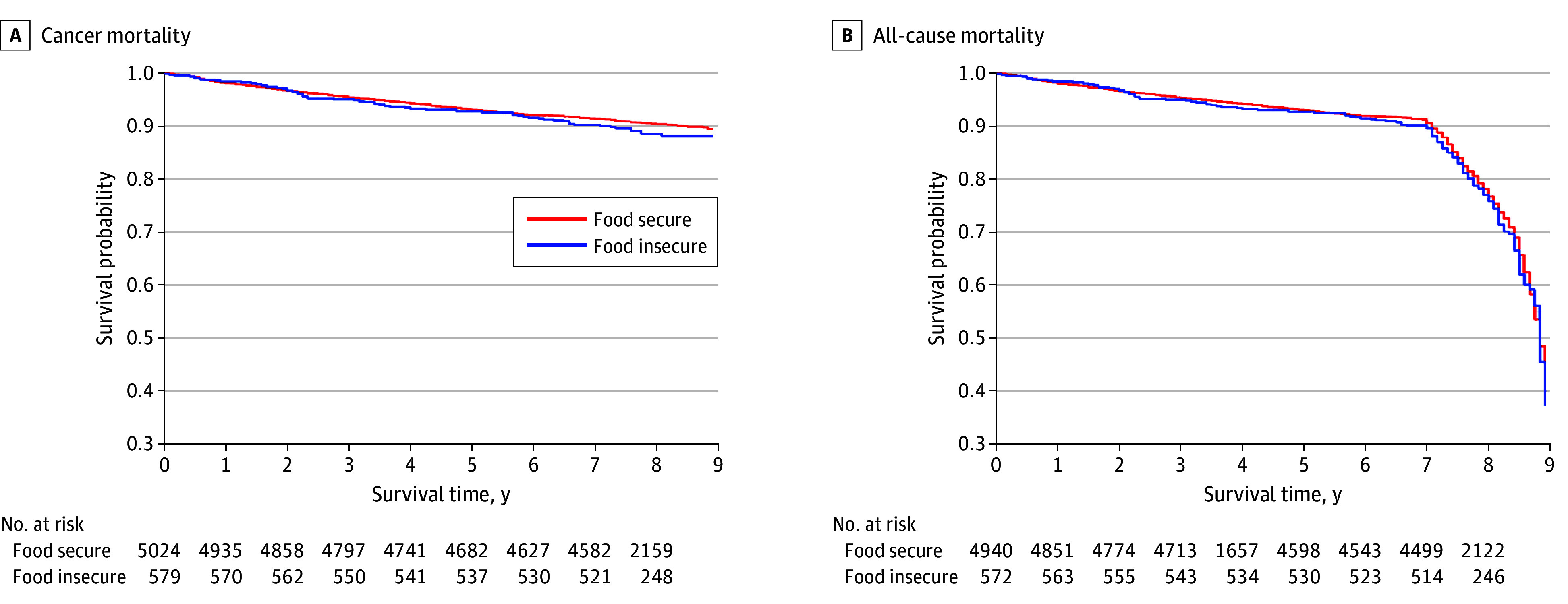
Among the 5603 participants (mean [SD] age, 67.03 [12.03] years; 3298 female individuals [59%]; 320 Hispanic individuals [6%], 22 Native American individuals [0.4%], 136 non-Hispanic Asian individuals [2%], 529 non-Hispanic Black individuals [9%], 4519 non-Hispanic White individuals [81%], and 75 multiracial or multiethnic individuals [1%]), the prevalence of food insecurity was 10.3% among survivors of cancer. Food insecurity was associated with higher all-cause mortality (HR, 1.28; 95% CI, 1.07-1.53) but not cancer-specific mortality after full adjustment. Subgroup analyses indicated that food insecurity was associated with cancer and all-cause mortality for those individuals with household incomes 200% or greater than the federal poverty level (cancer-specific mortality: HR, 1.93; 95% CI, 1.18-3.15; all-cause mortality: HR, 1.89; 95% CI, 1.34-2.68) and those not receiving food assistance (cancer-specific mortality: HR, 1.42; 95% CI, 1.00-2.01; all-cause mortality: HR, 1.42; 95% CI, 1.14-1.76). However, there was no significant association between food insecurity and cancer-specific or all-cause mortality for people with incomes less than 100% of the federal poverty level and households participating in food assistance programs.
The results of this cohort study suggest that food insecurity is a substantial factor associated with increased mortality among survivors of cancer. Addressing food insecurity through routine screenings and connecting patients with food assistance programs may improve survival outcomes, and further research should examine the longitudinal effects of integrating routine food insecurity screenings within cancer care settings and expanding food assistance program eligibility.
粮食不安全的特征是获得充足食物的机会有限或不确定,影响了美国约4000万人,包括许多癌症患者。了解粮食不安全与癌症死亡率之间的关联对于改善患者预后和解决健康差距至关重要。
调查美国成年癌症患者中粮食不安全与癌症特异性死亡率和全因死亡率之间的关联。
设计、背景和参与者:这项队列研究使用了2011年至2012年全国健康访谈调查中的具有全国代表性的数据,并与国家死亡指数相链接,随访至2019年12月31日的死亡率。研究包括全国健康访谈调查中40岁及以上报告被诊断患有癌症并回答了粮食安全问题的5603名受访者。
使用经过验证的由10个项目组成的国家卫生统计中心粮食不安全量表来衡量粮食不安全状况,根据美国农业部的指导方针,分为粮食安全(0 - 2)或粮食不安全(3 - 10)。
主要结局是癌症特异性死亡率(《疾病和相关健康问题国际统计分类》第十次修订版编码:C00 - C97)和全因死亡率。使用Cox比例风险模型估计这些结局的风险比(HRs),并对年龄、性别、种族和族裔、家庭收入、美国地区、体重指数、吸烟、饮酒、合并症和调查年份进行调整。
在5603名参与者中(平均[标准差]年龄为67.03[12.03]岁;女性3298人[59%];西班牙裔320人[6%],美国原住民22人[0.4%],非西班牙裔亚洲人136人[2%],非西班牙裔黑人529人[9%],非西班牙裔白人4519人[81%],多种族或多族裔75人[1%]),癌症幸存者中粮食不安全的患病率为10.3%。在完全调整后,粮食不安全与较高的全因死亡率相关(HR,1.28;95%CI,1.07 - 1.53),但与癌症特异性死亡率无关。亚组分析表明,对于家庭收入为联邦贫困水平200%或更高的个体(癌症特异性死亡率:HR,1.93;95%CI,1.18 - 3.15;全因死亡率:HR,1.89;95%CI,1.34 - 2.68)以及未接受粮食援助的个体(癌症特异性死亡率:HR,1.42;95%CI,1.00 - 2.01;全因死亡率:HR,1.42;95%CI,1.14 - 1.76),粮食不安全与癌症和全因死亡率相关。然而,对于收入低于联邦贫困水平100%的人群以及参与粮食援助计划的家庭,粮食不安全与癌症特异性死亡率或全因死亡率之间没有显著关联。
这项队列研究的结果表明,粮食不安全是癌症幸存者死亡率增加的一个重要因素。通过常规筛查解决粮食不安全问题并将患者与粮食援助计划联系起来可能会改善生存结局,进一步的研究应考察在癌症护理环境中纳入常规粮食不安全筛查以及扩大粮食援助计划资格的纵向影响。
