Han Chen, Zhang Yixuan, Yuan Heidi, Keiser Shalyn, Leonardo Trevor, Chen Lin, Wietecha Mateusz, DiPietro Luisa A
Center for Wound Healing and Tissue Regeneration, University of Illinois Chicago, Chicago, Illinois, USA.
Department of Integrative and Translation Physiology, University of Illinois Chicago, Chicago, Illinois, USA.
FASEB J. 2025 Jun 30;39(12):e70744. doi: 10.1096/fj.202500374R.
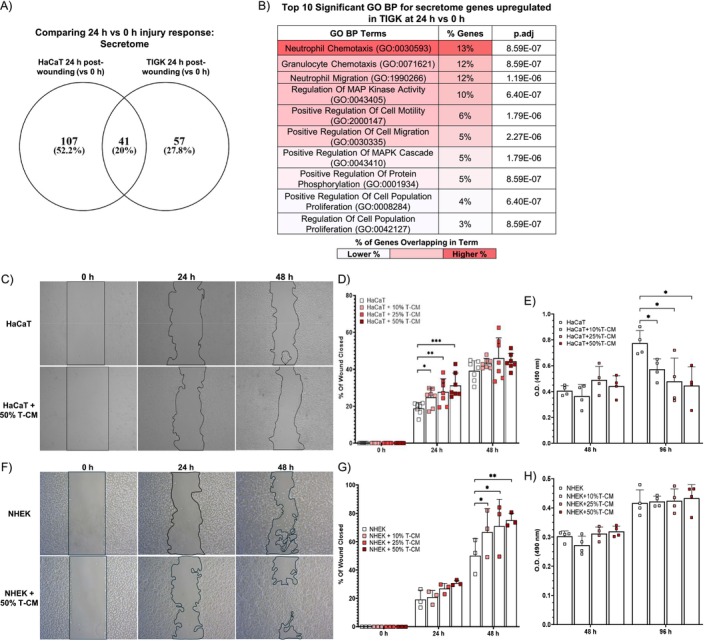
Compared to skin wounds, oral mucosal wounds heal quicker with less inflammation, faster re-epithelialization, and minimal scarring. Site-specific keratinocytes may be one differentiating factor. This study used immortalized skin and oral keratinocytes (HaCaT and TIGK), which maintain fidelity to their primary cell counterpart, to examine functional and transcriptional differences that might contribute to the differential wound healing at the two sites. Oral keratinocytes were found to have an enhanced migratory and proliferative capacity. To examine the transcriptomic differences, we generated an mRNA-sequencing gene expression dataset utilizing HaCaT and TIGK. Differentially expressed genes (DEGs) were identified between HaCaT and TIGK at baseline and throughout in vitro healing. DEGs in HaCaT and TIGK following injury were also identified when compared to each respective cell type's unwounded gene expression levels. Gene set enrichment analyses were performed to understand the biological significance of the DEGs. Processes related to interferon (IFN) signaling were uniquely enriched in TIGK. TIGK also exhibited a faster transcriptional response to injury and differential expression of integrins and matrix metalloproteinases (MMPs). When grown on extracellular matrix (ECM) proteins, TIGK retained its enhanced migratory capacity over HaCaT. Lastly, TIGK displayed a post-injury secretome that promoted keratinocyte migration. Our comparative analyses suggest that specific transcriptomic differences between oral and skin keratinocytes at unwounded baseline and in response to injury may underlie the distinct wound healing phenotypes observed in these two tissues. This work also provides a new resource of HaCaT and TIGK gene expression data that can be used for future analyses.
与皮肤伤口相比,口腔黏膜伤口愈合更快,炎症更少,再上皮化更快,且瘢痕形成最小。特定部位的角质形成细胞可能是一个区别因素。本研究使用永生化的皮肤和口腔角质形成细胞(HaCaT和TIGK),它们与原代细胞相似,以研究可能导致这两个部位伤口愈合差异的功能和转录差异。发现口腔角质形成细胞具有增强的迁移和增殖能力。为了研究转录组差异,我们利用HaCaT和TIGK生成了一个mRNA测序基因表达数据集。在基线和整个体外愈合过程中,鉴定了HaCaT和TIGK之间的差异表达基因(DEG)。与每种细胞类型的未受伤基因表达水平相比,还鉴定了受伤后HaCaT和TIGK中的DEG。进行基因集富集分析以了解DEG的生物学意义。与干扰素(IFN)信号相关的过程在TIGK中独特富集。TIGK对损伤也表现出更快的转录反应以及整合素和基质金属蛋白酶(MMP)的差异表达。当在细胞外基质(ECM)蛋白上生长时,TIGK比HaCaT保留了增强的迁移能力。最后,TIGK显示出一种促进角质形成细胞迁移的损伤后分泌组。我们的比较分析表明,未受伤基线时以及对损伤反应时口腔和皮肤角质形成细胞之间的特定转录组差异可能是这两种组织中观察到的不同伤口愈合表型的基础。这项工作还提供了一个可用于未来分析的HaCaT和TIGK基因表达数据的新资源。