Zhang Liwen, Huang Xumin, Liu Liwei, Nasar Naufal Kabir Ahamed, Gu Xinyan, Davis Thomas P, Zheng Xiaoyu Rayne, Wang Lianzhou, Qiao Ruirui
Australian Institute for Bioengineering and Nanotechnology, The University of Queensland, Brisbane, QLD, 4072, Australia.
Department of Material Science and Engineering, University of California, Berkeley, CA, 94720, USA.
Adv Mater. 2025 Sep;37(37):e2505504. doi: 10.1002/adma.202505504. Epub 2025 Jun 23.
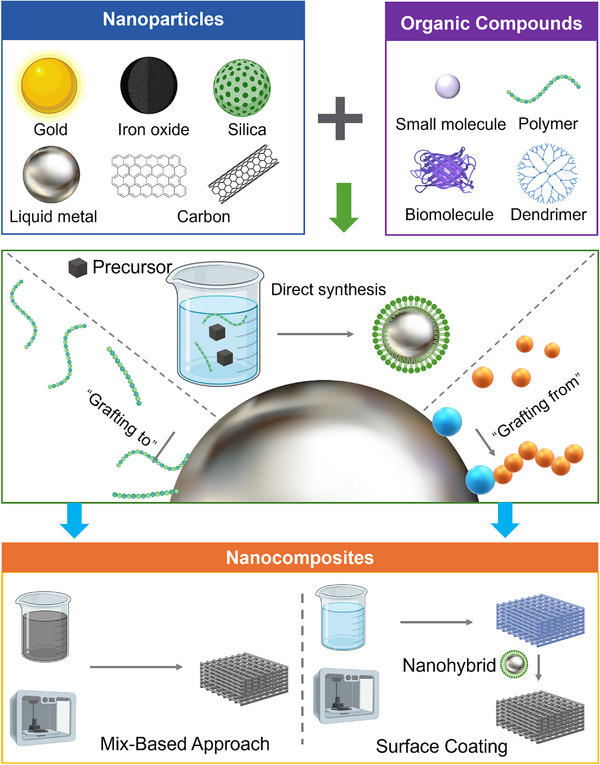
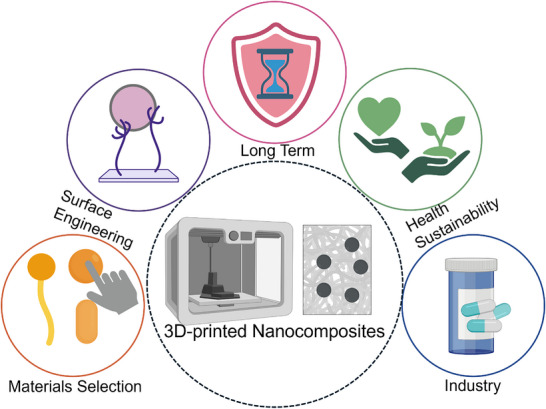
Nanocomposites, are materials that incorporate nanosized particles into a matrix of standard material, have emerged as a versatile class of materials with tunable properties for a wide range of applications. Traditional fabrication approaches, including physical blending, in situ polymerization, layer-by-layer assembly, and sol-gel synthetic methods, have been widely employed to develop nanocomposites with high structural homogeneity and tailored properties. This review presents a cohesive and comprehensive overview of nanocomposite fabrication methods, spanning from conventional synthetic strategies to cutting-edge approaches such as 3D printing technologies. How 3D printing has driven innovations in nanocomposite applications, particularly in biomedicine, soft robotics, electronics, and water treatment, is explored. Additionally, key challenges in 3D-printed nanocomposite development are discussed, and emerging advancements such as 5D printing, artificial intelligence (AI)-assisted material optimization, nanoscale additive manufacturing, and closed-loop recycling systems are highlighted. By bridging traditional synthesis with cutting-edge fabrication techniques, this review aims to provide insights into the future directions of nanocomposite research and applications.