Acharya Kadambini, Maity Kalyan, Acharya Rabindra Mohan, Pradhan Balaram, Patra Sanjib
The School of Yoga, Swami Vivekananda Yoga Anusandhana Samsthana (S-VYASA), Bengaluru, Karnataka, India.
Department of Yoga, Central University of Rajasthan, Ajmer, Rajasthan, India.
Ann Neurosci. 2025 Jun 20:09727531251345310. doi: 10.1177/09727531251345310.
recitation is a universal practice that involves repeating sacred words or phrases. It is widely acknowledged for its function in improving concentration, slowing down thought processes and causing a variety of psychophysiological changes. Yet, no research has methodically looked at how various recitation techniques affect physiological parameters.
This study was aimed to evaluate heart rate variability (HRV), autonomic function and respiratory variables prior to, during and following each style of recitation.
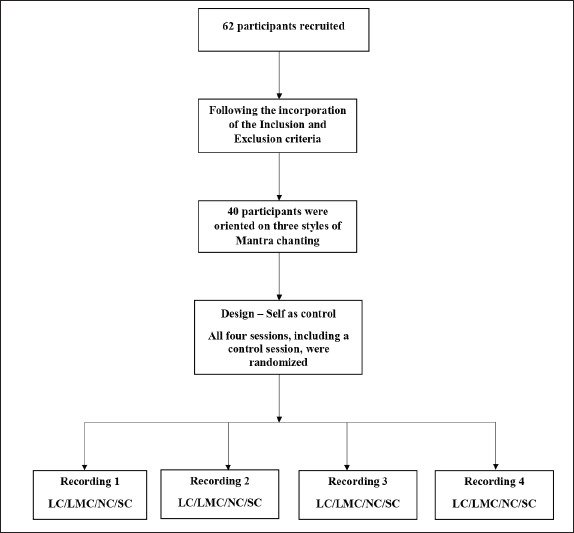
This trial involved 40 male novices between the ages of twenty and 25 years. The autonomic and respiratory variables of each participant were recorded before, during and following loud chanting (LC), lips movement chanting (LMC), silent chanting (SC) and no chanting (NC) in four distinct laboratory sessions. HRV frequency and time-domain measurements were taken from electrocardiogram (ECG) recordings, and data were obtained using a 16-channel polygraph. This study employed the repeated measures analysis of variance (RM ANOVA) to compare the differences between and within groups under the four conditions.
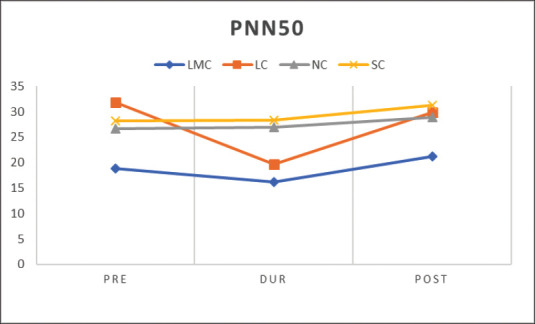
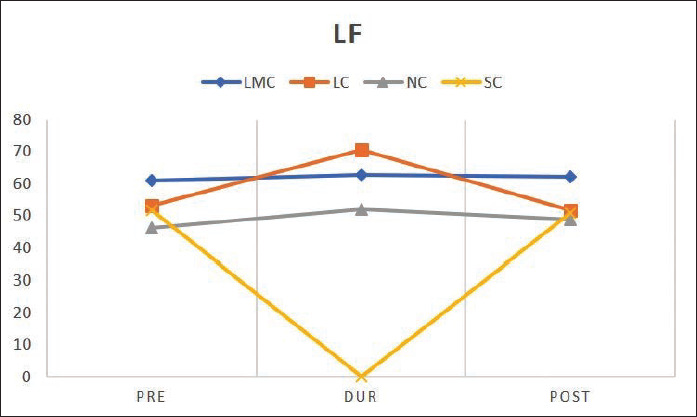
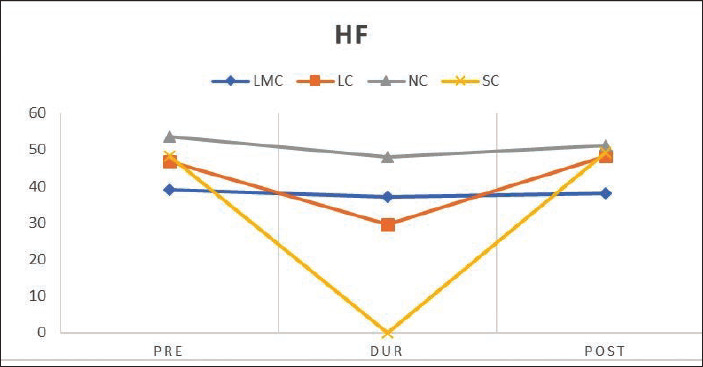
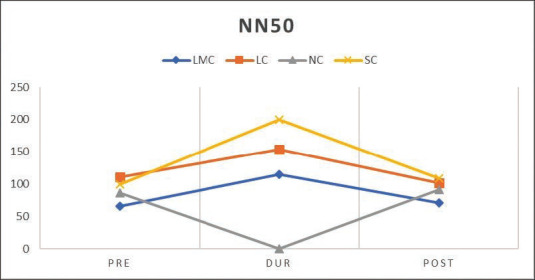
Based on frequency domain measurements, the results showed a significant decrease in high-frequency (HF) power ( < .001) and a significant increase in low-frequency (LF) power ( < .001) during LC. Furthermore, NN50 was significantly higher ( < .001) in all sessions and groups, while pNN50 was significantly lower ( < .001) as compared to NC during LC. Moreover, the mean HR was considerably higher during LMC and LC ( < .001).
These results imply that, although in a relaxed physiological state, the LC and LMC styles of recitation may improve attentional focus while overdriving sympathetic activity. Nevertheless, vagal tone remained intact throughout the entire duration of the SC recitation.
诵经是一种普遍的行为,包括重复神圣的词语或短语。其在提高注意力、减缓思维过程以及引起各种心理生理变化方面的作用已得到广泛认可。然而,尚无研究系统地探讨不同的诵经技巧如何影响生理参数。
本研究旨在评估每种诵经方式之前、期间和之后的心率变异性(HRV)、自主神经功能和呼吸变量。
本试验纳入了40名年龄在20至25岁之间的男性新手。在四个不同的实验室环节中,记录了每位参与者在大声诵经(LC)、嘴唇移动诵经(LMC)、默念诵经(SC)和不诵经(NC)之前、期间和之后的自主神经和呼吸变量。通过心电图(ECG)记录进行HRV频域和时域测量,并使用16通道多导记录仪获取数据。本研究采用重复测量方差分析(RM ANOVA)来比较四种条件下组间和组内的差异。
基于频域测量,结果显示在LC期间高频(HF)功率显著降低(<.001),低频(LF)功率显著增加(<.001)。此外,与NC相比,在所有环节和组中NN50均显著更高(<.001),而在LC期间pNN50显著更低(<.001)。此外,在LMC和LC期间平均心率显著更高(<.001)。
这些结果表明,尽管处于放松的生理状态,但LC和LMC诵经方式可能在过度驱动交感神经活动的同时提高注意力集中度。然而,在SC诵经的整个过程中迷走神经张力保持完好。