Kalyani Bangalore G, Venkatasubramanian Ganesan, Arasappa Rashmi, Rao Naren P, Kalmady Sunil V, Behere Rishikesh V, Rao Hariprasad, Vasudev Mandapati K, Gangadhar Bangalore N
Department of Psychiatry, Advanced Center for Yoga, National Institute of Mental Health and Neurosciences, Bangalore - 560 029, India.
Int J Yoga. 2011 Jan;4(1):3-6. doi: 10.4103/0973-6131.78171.
A sensation of vibration is experienced during audible 'OM' chanting. This has the potential for vagus nerve stimulation through its auricular branches and the effects on the brain thereof. The neurohemodynamic correlates of 'OM' chanting are yet to be explored.
Using functional Magnetic Resonance Imaging (fMRI), the neurohemodynamic correlates of audible 'OM' chanting were examined in right-handed healthy volunteers (n=12; nine men). The 'OM' chanting condition was compared with pronunciation of "ssss" as well as a rest state. fMRI analysis was done using Statistical Parametric Mapping 5 (SPM5).
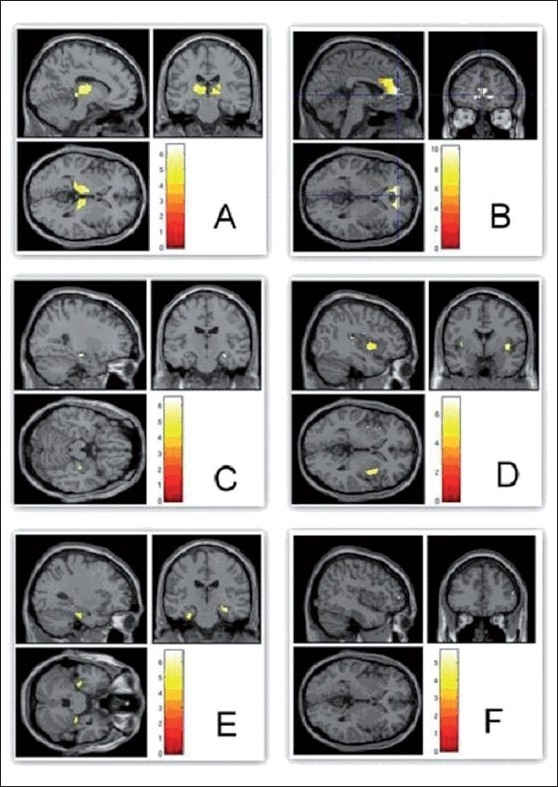
In this study, significant deactivation was observed bilaterally during 'OM' chanting in comparison to the resting brain state in bilateral orbitofrontal, anterior cingulate, parahippocampal gyri, thalami and hippocampi. The right amygdala too demonstrated significant deactivation. No significant activation was observed during 'OM' chanting. In contrast, neither activation nor deactivation occurred in these brain regions during the comparative task - namely the 'ssss' pronunciation condition.
The neurohemodynamic correlates of 'OM' chanting indicate limbic deactivation. As similar observations have been recorded with vagus nerve stimulation treatment used in depression and epilepsy, the study findings argue for a potential role of this 'OM' chanting in clinical practice.
在可听见的“唵”音唱诵期间会体验到一种振动感。这有可能通过其耳支刺激迷走神经及其对大脑的影响。“唵”音唱诵的神经血液动力学相关性尚未得到探索。
使用功能磁共振成像(fMRI),在右利手健康志愿者(n = 12;9名男性)中检查可听见的“唵”音唱诵的神经血液动力学相关性。将“唵”音唱诵状态与发“ssss”音以及静息状态进行比较。使用统计参数映射5(SPM5)进行fMRI分析。
在本研究中,与静息脑状态相比,双侧眶额、前扣带回、海马旁回、丘脑和海马在“唵”音唱诵期间均观察到显著失活。右侧杏仁核也显示出显著失活。在“唵”音唱诵期间未观察到显著激活。相比之下,在比较任务(即发“ssss”音状态)期间,这些脑区既未发生激活也未发生失活。
“唵”音唱诵的神经血液动力学相关性表明边缘系统失活。由于在抑郁症和癫痫中使用迷走神经刺激治疗时也记录到了类似的观察结果,该研究结果表明这种“唵”音唱诵在临床实践中可能具有潜在作用。