Pradhan Rachita, Dandsena Rutuparna Sibani, Singh Sneha, Ghosal Shishirendu, Bhattacharya Debdutta, Kanungo Srikanta, Pati Sanghamitra
ICMR-Regional Medical Research Centre, Bhubaneswar, India.
Faculty of Biological Sciences, Academy of Scientific and Innovative Research (ACSIR), Bhubaneswar, India.
Front Public Health. 2025 Jun 6;13:1495522. doi: 10.3389/fpubh.2025.1495522. eCollection 2025.
Tobacco use remains a major public health concern, particularly in low- and middle-income countries, which account for 80% of the world's tobacco users. In India, smokeless tobacco (SLT) use is higher among women, likely due to factors such as financial dependence resulting from limited occupational opportunities, peer influence, and gender inequality. Tobacco consumption in any form poses serious health risks to both mothers and their children.
This study aims to estimate the prevalence and factors associated with smoking tobacco and SLT among pregnant and breastfeeding mothers from the fifth National Family Health Survey (2019-21) (NFHS-5) in India.
After excluding outliers, 722,933 women of reproductive age (24,368 pregnant, 102,080 breastfeeding, and 592,699 non-pregnant/non-breastfeeding mothers) were eligible for this cross-sectional secondary data analysis. Descriptive statistics are presented as means with standard deviations (continuous variables) or frequencies (categorical variables), with a 95% confidence interval as a measure of uncertainty. The magnitude of the influence on the covariates of tobacco consumption was estimated using univariate and multivariate logistic regressions.
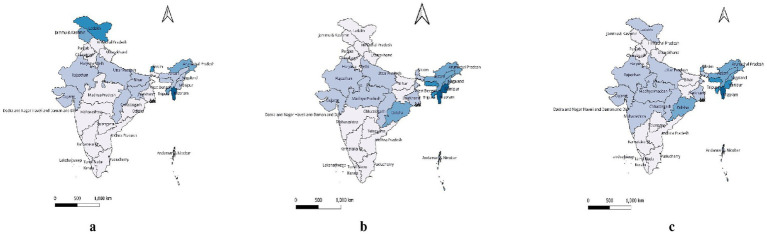
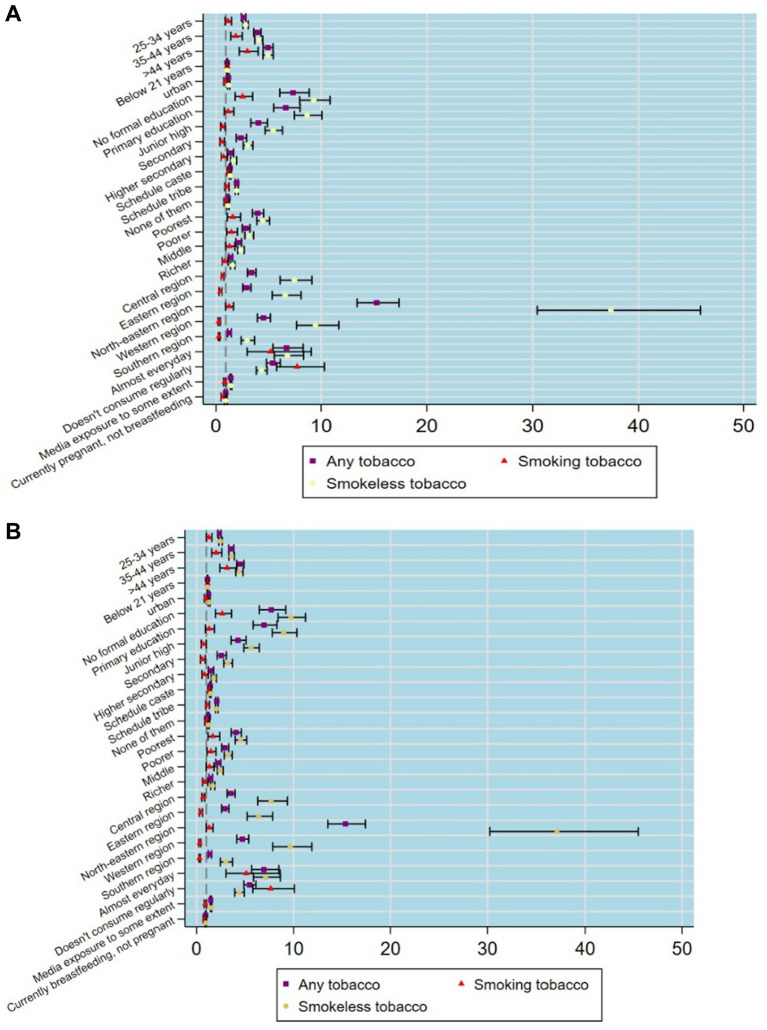
Approximately 3.2% of mothers reported using tobacco during their current pregnancy or while breastfeeding, with a strong preference for SLT, which was over 13 times more common than smoking tobacco. Significant predictors of SLT consumption included tribal ethnicity [AOR: 2.20 (1.95-2.48)] and early motherhood [AOR: 1.12 (1.08-1.16)]. Notably, mass media awareness campaigns were ineffective in preventing SLT use among mothers [AOR: 1.49 (1.43-1.57)]. A marked difference in prevalence was observed between pregnant (2.48%) and breastfeeding (3.34%) mothers, suggesting a potential postpartum relapse. These findings underscore the potential role that Accredited Social Health Activists (ASHAs) can play during antenatal care (ANC) visits by providing consistent support for tobacco cessation.
Tobacco use poses serious health hazards not only to the mother but also to the developing child. Our findings indicate a lack of management and awareness, underscoring the urgent need for reforms in tobacco production and distribution to ensure improved maternal care and child health outcomes.
烟草使用仍然是一个主要的公共卫生问题,尤其是在低收入和中等收入国家,这些国家占全球烟草使用者的80%。在印度,无烟烟草(SLT)在女性中的使用率较高,这可能是由于职业机会有限导致经济依赖、同伴影响和性别不平等。任何形式的烟草消费都会对母亲及其子女构成严重的健康风险。
本研究旨在估计印度第五次全国家庭健康调查(2019 - 21年)(NFHS - 5)中怀孕和哺乳期母亲吸烟和使用无烟烟草的患病率及相关因素。
在排除异常值后,722,933名育龄妇女(24,368名孕妇、102,080名哺乳期妇女和592,699名非孕妇/非哺乳期母亲)符合这项横断面二次数据分析的条件。描述性统计以均值和标准差(连续变量)或频率(分类变量)表示,并以95%置信区间作为不确定性的度量。使用单变量和多变量逻辑回归估计烟草消费对协变量的影响程度。
约3.2%的母亲报告在当前怀孕期间或哺乳期使用烟草,其中对无烟烟草有强烈偏好,无烟烟草的使用比吸烟普遍13倍以上。无烟烟草消费的显著预测因素包括部落种族[AOR:2.20(1.95 - 2.48)]和早育[AOR:1.12(1.08 - 1.16)]。值得注意的是,大众媒体宣传活动在预防母亲使用无烟烟草方面无效[AOR:1.49(1.43 - 1.57)]。观察到孕妇(2.48%)和哺乳期母亲(3.34%)的患病率存在显著差异,这表明可能存在产后复吸情况。这些发现强调了经认证的社会健康活动家(ASHAs)在产前检查(ANC)期间通过为戒烟提供持续支持可以发挥的潜在作用。
烟草使用不仅对母亲,而且对发育中的儿童都构成严重的健康危害。我们的研究结果表明缺乏管理和意识,强调迫切需要对烟草生产和分销进行改革,以确保改善孕产妇护理和儿童健康结果。