Lan Lan, Zhou Heng, Jiang Runjie, Cao Yimin, Yuan Jiajia, Mao Xiuhong, Wang Ke, Ji Shen, Hu Qing
NMPA Key Laboratory for Quality Control of Traditional Chinese Medicine, Shanghai Institute for Food and Drug Control, Shanghai 201203, China.
Shanghai University of Traditional Chinese Medicine, Shanghai 201203, China.
Food Chem X. 2025 Jun 9;29:102639. doi: 10.1016/j.fochx.2025.102639. eCollection 2025 Jul.
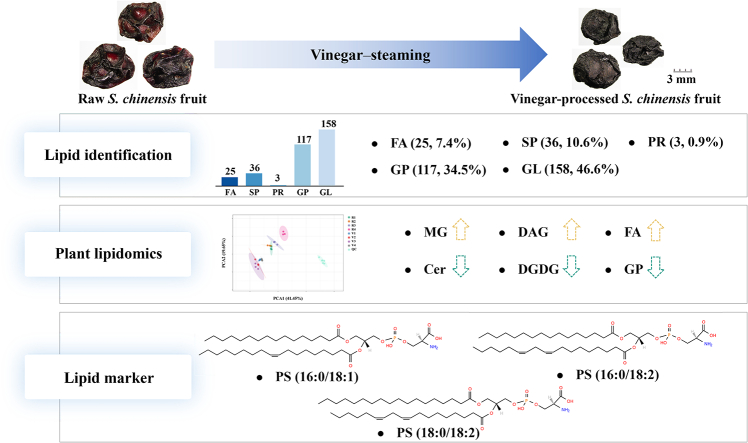
fruit is a food-as-medicine species extensively used in diverse phytotherapeutical applications. Spurred by its widespread use, this study employed a modified MTBE-based lipid extraction procedure on raw and vinegar-processed fruit. Subsequently, lipid composition analysis was conducted using ultra-high-performance liquid chromatography interfaced with ion mobility-quadrupole time-of-flight mass spectrometry. Altogether, 339 lipid molecular species were annotated for the raw and vinegar-processed variants, spanning 24 subclasses and falling into five categories. The KEGG analysis revealed that glycerophospholipid metabolism, biosynthesis of secondary metabolites, and autophagy were the top three pivotal biological pathways in the response to vinegar processing. Moreover, this study pinpointed potential lipid markers capable of differentiating between the two forms, and initiated a preliminary quantitative analysis for their concurrent determination. The results presented in this work offer novel perspectives into the molecular mechanism underlying the vinegar processing of the fruit.
水果是一种广泛应用于多种植物治疗用途的食药两用物种。受其广泛应用的推动,本研究对生的和经醋处理的水果采用了改良的基于甲基叔丁基醚的脂质提取方法。随后,使用与离子淌度-四极杆飞行时间质谱联用的超高效液相色谱进行脂质成分分析。总共为生的和经醋处理的变体注释了339种脂质分子物种,涵盖24个亚类,分为五类。KEGG分析表明,甘油磷脂代谢、次生代谢物的生物合成和自噬是响应醋处理的前三大关键生物学途径。此外,本研究确定了能够区分这两种形式的潜在脂质标志物,并启动了对它们同时测定的初步定量分析。这项工作中呈现的结果为水果醋处理的分子机制提供了新的视角。