Biswas Koushik, Arias-Urueña Liliana, Fearon David
Department of Biochemistry, All India Institute of Medical Sciences, Raebareli, Uttar Pradesh, India.
Usher Institute, The University of Edinburgh, Edinburgh, UK.
J Family Med Prim Care. 2025 May;14(5):1617-1626. doi: 10.4103/jfmpc.jfmpc_1785_24. Epub 2025 May 31.
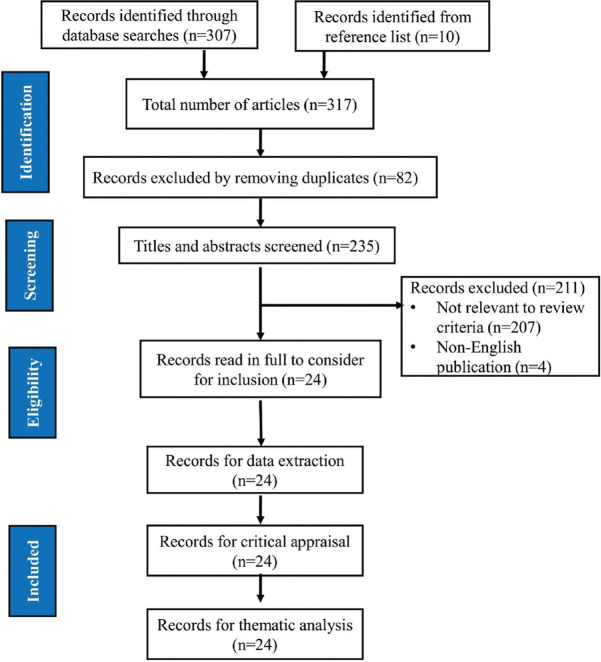
Vasectomy was introduced under the National Family Planning Programme in 1954 to enhance male participation in family planning in India. Despite adopting the non-scalpel technique in 1992 to popularise vasectomy, its acceptance among married couples has declined from 3.31% to 0.3% over the past 3 decades. This study aims to identify the barriers among the married male population in India for adopting vasectomy as a method of family planning. This systematic review was conducted following PRISMA guidelines after PROSPERO registration (CRD42023434518). Six electronic databases (MEDLINE, Embase, Global Health, Allied and Complementary Medicine, APA PsycInfo, and CAB Abstracts Archive) were searched using terms including "vasectomy", "barriers", and "India" for studies reporting the barriers to accepting vasectomy as a family planning method. Qualitative, quantitative, and mixed-method studies on Indian male populations, reported in English and published up to May 2023, were included. Quality assessments were conducted using the JBI Critical Appraisal Tools. Extracted data were analysed using a thematic synthesis. Twenty-four studies conducted across India were included in the systematic review (18 cross-sectional, 2 interview-based, 2 mixed-method, 1 case-control and 1 focus group discussion-based). Five themes of barriers were identified: fear, social issues, cultural issues, knowledge, and health system issues. Men feared undergoing a surgical procedure for sterilisation. They presumed the procedure would lead to loss of libido, physical weakness leading to income loss, and social stigma from community members. Health education and financial incentives are likely to increase vasectomy acceptance in India.
1954年,输精管切除术在国家计划生育计划下被引入,以提高印度男性在计划生育中的参与度。尽管在1992年采用了非手术刀技术来推广输精管切除术,但在过去30年里,已婚夫妇对它的接受率已从3.31%降至0.3%。本研究旨在确定印度已婚男性人群中采用输精管切除术作为计划生育方法的障碍。在PROSPERO注册(CRD42023434518)后,按照PRISMA指南进行了这项系统评价。使用包括“输精管切除术”“障碍”和“印度”等术语,在六个电子数据库(MEDLINE、Embase、全球健康、补充与替代医学、美国心理学会心理学文摘数据库和CAB文摘数据库)中搜索报告接受输精管切除术作为计划生育方法的障碍的研究。纳入了2023年5月之前以英文发表的关于印度男性人群的定性、定量和混合方法研究。使用JBI批判性评价工具进行质量评估。提取的数据采用主题综合法进行分析。系统评价纳入了在印度各地进行的24项研究(18项横断面研究、2项基于访谈的研究、2项混合方法研究、1项病例对照研究和1项基于焦点小组讨论的研究)。确定了五个障碍主题:恐惧、社会问题、文化问题、知识和卫生系统问题。男性害怕接受绝育手术。他们认为该手术会导致性欲丧失、身体虚弱导致收入损失以及受到社区成员给予的社会耻辱。健康教育和经济激励措施可能会提高印度对输精管切除术的接受度。