Maloy Gwyneth C, Doshi Rushabh H, Day Wesley, Dhodapkar Meera M, Halperin Scott J, Jayaram Rahul H, Jain Bhav, Grauer Jonathan N, Varthi Arya G
Department of Orthopaedics and Rehabilitation, Yale School of Medicine, 333 Cedar St, New Haven, CT 06510, United States.
Department of Orthopaedic surgery, Albert Einstein College of Medicine, 1300 Morris Park Ave, Bronx, NY 10461, United States.
N Am Spine Soc J. 2025 May 14;22:100617. doi: 10.1016/j.xnsj.2025.100617. eCollection 2025 Jun.
Sickle cell disease (SCD) is the most common genetic disorder in the United States, affecting approximately 300,000 infants worldwide annually. As advancements in treatment have led to increased life expectancy for individuals with SCD, this population may be considered for anterior cervical discectomy and fusion (ACDF) due to potentially accelerated degenerative disc disease. The current study sought to characterize 90-day postoperative outcomes among SCD patients undergoing ACDF using matched cohorts.
Adult patients undergoing single-level ACDF were identified from the 2010 to 2021 Q1 M151 PearlDiver database. Those with SCD were matched 1:4 to controls based on age, sex, and Elixhauser Comorbidity Index (ECI). The occurrence of 90-day postoperative adverse events, readmissions, and emergency department (ED) visits were assessed. Patient characteristics and postoperative outcomes were compared using Student's t-tests and chi-square tests. Multivariable logistic regression was performed to compare outcomes between the matched cohorts. p < 0.05 was considered statistically significant.
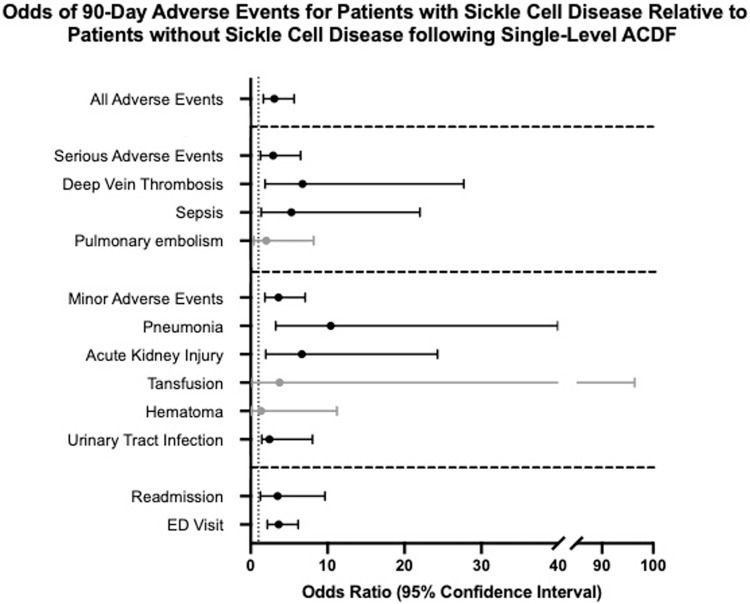
After matching, 82 SCD patients and 324 controls were identified. Patients with SCD had significantly higher odds of adverse events including: any 90-day adverse events (OR 3.06), serious adverse events (OR 2.91), minor adverse events (OR 3.62), readmissions (OR 3.50), and ED visits (OR 3.64) (p < 0.05 for all). In terms of individual adverse events, in decreasing OR order patients with SCD had higher odds of: pneumonia (OR 10.41), acute kidney injury (OR 6.65), deep vein thrombosis (OR 6.73), sepsis (OR 5.30), urinary tract infections (OR 3.43) (p < 0.05 for all).
SCD patients undergoing single-level ACDF were found to have significantly higher odds of multiple postoperative complications compared to matched controls. These findings suggest that SCD patients may require more intensive perioperative care and monitoring to minimize such adverse outcomes. Further research is needed to optimize management strategies for this high-risk population.
镰状细胞病(SCD)是美国最常见的遗传性疾病,全球每年约有30万名婴儿受其影响。随着治疗的进步,SCD患者的预期寿命有所延长,由于可能加速的椎间盘退变疾病,这一人群可能适合接受颈椎前路椎间盘切除融合术(ACDF)。本研究旨在通过匹配队列来描述接受ACDF的SCD患者术后90天的结局。
从2010年至2021年第一季度的M151 PearlDiver数据库中识别接受单节段ACDF的成年患者。根据年龄、性别和埃利克斯豪泽合并症指数(ECI),将患有SCD的患者与对照组按1:4进行匹配。评估术后90天不良事件、再入院和急诊科就诊情况。使用学生t检验和卡方检验比较患者特征和术后结局。进行多变量逻辑回归以比较匹配队列之间的结局。p < 0.05被认为具有统计学意义。
匹配后,确定了82例SCD患者和324例对照。SCD患者发生不良事件的几率显著更高,包括:任何90天不良事件(比值比[OR] 3.06)、严重不良事件(OR 2.91)、轻微不良事件(OR 3.62)、再入院(OR 3.50)和急诊科就诊(OR 3.64)(所有p < 0.05)。就个体不良事件而言,按OR值降序排列,SCD患者发生以下事件的几率更高:肺炎(OR 10.41)、急性肾损伤(OR 6.65)、深静脉血栓形成(OR 6.73)、脓毒症(OR 5.30)、尿路感染(OR 3.4)(所有p < 0.05)。
与匹配的对照组相比,接受单节段ACDF的SCD患者术后发生多种并发症的几率显著更高。这些发现表明,SCD患者可能需要更强化的围手术期护理和监测,以尽量减少此类不良结局。需要进一步研究以优化针对这一高危人群的管理策略。