van Gennip Lucky L A, Bulthuis Marjolein S, Hannink Gerjon, Bronkhorst Ewald M, van Leeuwen Stephanie J M, Blijlevens Nicole M A, Huysmans Marie-Charlotte D N J M, Thomas Renske Z
Department of Dentistry, Radboud University Medical Center, Nijmegen, The Netherlands.
Department of Medical Imaging, Radboud University Medical Center, Nijmegen, The Netherlands.
Support Care Cancer. 2025 Jun 23;33(7):612. doi: 10.1007/s00520-025-09654-9.
To evaluate periodontal health after allogeneic haematopoietic cell transplantation (HCT), and its association with conditioning regimen intensity.
This single-centre retrospective cohort study included 82 allogeneic HCT recipients between 01/08/2017 and 31/03/2022. Probing pocket depth (PPD), bleeding on probing (BOP), periodontal epithelial surface area (PESA) and periodontal inflamed surface area (PISA) were assessed pre- and post-HCT. Change scores were calculated, and regression models were applied to analyse associations with conditioning intensity. Conditioning regimens were categorised based on intensity as non-myeloablative (NMA), reduced intensity (RIC) or myeloablative (MA).
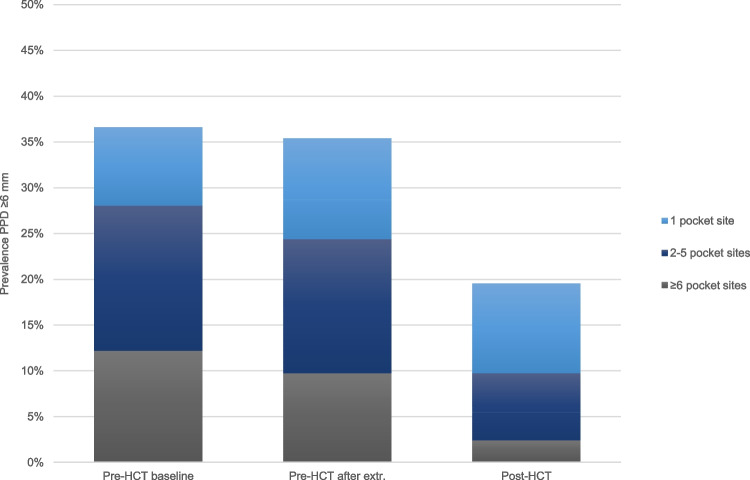
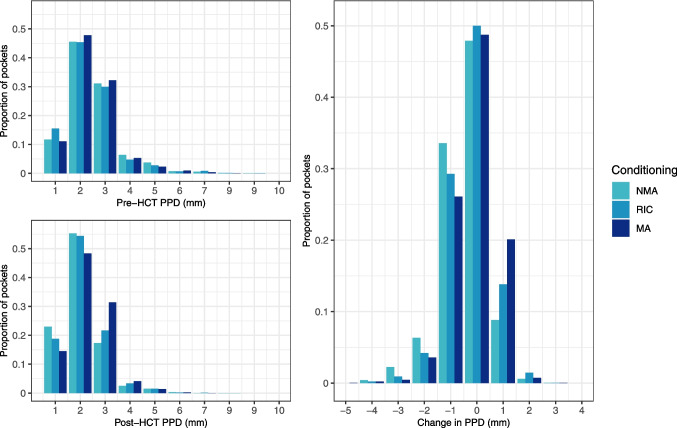
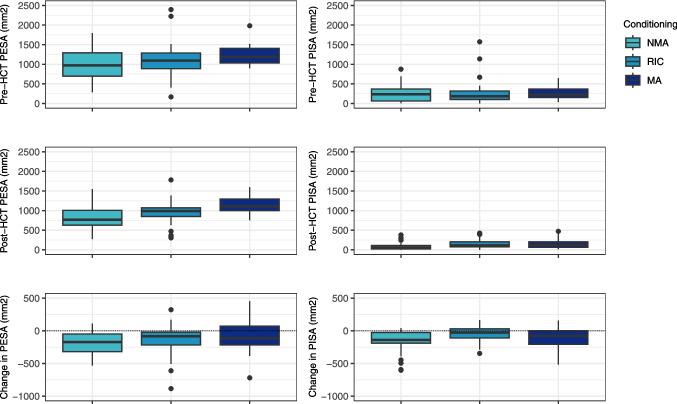
HCT recipients had a median age of 59 years (IQR 48-66); 63% were male. Median time to HCT was 53 days (IQR 29-89), median follow-up was 279 days (IQR 183-349). Severe periodontitis (≥ 1 site with PPD ≥ 6 mm) was observed in 37% of patients pre-HCT and 20% of patients post-HCT. PPD, BOP, PESA and PISA decreased from pre- to post-HCT, by 0.26 mm [95%CI 0.16;0.37], 8% [95%CI 5;12], 140 mm [95%CI 89;190] and 123 mm [95%CI 83;185], respectively. Prevalence of severe periodontitis decreased from pre- to post-HCT in all groups: NMA 50% to 27%, RIC 32% to 19%, MA 31% to 13%. Conditioning intensity was statistically significantly associated with post-HCT PPD and PESA; however, differences were small. No statistically significant differences were observed in post-HCT PISA between conditioning regimens.
Periodontal health improved marginally in the short-term following HCT and supportive oral care. Differences in post-HCT periodontal health between patients conditioned with NMA, RIC, and MA were not clinically relevant.
评估异基因造血细胞移植(HCT)后的牙周健康状况及其与预处理方案强度的关联。
这项单中心回顾性队列研究纳入了2017年8月1日至2022年3月31日期间的82例异基因HCT受者。在HCT前后评估探诊深度(PPD)、探诊出血(BOP)、牙周上皮表面积(PESA)和牙周炎症表面积(PISA)。计算变化分数,并应用回归模型分析与预处理强度的关联。预处理方案根据强度分为非清髓性(NMA)、减低强度(RIC)或清髓性(MA)。
HCT受者的中位年龄为59岁(四分位间距48 - 66岁);63%为男性。HCT的中位时间为53天(四分位间距29 - 89天),中位随访时间为279天(四分位间距183 - 349天)。37%的患者在HCT前患有重度牙周炎(≥1个部位PPD≥6 mm),20%的患者在HCT后患有重度牙周炎。从HCT前到HCT后,PPD、BOP、PESA和PISA分别下降了0.26 mm [95%置信区间0.16;0.37]、8% [95%置信区间5;12]、140 mm [95%置信区间89;190]和123 mm [95%置信区间83;185]。所有组中重度牙周炎的患病率从HCT前到HCT后均有所下降:NMA组从50%降至27%,RIC组从32%降至19%,MA组从31%降至13%。预处理强度与HCT后的PPD和PESA在统计学上有显著关联;然而,差异较小。在不同预处理方案之间,HCT后的PISA未观察到统计学上的显著差异。
HCT及支持性口腔护理后的短期内,牙周健康略有改善。接受NMA、RIC和MA预处理的患者在HCT后牙周健康的差异无临床意义。