
治疗与眼睑健康专家小组(DEPTH)关于睑缘炎首选治疗方法的共识
The Expert Panel on Treatment and Eyelid Health (DEPTH) Consensus Regarding the Preferred Treatment for Blepharitis.
作者信息
Donnenfeld Eric, Nichols Kelly K, Ayres Brandon D, Farid Marjan, Gupta Preeya K, Lindstrom Richard Lyndon, Pflugfelder Stephen, Starr Christopher E, Venkateswaran Nandini, Gaddie Ian Benjamin, Karpecki Paul M, Koetting Cecelia, McGee Selina, Periman Laura M, Yeu Elizabeth
机构信息
Ophthalmic Consultants of Long Island, Long Island, NY, USA.
School of Optometry, University of Alabama at Birmingham, Birmingham, AL, USA.
出版信息
Clin Ophthalmol. 2025 Jun 18;19:1893-1904. doi: 10.2147/OPTH.S525681. eCollection 2025.
PURPOSE
To reach consensus on blepharitis (DB) treatment approaches using a modified Delphi process involving 15 ocular surface disease experts.
METHODS
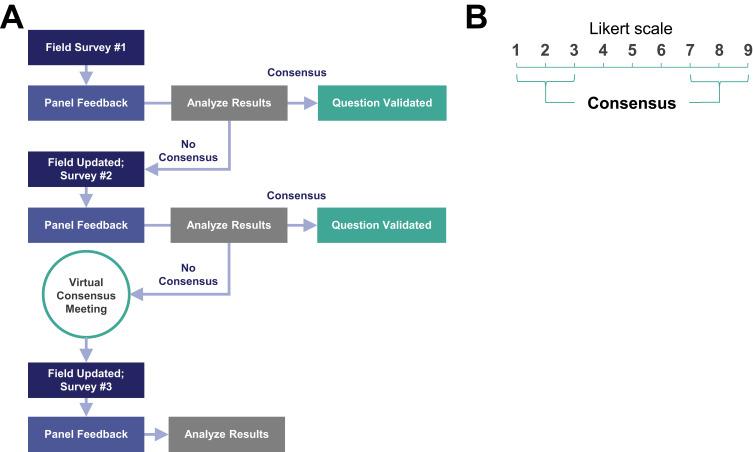
The Expert Panel on Treatment and Eyelid Health (DEPTH) consisted of 15 well-published ocular surface disease experts. Panelists completed two online surveys, a live consensus meeting, and a follow-up survey. The surveys consisted of scaled and multiple-choice questions related to the clinical and patient-reported outcomes of DB and its treatment. For the scaled questions using a 1 to 9 Likert scale, consensus was defined as weighted mean scores of 1-3 and 7-9, whereas for multiple-choice questions, consensus was achieved when a minimum of 10 of 15 panelists agreed.
RESULTS
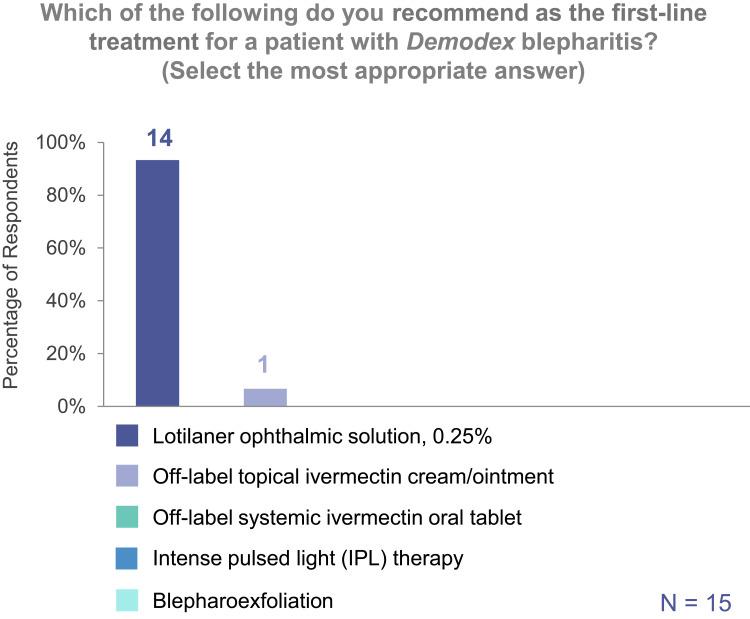
The DEPTH panel reached consensus that lotilaner ophthalmic solution, 0.25% should be the first-line treatment for DB. Experts agreed no additional clinical findings are needed to prompt treatment with lotilaner ophthalmic solution, 0.25% for patients with >10 collarettes (12/15), while one additional clinical finding is needed for patients with 0-2 (11/15) or 3-10 collarettes (10/15). In the absence of allergies, panelists would consider first-line treatment for DB in a patient with eyelid itching but without collarettes (weighted mean: 7.47; range: 2-9). Panelists agreed that blepharoexfoliation (weighted mean: 8.27; range: 3-9) or intense pulsed light (IPL) therapy (weighted mean: 8.4; range: 6-9) could supplement first-line treatment with lotilaner ophthalmic solution, 0.25%. The DEPTH panelists agreed that topical (10/15) and systemic ivermectin (14/15) are not their preferred treatment for DB. Experts did not reach consensus about the use of tea tree oil to treat DB.
CONCLUSION
Experts achieved consensus on the use of lotilaner ophthalmic solution, 0.25% as the first-line treatment for patients with DB. Panelists also agreed that blepharoexfoliation or IPL therapy could serve supplementally to lotilaner ophthalmic solution, 0.25%, if needed.
目的
通过涉及15位眼表疾病专家的改良德尔菲法,就睑缘炎(DB)的治疗方法达成共识。
方法
治疗与眼睑健康专家小组(DEPTH)由15位发表过大量论文的眼表疾病专家组成。小组成员完成了两项在线调查、一次现场共识会议和一次后续调查。调查包括与DB及其治疗的临床和患者报告结局相关的量表和多项选择题。对于使用1至9李克特量表的量表问题,共识定义为加权平均分为1 - 3分和7 - 9分,而对于多项选择题,当15位小组成员中至少有10位达成一致时即达成共识。
结果
DEPTH小组达成共识,0.25%的洛替拉纳眼科溶液应作为DB的一线治疗药物。专家们一致认为,对于有超过10个睑缘皱襞的患者(12/15),使用0.25%的洛替拉纳眼科溶液进行治疗无需额外的临床发现,而对于有0 - 2个(11/15)或3 - 10个睑缘皱襞的患者(10/15),则需要一项额外的临床发现。在无过敏的情况下,小组成员会考虑对有眼睑瘙痒但无睑缘皱襞的患者将DB的一线治疗药物选为0.25%的洛替拉纳眼科溶液(加权平均分:7.47;范围:2 - 9)。小组成员一致认为睑缘剥脱术(加权平均分:8.27;范围:3 - 9)或强脉冲光(IPL)治疗(加权平均分:8.4;范围:6 - 9)可作为0.25%的洛替拉纳眼科溶液一线治疗的补充。DEPTH小组成员一致认为局部使用(10/15)和全身使用伊维菌素(14/15)并非他们首选的DB治疗方法。专家们对于使用茶树油治疗DB未达成共识。
结论
专家们就使用0.25%的洛替拉纳眼科溶液作为DB患者的一线治疗药物达成了共识。小组成员还一致认为,如果需要,睑缘剥脱术或IPL治疗可作为0.25%的洛替拉纳眼科溶液的补充治疗。

 Zotero 插件