Gross Rachel S, Thaweethai Tanayott, Salisbury Amy L, Kleinman Lawrence C, Mohandas Sindhu, Rhee Kyung E, Snowden Jessica N, Tantisira Kelan G, Warburton David, Wood John C, Kinser Patricia A, Milner Joshua D, Rosenzweig Erika B, Irby Katherine, Flaherman Valerie J, Karlson Elizabeth W, Chibnik Lori B, Pant Deepti B, Krishnamoorthy Aparna, Gallagher Richard, Lamendola-Essel Michelle F, Hasson Denise C, Katz Stuart D, Yin Shonna, Dreyer Benard P, Blancero Frank, Carmilani Megan, Coombs K, Fitzgerald Megan L, Letts Rebecca J, Peddie Aimee K, Foulkes Andrea S, Stockwell Melissa S, Aschner Judy L, Atz Andrew M, Banerjee Dithi, Bogie Amanda, Bukulmez Hulya, Clouser Katharine, Cottrell Lesley A, Cowan Kelly, D'Sa Viren A, Dozor Allen, Elliott Amy J, Faustino E Vincent S, Fiks Alexander G, Gaur Sunanda, Gennaro Maria L, Gordon Stewart, Hasan Uzma N, Hester Christina M, Hogan Alexander, Hsia Daniel S, Kaelber David C, Kosut Jessica S, Krishnan Sankaran, McCulloh Russell J, Michelow Ian C, Nolan Sheila M, Oliveira Carlos R, Olson Lynn M, Pace Wilson D, Palumbo Paul, Raissy Hengameh, Reyes Andy, Ross Judith L, Salazar Juan C, Selvarangan Rangaraj, Stein Cheryl R, Stevenson Michelle D, Teufel Ronald J, Werzberger Alan, Westfall John M, Zani Kathleen, Zempsky William T, Zimmerman Emily, Bind Marie-Abele C, Chan James, Guan Zoe, Morse Richard E, Reeder Harrison T, Metz Torri D, Newburger Jane W, Truong Dongngan T
Department of Pediatrics, Division of General Pediatrics, NYU Grossman School of Medicine, New York, New York.
Massachusetts General Hospital Biostatistics, Boston.
JAMA Pediatr. 2025 May 27. doi: 10.1001/jamapediatrics.2025.1066.
Recent studies have identified characteristic symptom patterns of long COVID (LC) in adults and children older than 5 years. However, LC remains poorly characterized in early childhood. This knowledge gap limits efforts to identify, care for, and prevent LC in this vulnerable population.
To identify symptoms that had the greatest difference in frequency comparing children with a history of SARS-CoV-2 infection to those without, to identify differences in the types of symptoms by age group (infants/toddlers [0-2 years] vs preschool-aged children [3-5 years]), and to derive an index that can be used in research studies to identify young children with LC.
DESIGN, SETTING, AND PARTICIPANTS: This was a multisite longitudinal cohort study with enrollment from over 30 US health care and community settings, including infants, toddlers, and preschool-aged children with and without SARS-CoV-2 infection history. Study data were analyzed from May to December 2024.
SARS-CoV-2 infection.
LC and 41 symptoms among infants/toddlers and 75 symptoms among preschool-aged children.
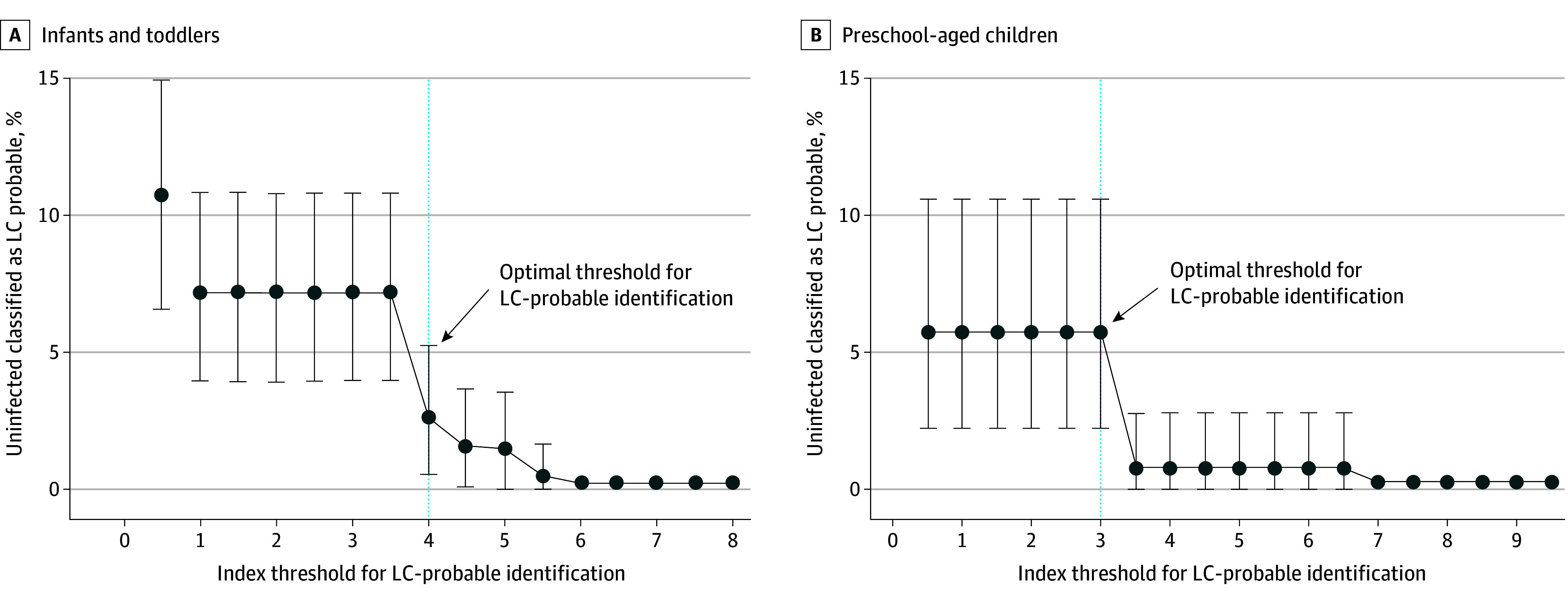
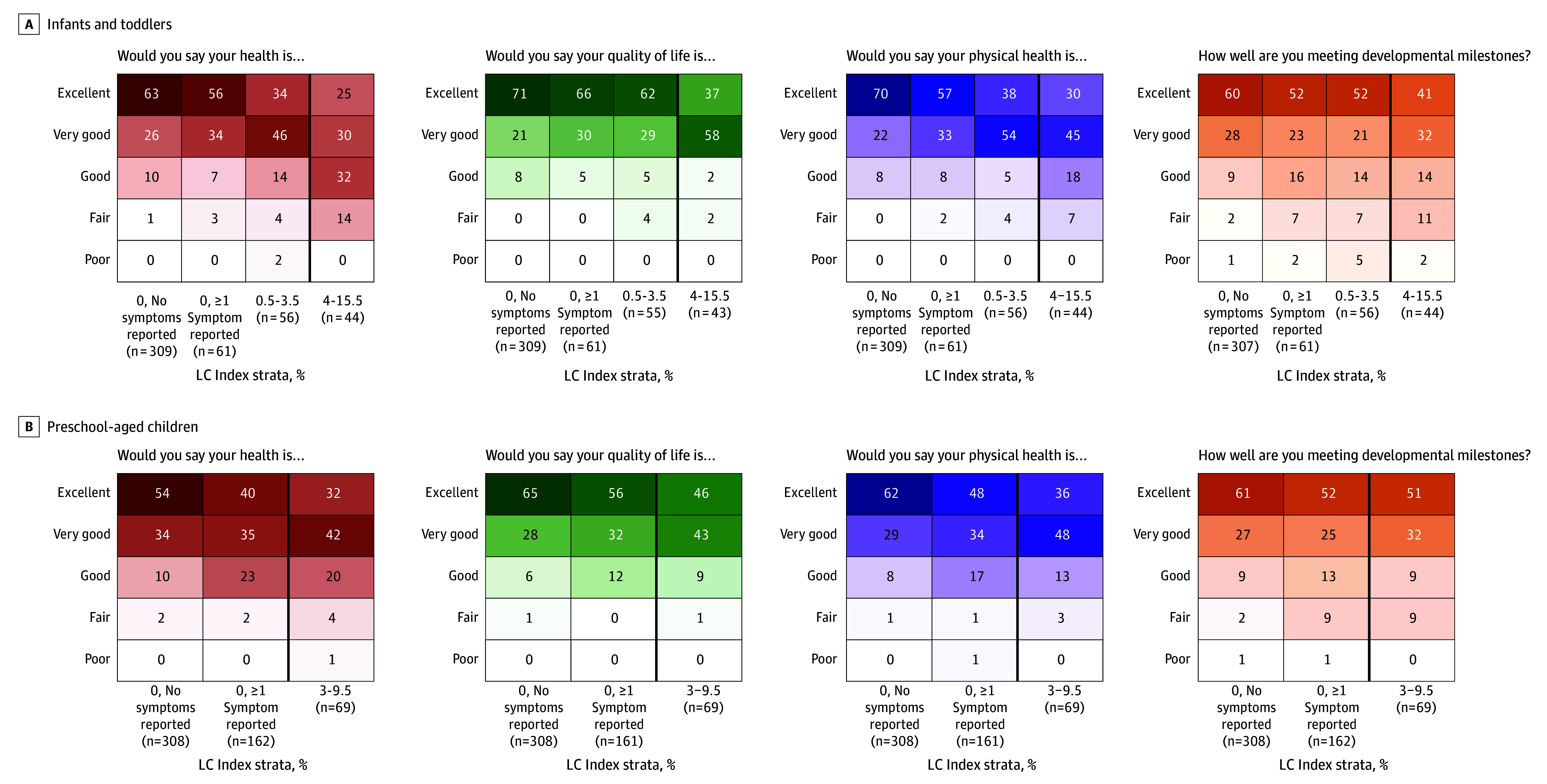
The study included 472 infants/toddlers (mean [SD] age, 12 [9] months; 278 infected with SARS-CoV-2; 194 uninfected; 234 male [50%]; 73 Black or African American [16%]; 198 Hispanic, Latino, or Spanish [43%]; 242 White [52%]) and 539 preschool-aged children (mean [SD] age, 48 [10] months; 399 infected with SARS-CoV-2; 140 uninfected; 277 female [51%]; 70 Black or African American [13%]; 210 Hispanic, Latino, or Spanish [39%]; 287 White [54%]). The median (IQR) time between first infections and completion of symptom surveys was 318 (198-494) days for infants/toddlers and 520 (330-844) days for preschool-aged children. A research index was derived for each age group based on symptoms most associated with infection history. The index is calculated by summing scores assigned to each prolonged symptom that was present, where higher scores indicate greater magnitude of association with history of SARS-CoV-2 infection: poor appetite (5 points), trouble sleeping (3.5 points), wet cough (3.5 points), dry cough (3 points), and stuffy nose (0.5 points) for infants/toddlers, and daytime tiredness/sleepiness/low energy (6.5 points) and dry cough (3 points) for preschool-aged children. Among infants/toddlers with infection, 40 of 278 (14%) were classified as having probable LC by having an index of at least 4 points. Among preschool-aged children, 61 of 399 (15%) were classified as having probable LC by having an index of at least 3 points. Participants with higher indices often had poorer overall health, lower quality of life, and perceived delays in developmental milestones.
This cohort study identified symptom patterns and derived research indices that were distinct between the 2 age groups and differed from those previously identified in older ages, demonstrating the need to characterize LC separately across age ranges.
最近的研究已经确定了成人和5岁以上儿童长期新冠(LC)的特征性症状模式。然而,幼儿期的LC特征仍不明确。这一知识空白限制了在这一脆弱人群中识别、护理和预防LC的努力。
确定有SARS-CoV-2感染史的儿童与无感染史儿童在症状出现频率上差异最大的症状,确定不同年龄组(婴儿/幼儿[0 - 2岁]与学龄前儿童[3 - 5岁])症状类型的差异,并得出一个可用于研究以识别患有LC的幼儿的指标。
设计、背景和参与者:这是一项多地点纵向队列研究,招募来自美国30多个医疗保健和社区机构,包括有和无SARS-CoV-2感染史的婴儿、幼儿和学龄前儿童。研究数据于2024年5月至12月进行分析。
SARS-CoV-2感染。
婴儿/幼儿中的LC和41种症状,以及学龄前儿童中的75种症状。
该研究纳入了472名婴儿/幼儿(平均[标准差]年龄,12[9]个月;278名感染SARS-CoV-2;194名未感染;234名男性[50%];73名黑人或非裔美国人[16%];198名西班牙裔、拉丁裔或西班牙人[43%];242名白人[52%])和539名学龄前儿童(平均[标准差]年龄,48[10]个月;399名感染SARS-CoV-2;140名未感染;277名女性[51%];70名黑人或非裔美国人[13%];210名西班牙裔、拉丁裔或西班牙人[39%];287名白人[54%])。婴儿/幼儿首次感染与症状调查完成之间的中位(四分位间距)时间为318(198 - 494)天,学龄前儿童为520(330 - 844)天。根据与感染史最相关的症状为每个年龄组得出一个研究指标。该指标通过对每个存在的持续症状的得分求和来计算,得分越高表明与SARS-CoV-2感染史的关联程度越大:婴儿/幼儿中食欲不佳(5分)、睡眠困难(3.5分)、湿性咳嗽(3.5分)干咳嗽(3分)和鼻塞(0.5分),学龄前儿童中白天疲倦/嗜睡/精力不足(6.5分)和干咳(3分)。在有感染的婴儿/幼儿中,278名中有40名(14%)因指标至少为4分被归类为可能患有LC。在学龄前儿童中,399名中有61名(15%)因指标至少为3分被归类为可能患有LC。指标较高的参与者总体健康状况往往较差,生活质量较低,且发育里程碑有明显延迟。
这项队列研究确定了两个年龄组之间不同的症状模式并得出了研究指标,且与之前在较大年龄组中确定的不同,表明需要按年龄范围分别描述LC的特征。