You Chongzhao, Guo Shimeng, Zhang Tianwei, He Xinheng, Gao Tianyu, Xin Wenwen, Zhu Zining, Lu Yujie, Xu Youwei, Li Zhen, Zhang Yumu, Cheng Xi, Jiang Yi, Xie Xin, Xu H Eric
The State Key Laboratory of Drug Research, Shanghai Institute of Materia Medica, Chinese Academy of Sciences, Shanghai, China.
University of Chinese Academy of Sciences, Beijing, China.
Cell Discov. 2025 Jun 25;11(1):59. doi: 10.1038/s41421-025-00807-y.
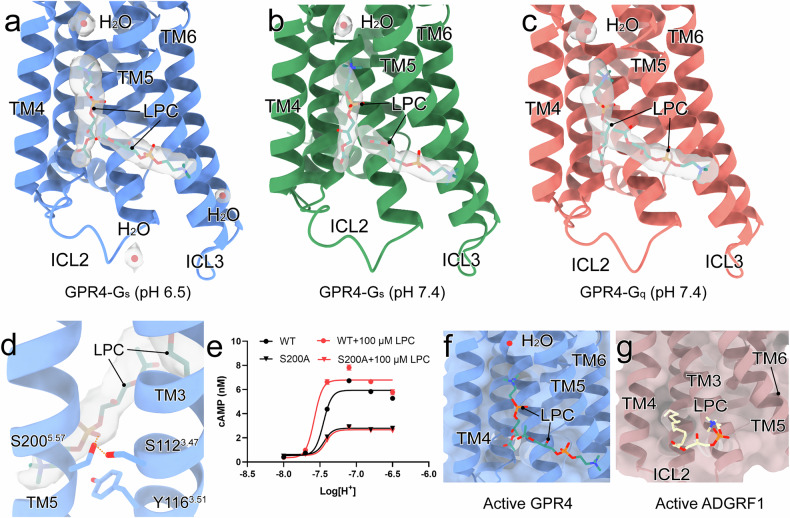
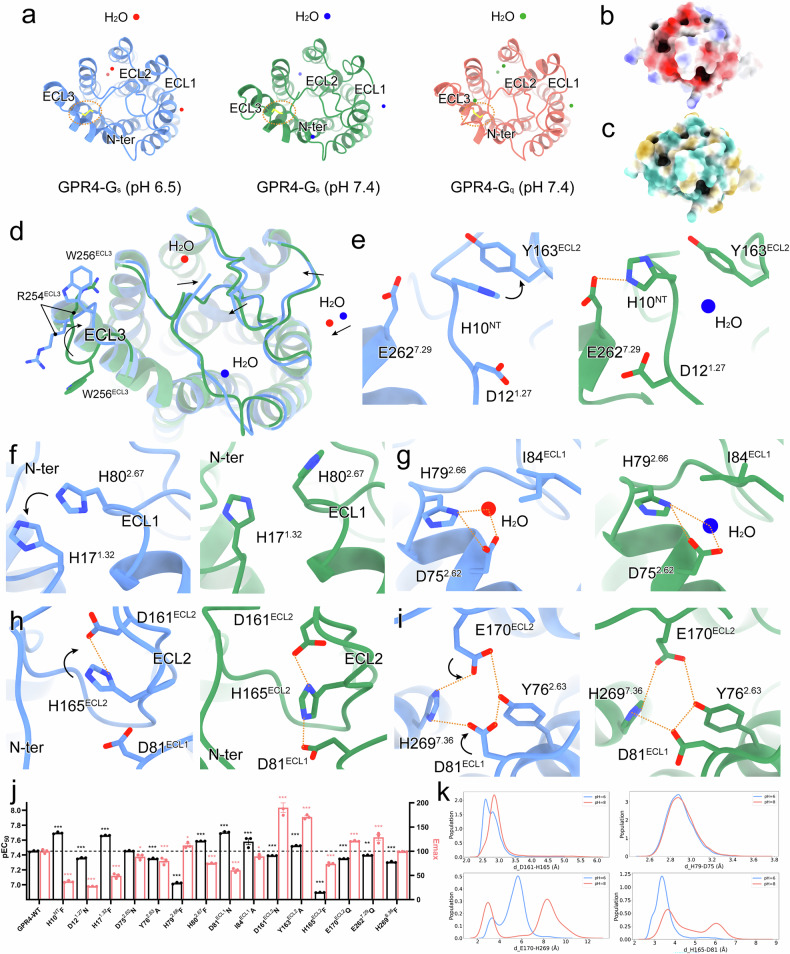
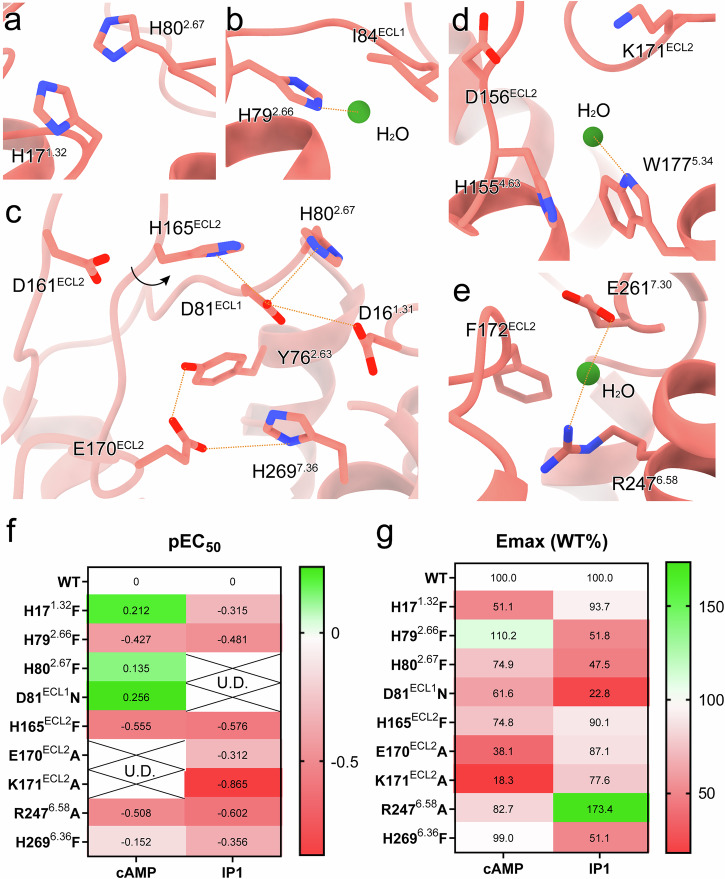
Maintaining pH homeostasis is critical for cellular function across all living organisms. Proton-sensing G protein-coupled receptors (GPCRs), particularly GPR4, play a pivotal role in cellular responses to pH changes. Yet, the molecular mechanisms underlying their proton sensing and activation remain incompletely understood. Here we present high-resolution cryo-electron microscopy structures of GPR4 in complex with G proteins under physiological and acidic pH conditions. Our structures reveal an intricate proton-sensing mechanism driven by a sophisticated histidine network in the receptor's extracellular domain. Upon protonation of key histidines under acidic conditions, a remarkable conformational cascade is initiated, propagating from the extracellular region to the intracellular G protein-coupling interface. This dynamic process involves precise transmembrane helix rearrangements and conformational shifts of conserved motifs, mediated by strategically positioned water molecules. Notably, we discovered a bound bioactive lipid, lysophosphatidylcholine, which has positive allosteric effects on GPR4 activation. These findings provide a comprehensive framework for understanding proton sensing in GPCRs and the interplay between pH sensing and lipid regulation, offering insights into cellular pH homeostasis and potential therapies for pH-related disorders.
维持pH稳态对于所有生物的细胞功能至关重要。质子感应G蛋白偶联受体(GPCR),特别是GPR4,在细胞对pH变化的反应中起关键作用。然而,其质子感应和激活的分子机制仍未完全了解。在这里,我们展示了在生理和酸性pH条件下GPR4与G蛋白复合物的高分辨率冷冻电子显微镜结构。我们的结构揭示了一种由受体细胞外结构域中复杂的组氨酸网络驱动的复杂质子感应机制。在酸性条件下关键组氨酸质子化后,会引发显著的构象级联反应,从细胞外区域传播到细胞内G蛋白偶联界面。这个动态过程涉及精确的跨膜螺旋重排和保守基序的构象变化,由精心定位的水分子介导。值得注意的是,我们发现了一种结合的生物活性脂质,溶血磷脂酰胆碱,它对GPR4激活具有正变构效应。这些发现为理解GPCR中的质子感应以及pH感应与脂质调节之间的相互作用提供了一个全面的框架,为细胞pH稳态和pH相关疾病的潜在治疗提供了见解。