Ju Keke, Liu Na, Wu Ruikai, Shi Xiujiang
Shaanxi Provincial People's Hospital, Xi'an, China.
Department of Gastroenterology, First Affiliated Hospital of Xinjiang Medical University, Urumqi, China.
Front Neurol. 2025 Jun 10;16:1488443. doi: 10.3389/fneur.2025.1488443. eCollection 2025.
Sedentary behavior is closely related to sleep disorders, and long-term lack of physical activity may disrupt circadian rhythms and increase the risk of sleep disorders; Excessive or insufficient sleep time may exacerbate health risks, therefore, analyzing the correlation between sedentary behavior, sleep duration, and sleep disorders.
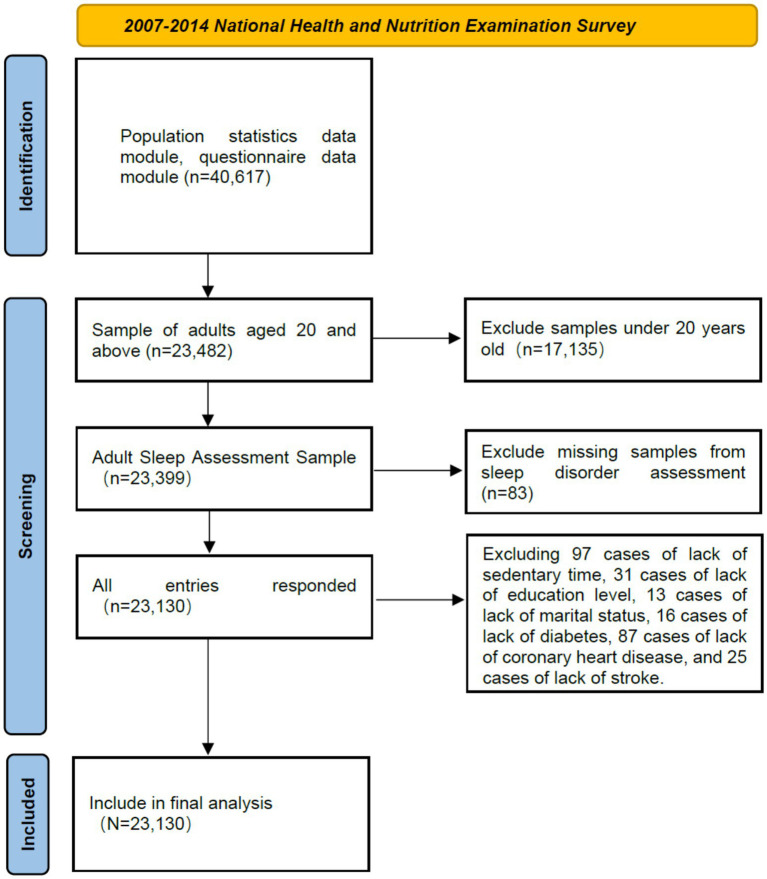
Using the NHANES research project, multiple logistic regression analysis was conducted to investigate the relationship between sedentary behavior, sleep duration, and sleep disorders in adults. Restrictive cubic spline curves were used to further explore the dose-response relationship between sedentary behavior, sleep duration, and sleep disorders.
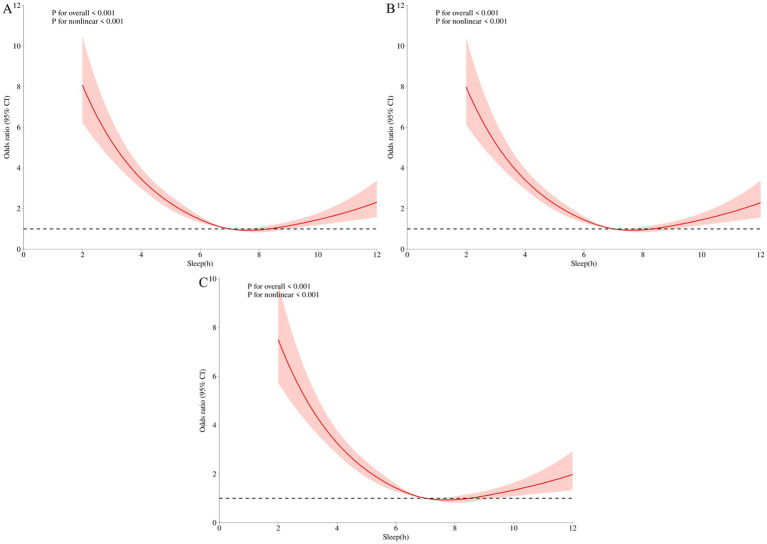
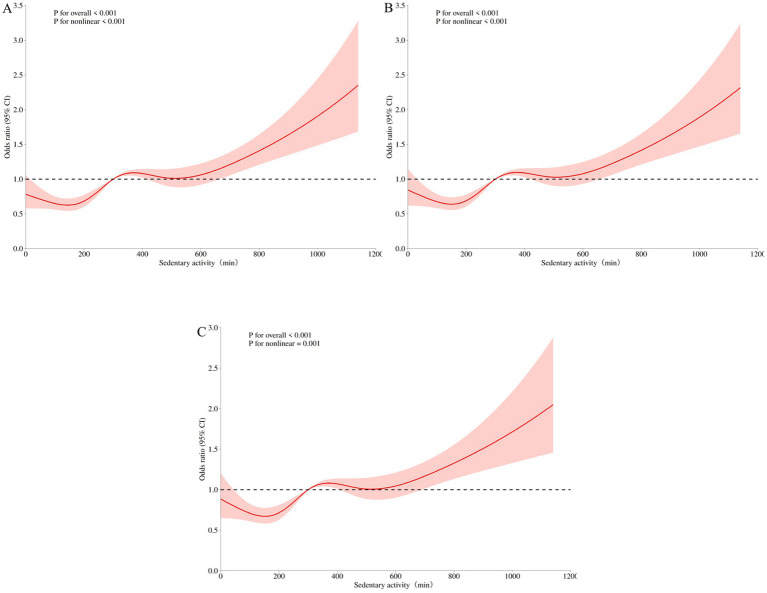
In the entire study population, compared to the lowest quartile of Sedentary activity duration, the third quartile [OR = 1.441 (95% CI: 1.226-1.693), < 0.05] and fourth quartile [OR = 1.480 (95% CI: 1.267-1.729), < 0.05] had an increased risk of developing sleep disorders. Compared with adults who sleep for less than 6 h, those who sleep for 6 to less than 8 h [OR = 0.444 (95%CI: 0.395-0.499), < 0.05], ≥8 h [OR = 0.370 (95%CI: 0.325-0.422), < 0.05] the risk of developing sleep disorders decreases. Subgroup analysis found that sedentary behavior and sleep duration have a higher impact on sleep in men under 45 years old. There is a dose-response relationship between sedentary behavior, sleep duration, and the risk of sleep disorders. RCS analysis results show that prolonged sitting for more than 300 min significantly increases the risk of sleep disorders; when the sleep duration is less than 7 h or greater than 8 h, there is a significant increase in the risk of developing sleep disorders. Sensitivity analysis confirmed the robustness of the research results.
There is a significant non-linear relationship between sedentary time, sleep duration, and sleep disorders. It is recommended to limit sedentary time to 300 min per day and sleep duration to 7-8 h to reduce the risk of sleep disorders and improve sleep quality.
久坐行为与睡眠障碍密切相关,长期缺乏身体活动可能会扰乱昼夜节律并增加睡眠障碍的风险;睡眠时间过长或过短可能会加剧健康风险,因此,分析久坐行为、睡眠时间和睡眠障碍之间的相关性。
利用美国国家健康与营养检查调查(NHANES)研究项目,进行多元逻辑回归分析,以研究成年人久坐行为、睡眠时间和睡眠障碍之间的关系。使用限制性立方样条曲线进一步探索久坐行为、睡眠时间和睡眠障碍之间的剂量反应关系。
在整个研究人群中,与久坐活动时长的最低四分位数相比,第三四分位数[比值比(OR)=1.441(95%置信区间:1.226 - 1.693),P<0.05]和第四四分位数[OR = 1.480(95%置信区间:1.267 - 1.729),P<0.05]患睡眠障碍的风险增加。与睡眠时间少于6小时的成年人相比,睡眠时间为6至不足8小时的成年人[OR = 0.444(95%置信区间:0.395 - 0.499),P<0.05]、≥8小时的成年人[OR = 0.370(95%置信区间:0.325 - 0.422),P<0.05]患睡眠障碍的风险降低。亚组分析发现,久坐行为和睡眠时间对45岁以下男性的睡眠影响更大。久坐行为、睡眠时间与睡眠障碍风险之间存在剂量反应关系。限制性立方样条(RCS)分析结果显示,久坐超过300分钟会显著增加睡眠障碍的风险;当睡眠时间少于7小时或大于8小时时,患睡眠障碍的风险会显著增加。敏感性分析证实了研究结果的稳健性。
久坐时间、睡眠时间和睡眠障碍之间存在显著的非线性关系。建议将久坐时间限制在每天300分钟以内,睡眠时间限制在7 - 8小时,以降低睡眠障碍风险并提高睡眠质量。