Fiore Marco, Alfieri Aniello, Fiore Daniela, Iuliano Pasquale, Spatola Francesco Giuseppe, Limone Andrea, Pezone Ilaria, Leone Sebastiano
Department of Women, Child and General and Specialized Surgery, University of Campania "Luigi Vanvitelli", 80138 Naples, Italy.
Department of Elective Surgery, Postoperative Intensive Care Unit and Hyperbaric Oxygen Therapy, A.O.R.N. Antonio Cardarelli, V.le Antonio Cardarelli 9, 80131 Naples, Italy.
Antibiotics (Basel). 2025 Jun 18;14(6):617. doi: 10.3390/antibiotics14060617.
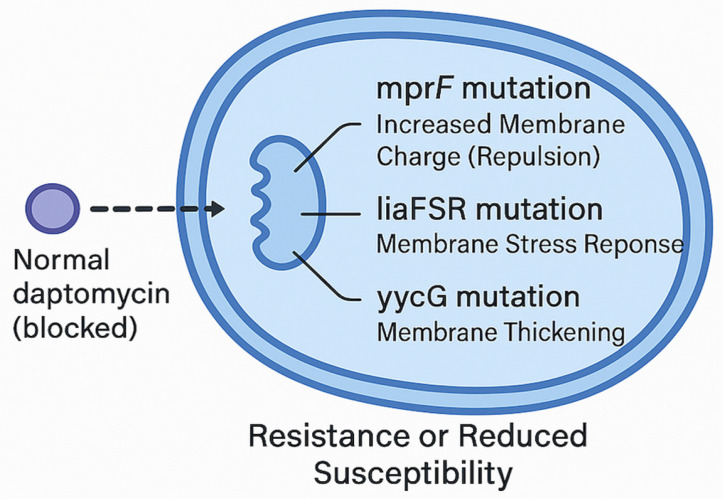
Methicillin-resistant (MRSA) represents a major therapeutic challenge due to its multidrug-resistance and the associated clinical burden. Daptomycin (DAP), a cyclic lipopeptide antibiotic, has become a key agent for the treatment of severe MRSA infections owing to its rapid bactericidal activity and favourable safety profile. In this narrative review, we examine studies published between 2010 and April 2025. The data suggest that treatment with high-dose (8-10 mg kg⁻) DAP shortened the time to blood-culture sterilisation by a median of 2 days compared with standard-dose vancomycin without increasing toxicity when model-informed area-under-the-curve monitoring was employed. Particular attention is given to the synergistic effects of DAP combined with fosfomycin or β-lactams, especially ceftaroline and ceftobiprole, in overcoming persistent and refractory MRSA infections; this approach results in a reduction in microbiological failure relative to monotherapy. Resistance remains uncommon (<2% of isolates), but recurrent mutations in , , and underscore the need for proactive genomic surveillance. Despite promising preclinical and clinical evidence supporting combination strategies, further randomized controlled trials are necessary to establish their definitive role in clinical practice, as are head-to-head cost-effectiveness evaluations. DAP remains a critical option in the evolving landscape of MRSA management, provided its use is integrated with precision dosing, resistance surveillance, and antimicrobial-stewardship frameworks.
耐甲氧西林金黄色葡萄球菌(MRSA)由于其多重耐药性及相关临床负担,构成了重大治疗挑战。达托霉素(DAP)是一种环状脂肽抗生素,因其快速杀菌活性和良好的安全性,已成为治疗严重MRSA感染的关键药物。在这篇叙述性综述中,我们考察了2010年至2025年4月期间发表的研究。数据表明,采用模型指导的曲线下面积监测时,与标准剂量万古霉素相比,高剂量(8 - 10 mg/kg)DAP治疗可使血培养转阴时间中位数缩短2天,且不增加毒性。特别关注了DAP与磷霉素或β-内酰胺类药物(尤其是头孢洛林和头孢比普)联合使用在克服持续性和难治性MRSA感染方面的协同作用;相对于单一疗法,这种方法可降低微生物学治疗失败率。耐药性仍然不常见(分离株<2%),但rpoB、gyrA和mecA中的反复突变凸显了进行前瞻性基因组监测的必要性。尽管有支持联合策略的临床前和临床证据,但仍需要进一步的随机对照试验来确定它们在临床实践中的明确作用,以及进行直接的成本效益评估。只要DAP的使用与精准给药、耐药性监测和抗菌药物管理框架相结合,它在不断演变的MRSA管理格局中仍是一个关键选择。