Okubo Masashi, Komukai Sho, Izawa Junichi, Chung SunHee, Dezfulian Cameron, Guyette Francis X, Lupton Joshua R, Martin-Gill Christian, Owusu-Ansah Sylvia, Ramgopal Sriram, Callaway Clifton W
Department of Emergency Medicine, University of Pittsburgh School of Medicine, Pittsburgh, Pennsylvania.
Division of Biomedical Statistics, Department of Integrated Medicine, Osaka University, Graduate School of Medicine, Osaka, Japan.
JAMA Netw Open. 2025 Jun 2;8(6):e2517291. doi: 10.1001/jamanetworkopen.2025.17291.
While epinephrine is commonly administered in children with out-of-hospital cardiac arrest (OHCA) via an intraosseous (IO) or intravenous (IV) route, the optimal route of epinephrine delivery is unclear.
To evaluate the association between the route of epinephrine administration (IO or IV) and patient outcomes after pediatric OHCA.
DESIGN, SETTING, AND PARTICIPANTS: Retrospective cohort study of pediatric patients (aged <18 years) with nontraumatic OHCA treated by emergency medical services who received prehospital epinephrine either via an IO or IV route. Patients were included in the Resuscitation Outcomes Consortium Epidemiologic Registry, a prospective OHCA registry at 10 sites in the US and Canada from April 2011 to June 2015. Data analysis was performed from May 2024 to April 2025.
Epinephrine administration route: IO or IV route.
The primary outcome was survival to hospital discharge. The secondary outcome was return of spontaneous circulation (ROSC) before hospital arrival. Propensity scores were calculated and inverse probability of treatment weighting (IPTW) was performed with stabilized weights to control imbalances in measured patient demographics, cardiac arrest characteristics, and bystander and prehospital interventions.
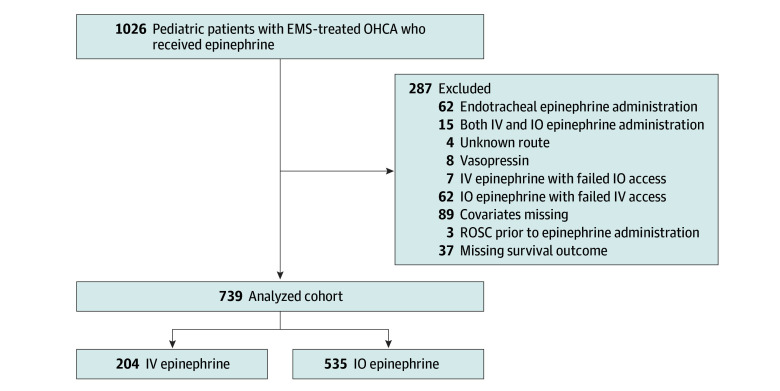
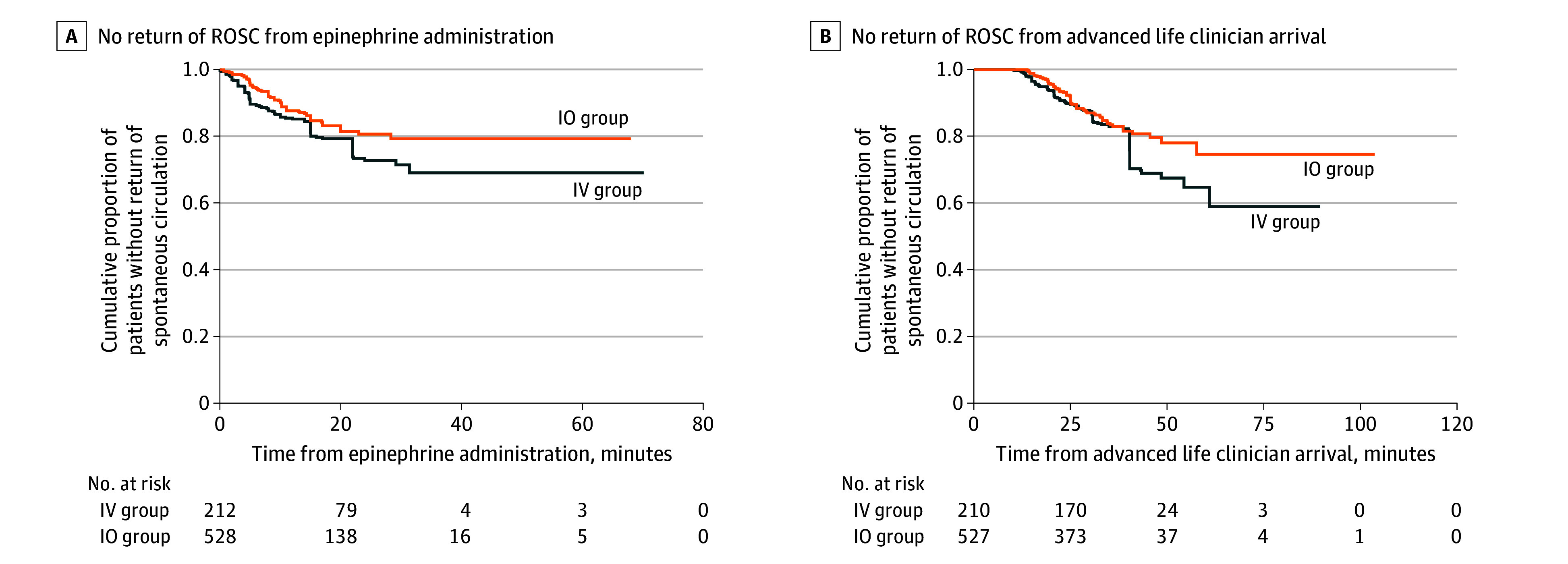
Of 739 eligible patients (median [IQR] age, 1 [0-11] years), 449 (60.8%) were male. Epinephrine was administered via an IO route for 535 (72.4%) and via an IV route for 204 (27.6%) patients. In the IPTW pseudopopulation (740 weighted cases), there was no significant difference in survival to hospital discharge (IO epinephrine: 28 of 528 patients [5.3%] vs IV epinephrine: 12 of 212 patients [5.7%]; risk ratio [RR], 0.92; 95% CI, 0.41-2.07) or prehospital ROSC (IO epinephrine: 76 of 528 patients [14.4%] vs IV epinephrine: 46 of 212 patients [21.7%]; RR, 0.66; 95% CI, 0.42-1.03) between the IO and IV epinephrine groups.
In this retrospective cohort study of pediatric patients with OHCA in the US and Canada, the route of epinephrine administration was not associated with survival to hospital discharge or prehospital ROSC. This may support the practice of administering epinephrine via IO or IV route.
虽然肾上腺素通常通过骨内(IO)或静脉内(IV)途径用于院外心脏骤停(OHCA)的儿童,但肾上腺素给药的最佳途径尚不清楚。
评估肾上腺素给药途径(IO或IV)与儿科OHCA后患者结局之间的关联。
设计、设置和参与者:对接受院前肾上腺素治疗的非创伤性OHCA儿科患者(年龄<18岁)进行回顾性队列研究,这些患者通过IO或IV途径接受肾上腺素治疗。患者被纳入复苏结果联盟流行病学登记处,这是一项在美国和加拿大10个地点进行的前瞻性OHCA登记处,时间为2011年4月至2015年6月。数据分析于2024年5月至2025年4月进行。
肾上腺素给药途径:IO或IV途径。
主要结局是存活至出院。次要结局是入院前自主循环恢复(ROSC)。计算倾向得分,并使用稳定权重进行逆概率治疗加权(IPTW),以控制测量的患者人口统计学、心脏骤停特征以及旁观者和院前干预措施中的不平衡。
在739名符合条件的患者(中位[IQR]年龄,1[0 - 11]岁)中,449名(60.8%)为男性。535名(72.4%)患者通过IO途径给予肾上腺素,204名(27.6%)患者通过IV途径给予肾上腺素。在IPTW虚拟总体(740个加权病例)中,IO和IV肾上腺素组在存活至出院(IO肾上腺素:528名患者中的28名[5.3%] vs IV肾上腺素:212名患者中的12名[5.7%];风险比[RR],0.92;9