Section of Emergency Medicine, Department of Medicine, National Taiwan University Cancer Center, Taipei, Taiwan.
Department of Emergency Medicine, National Taiwan University Hospital, Taipei, Taiwan.
BMJ. 2024 Jul 23;386:e079878. doi: 10.1136/bmj-2024-079878.
To compare the effectiveness of intraosseous versus intravenous vascular access in the treatment of adult patients with out-of-hospital cardiac arrest.
Cluster randomised controlled trial.
The VICTOR (Venous Injection Compared To intraOsseous injection during resuscitation of patients with out-of-hospital cardiac arrest) trial involved emergency medical service agencies with all four advanced life support ambulance teams in Taipei City, Taiwan. The enrolment period spanned 6 July 2020 to 30 June 2023 and was temporarily suspended between 20 May 2021 and 31 July 2021 owing to the covid-19 pandemic.
Adult (age 20-80 years) patients with non-traumatic out-of-hospital cardiac arrest.
Biweekly randomised clusters of four participating advanced life support ambulance teams were assigned to insert either intravenous or intraosseous access.
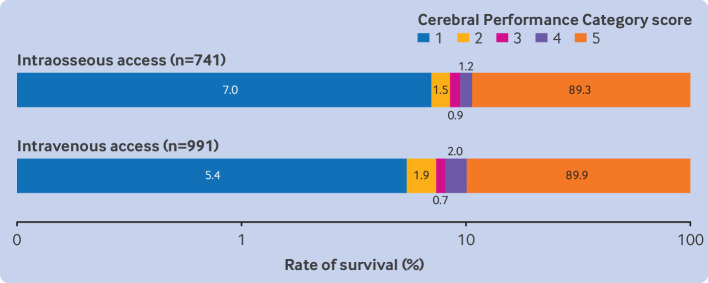
The primary outcome was survival to hospital discharge. Secondary outcomes included return of spontaneous circulation, sustained return of spontaneous circulation (≥2 hours), and survival with favourable neurological outcomes (cerebral performance category score ≤2) at hospital discharge.
Among 1771 enrolled patients, 1732 (741 in the intraosseous group and 991 in the intravenous group) were included in the primary analysis (median age 65.0 years; 1234 (71.2%) men). In the intraosseous group, 79 (10.7%) patients were discharged alive, compared with 102 (10.3%) patients in the intravenous group (odds ratio 1.04, 95% confidence interval 0.76 to 1.42; P=0.81). The odds ratio of intraosseous versus intravenous access was 1.23 (0.89 to 1.69; P=0.21) for pre-hospital return of spontaneous circulation, 0.92 (0.75 to 1.13; P=0.44) for sustained return of spontaneous circulation, and 1.17 (0.82 to 1.66; P=0.39) for survival with favourable neurological outcomes.
Among adults with non-traumatic out-of-hospital cardiac arrest, initial attempts to establish vascular access through the intraosseous route did not result in different outcomes compared with intravenous access in terms of the proportion of patients surviving to hospital discharge, pre-hospital return of spontaneous circulation, sustained return of spontaneous circulation, and favourable neurological outcomes.
NCT04135547ClinicalTrials.gov NCT04135547.
比较经皮穿刺与静脉血管通路在治疗院外心搏骤停成人患者中的效果。
集群随机对照试验。
VICTOR(静脉注射与经皮穿刺骨内注射在院外心搏骤停患者复苏中的比较)试验涉及台湾台北市的急救医疗服务机构,所有四个高级生命支持救护车团队均参与其中。招募期为 2020 年 7 月 6 日至 2023 年 6 月 30 日,由于 2021 年 5 月 20 日至 7 月 31 日期间的新冠疫情而暂时暂停。
年龄在 20-80 岁之间的非创伤性院外心搏骤停成年患者。
每隔两周随机抽取四个参与的高级生命支持救护车团队,分配进行静脉或经皮穿刺骨内通路插入。
主要结局为出院时存活。次要结局包括院外自主循环恢复、持续自主循环恢复(≥2 小时)以及出院时具有良好神经结局(脑功能状态评分≤2)的存活。
在 1771 名入组患者中,1732 名(经皮穿刺骨内组 741 名,静脉组 991 名)纳入主要分析(中位年龄 65.0 岁;1234 名(71.2%)为男性)。在经皮穿刺骨内组中,79 名(10.7%)患者存活出院,而静脉组中 102 名(10.3%)患者存活出院(优势比 1.04,95%置信区间 0.76 至 1.42;P=0.81)。经皮穿刺骨内与静脉通路相比,院外自主循环恢复的优势比为 1.23(0.89 至 1.69;P=0.21),持续自主循环恢复的优势比为 0.92(0.75 至 1.13;P=0.44),具有良好神经结局的存活优势比为 1.17(0.82 至 1.66;P=0.39)。
在非创伤性院外心搏骤停的成年人中,与静脉通路相比,经皮穿刺骨内途径最初建立血管通路的尝试并未在患者出院时存活、院外自主循环恢复、持续自主循环恢复和良好神经结局方面产生不同的结果。
NCT04135547ClinicalTrials.gov NCT04135547。