Campbell Andrew M, Anderson Mallory G, Haussmann Mark F, Rowell Raquel, Jacobs Leonie
Virginia Tech, School of Animal Sciences, Blacksburg, United States of America.
Bucknell University, Department of Biology, Lewisburg, United States of America.
PLoS One. 2025 Jun 25;20(6):e0326195. doi: 10.1371/journal.pone.0326195. eCollection 2025.
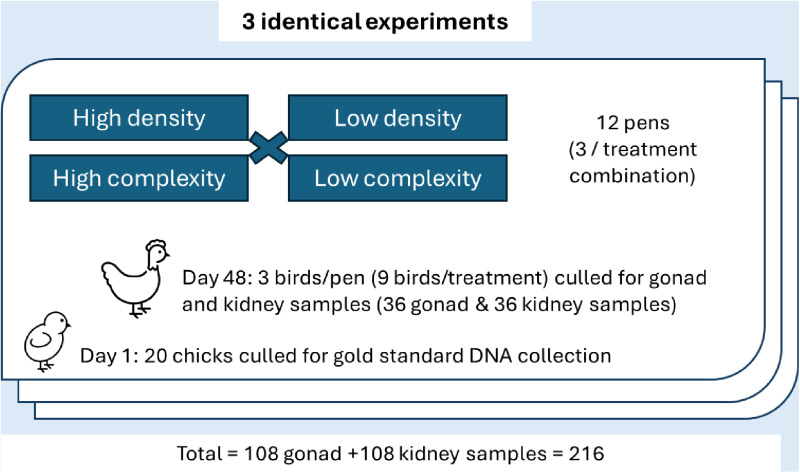
Cumulative experience can be defined as the sum of all positive and negative experiences during an animal's lifetime. Telomere length shows promise as a biomarker of cumulative experience in humans and non-human animals but is not yet assessed for broiler chickens. Therefore, our objective was to determine telomere length changes due to positive and negative experiences in fast-growing broiler chickens. In three replicated experiments, male Ross 708 broilers were housed in a 2 × 2 factorial study investigating high environmental complexity as a positive environment (vs. low complexity; 6 pens/treatment) and high stocking density as a negative environment (vs. low density; 6 pens/treatment). Telomere length was quantified at day 48 of age via quantitative RT-PCR (qRT-PCR) from gonad and kidney samples (N = 9 samples/treatment/tissue/experiment). Prior to analysis, raw relative telomere length (rTL) values were z-transformed to allow comparison between experiments. Combined data from the three experiments were analyzed using mixed models with complexity, density, and their interactions as fixed factor and pen nested within experiment and qRT-PCR plate number as random factors. Over all three trials, birds housed in high complexity environments tended (P = 0.0503) to have longer telomeres from kidney tissue than birds housed in low complexity environments. Stocking density did not impact combined kidney telomere length and gonadal telomere length was not impacted by environmental complexity or stocking density. Longer telomeres (statistical trend) in response to positive experience (environmental complexity) when compared to low-complexity indicate that high-complexity environments elicited positive cumulative experience in broiler chickens, although effect size was small. Telomere length has the potential to be a valuable tool in the assessment of cumulative experience in production settings, and future works should replicate these findings and expand upon this work by comparing telomere length with other more traditional animal welfare markers.
累积经验可定义为动物一生中所有正面和负面经历的总和。端粒长度有望成为人类和非人类动物累积经验的生物标志物,但尚未对肉鸡进行评估。因此,我们的目标是确定快速生长的肉鸡在正面和负面经历下的端粒长度变化。在三个重复实验中,雄性罗斯708肉鸡被安置在一个2×2析因研究中,研究高环境复杂性作为正面环境(与低复杂性相比;每组6个鸡笼)和高饲养密度作为负面环境(与低密度相比;每组6个鸡笼)。在48日龄时,通过定量逆转录聚合酶链反应(qRT-PCR)对性腺和肾脏样本(每个处理/组织/实验N = 9个样本)的端粒长度进行定量。在分析之前,将原始相对端粒长度(rTL)值进行z变换,以便在实验之间进行比较。使用混合模型分析来自三个实验的合并数据,将复杂性、密度及其相互作用作为固定因素,将嵌套在实验中的鸡笼和qRT-PCR板号作为随机因素。在所有三个试验中,饲养在高复杂性环境中的鸡,其肾脏组织的端粒往往(P = 0.0503)比饲养在低复杂性环境中的鸡更长。饲养密度对合并的肾脏端粒长度没有影响,性腺端粒长度也不受环境复杂性或饲养密度的影响。与低复杂性相比,对正面经历(环境复杂性)的反应中端粒更长(统计趋势),这表明高复杂性环境在肉鸡中引发了正面的累积经验,尽管效应大小较小。端粒长度有可能成为评估生产环境中累积经验的有价值工具,未来的研究应该重复这些发现,并通过将端粒长度与其他更传统的动物福利指标进行比较来扩展这项工作。