Signorelli Carlo, Calegari Maria Alessandra, Anghelone Annunziato, Passardi Alessandro, Gallio Chiara, Bittoni Alessandro, Lucchetti Jessica, Angotti Lorenzo, Di Giacomo Emanuela, Zurlo Ina Valeria, Morelli Cristina, Dell'Aquila Emanuela, Artemi Adele, Gemma Donatello, Emiliani Alessandra, Ribelli Marta, Corsi Domenico Cristiano, Arrivi Giulia, Mazzuca Federica, Zoratto Federica, Chilelli Mario Giovanni, Schirripa Marta, Schietroma Francesco, Morandi Maria Grazia, Santamaria Fiorenza, Dettori Manuela, Cosimati Antonella, Saltarelli Rosa, Minelli Alessandro, Lucci-Cordisco Emanuela, Basso Michele
Medical Oncology Unit, S.Rosa Hospital, ASL Viterbo, 01100 Viterbo, Italy.
Oncologia Medica, Comprehensive Cancer Center, Fondazione Policlinico Universitario Agostino Gemelli-IRCCS, 00168 Rome, Italy.
Cancers (Basel). 2025 Jun 18;17(12):2037. doi: 10.3390/cancers17122037.
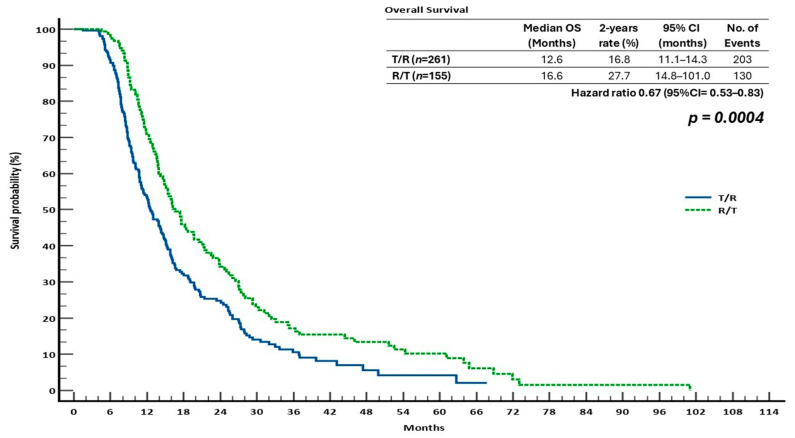
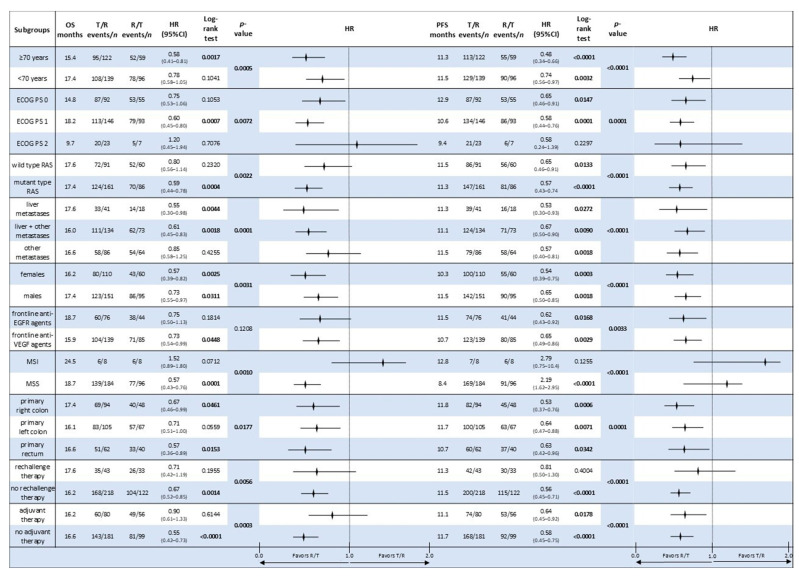
Regorafenib (R) and trifluridine/tipiracil (T) are approved treatments for metastatic colorectal cancer (mCRC) in refractory cases. However, the optimal sequencing of these agents is unknown. The ReTrITA study planned to assess the real-world efficacy of R and T, administered either sequentially or as monotherapy, in a large Italian multicentre population. This retrospective observational analysis comprised 1156 mCRC patients treated between 2012 and 2023 at 17 Italian cancer centres. Patients were divided into four groups: sequential T/R ( = 261), sequential R/T ( = 155), R monotherapy ( = 313), and T monotherapy ( = 427). The primary objectives were overall survival (OS) and progression-free survival (PFS), with secondary goals being disease control rate, objective response rate, and treatment-related toxicity. The monotherapy cohorts showed no significant difference in OS (R: 5.0 months; T: 5.9 months; = 0.8371) or PFS (R: 3.2 months; T: 3.3 months; = 0.6531). Compared to T/R, the sequential R/T group had significantly better outcomes: median OS was 16.6 vs. 12.6 months (HR = 0.67; = 0.0004), and median PFS was 11.5 vs. 8.5 months (HR = 0.60; < 0.0001). The survival advantage of R/T was consistent across clinical subgroups. The toxicity profiles were comparable with known safety data, with a lower prevalence of neutropenia reported in the R/T sequence. ReTrITA confirms the efficacy of R and T as monotherapies and provides compelling real-world evidence that the R/T sequence improves survival in refractory mCRC. These findings support a regorafenib-first approach in patients who are eligible, and they emphasise the need for future research into combination strategies and comparisons with newer drugs such as fruquintinib.
瑞戈非尼(R)和曲氟尿苷/替匹嘧啶(T)被批准用于治疗难治性转移性结直肠癌(mCRC)。然而,这些药物的最佳用药顺序尚不清楚。ReTrITA研究计划在意大利的一个大型多中心人群中评估R和T序贯给药或单药治疗的真实疗效。这项回顾性观察分析纳入了2012年至2023年期间在17家意大利癌症中心接受治疗的1156例mCRC患者。患者被分为四组:序贯T/R组(n = 261)、序贯R/T组(n = 155)、R单药治疗组(n = 313)和T单药治疗组(n = 427)。主要目标是总生存期(OS)和无进展生存期(PFS),次要目标是疾病控制率、客观缓解率和治疗相关毒性。单药治疗组在OS(R组:5.0个月;T组:5.9个月;P = 0.8371)或PFS(R组:3.2个月;T组:3.3个月;P = 0.6531)方面无显著差异。与T/R组相比,序贯R/T组的疗效显著更好:中位OS为16.6个月对12.6个月(HR = 0.67;P = 0.0004),中位PFS为11.5个月对8.5个月(HR = 0.60;P < 0.0001)。R/T组的生存优势在各临床亚组中均一致。毒性特征与已知的安全性数据相当,R/T用药顺序报告的中性粒细胞减少发生率较低。ReTrITA证实了R和T作为单药治疗的疗效,并提供了令人信服的真实世界证据,表明R/T用药顺序可改善难治性mCRC的生存期。这些发现支持对符合条件的患者采用瑞戈非尼优先的治疗方法,并强调未来需要对联合治疗策略以及与呋喹替尼等新药进行比较的研究。