
三线及以上治疗转移性结直肠癌时regorafenib 联合替氟尿苷/盐酸拓扑替康的治疗环境和结局:一项真实世界的多中心回顾性研究。
Treatment Settings and Outcomes with Regorafenib and Trifluridine/Tipiracil at Third-Line Treatment and beyond in Metastatic Colorectal Cancer: A Real-World Multicenter Retrospective Study.
机构信息
Medical Oncology Unit, Belcolle Hospital, ASL Viterbo, 01100 Viterbo, Italy.
Unit of Medical Oncology, Comprehensive Cancer Center, Fondazione Policlinico Universitario Agostino Gemelli, IRCCS, 00168 Rome, Italy.
出版信息
Curr Oncol. 2023 Jun 4;30(6):5456-5469. doi: 10.3390/curroncol30060413.
BACKGROUND
Patients with refractory mCRC rarely undergo third-line or subsequent treatment. This strategy could negatively impact their survival. In this setting, regorafenib (R) and trifluridine/tipiracil (T) are two key new treatment options with statistically significant improvements in overall survival (OS), progression-free survival (PFS), and disease control with different tolerance profiles. This study aimed to retrospectively evaluate the efficacy and safety profiles of these agents in real-world practice.
MATERIALS AND METHODS
In 2012-2022, 866 patients diagnosed with mCRC who received sequential R and T (T/R, n = 146; R/T, n = 116]) or T (n = 325]) or R (n = 279) only were retrospectively recruited from 13 Italian cancer institutes.
RESULTS
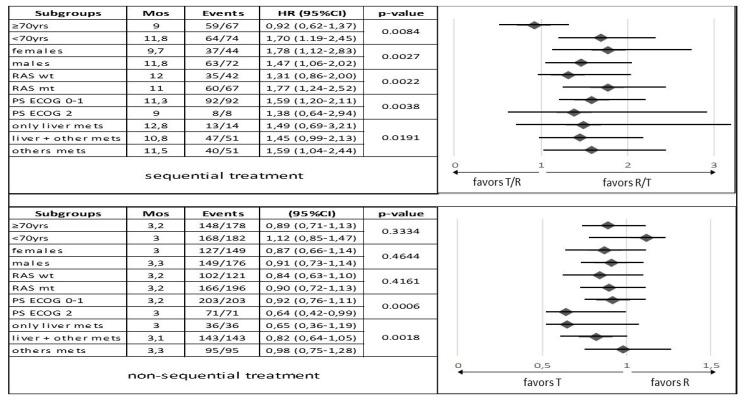
The median OS is significantly longer in the R/T group (15.9 months) than in the T/R group (13.9 months) ( = 0.0194). The R/T sequence had a statistically significant advantage in the mPFS, which was 8.8 months with T/R vs. 11.2 months with R/T ( = 0.0005). We did not find significant differences in outcomes between groups receiving T or R only. A total of 582 grade 3/4 toxicities were recorded. The frequency of grade 3/4 hand-foot skin reactions was higher in the R/T sequence compared to the reverse sequence (37.3% vs. 7.4%) ( = 0.01), while grade 3/4 neutropenia was slightly lower in the R/T group than in the T/R group (66.2% vs. 78.2%) ( = 0.13). Toxicities in the non-sequential groups were similar and in line with previous studies.
CONCLUSIONS
The R/T sequence resulted in a significantly longer OS and PFS and improved disease control compared with the reverse sequence. R and T given not sequentially have similar impacts on survival. More data are needed to define the best sequence and to explore the efficacy of sequential (T/R or R/T) treatment combined with molecular-targeted drugs.
背景
难治性 mCRC 患者很少接受三线或后续治疗。这一策略可能会对他们的生存产生负面影响。在这种情况下,regorafenib(R)和曲氟尿苷/盐酸替匹嘧啶(T)是两种关键的新治疗选择,在总生存期(OS)、无进展生存期(PFS)和疾病控制方面具有统计学意义的改善,同时具有不同的耐受谱。本研究旨在回顾性评估这些药物在真实世界实践中的疗效和安全性。
材料与方法
2012 年至 2022 年,从 13 家意大利癌症研究所回顾性招募了 866 名接受序贯 R 和 T(T/R,n=146;R/T,n=116)或 T(n=325)或 R(n=279)治疗的 mCRC 患者。
结果
R/T 组的中位 OS 明显长于 T/R 组(15.9 个月 vs. 13.9 个月)(=0.0194)。R/T 序贯在 mPFS 方面具有统计学优势,T/R 组为 8.8 个月,R/T 组为 11.2 个月(=0.0005)。我们未发现仅接受 T 或 R 治疗的组之间在结果上有显著差异。共记录到 582 例 3/4 级毒性反应。R/T 序贯组手足皮肤反应 3/4 级的频率高于逆序组(37.3% vs. 7.4%)(=0.01),而 R/T 组的 3/4 级中性粒细胞减少症略低于 T/R 组(66.2% vs. 78.2%)(=0.13)。非序贯组的毒性反应与既往研究相似。
结论
与逆序组相比,R/T 序贯可显著延长 OS 和 PFS,并改善疾病控制。不序贯使用 R 和 T 对生存的影响相似。需要更多的数据来确定最佳的序贯方案,并探索序贯(T/R 或 R/T)治疗联合分子靶向药物的疗效。


 Zotero 插件