Monclús-Díez Germán, Díaz-Arribas María José, Fernández-de-Las-Peñas César, Kosson Dariusz, Kołacz Marcin, Kobylarz Mateusz D, Sánchez-Jorge Sandra, Valera-Calero Juan Antonio
Department of Radiology, Rehabilitation and Physiotherapy, Faculty of Nursery, Physiotherapy and Podiatry, Complutense University of Madrid, 28040 Madrid, Spain.
Grupo InPhysio, Instituto de Investigación Sanitaria del Hospital Clínico San Carlos (IdISSC), 28040 Madrid, Spain.
Biomedicines. 2025 Jun 12;13(6):1453. doi: 10.3390/biomedicines13061453.
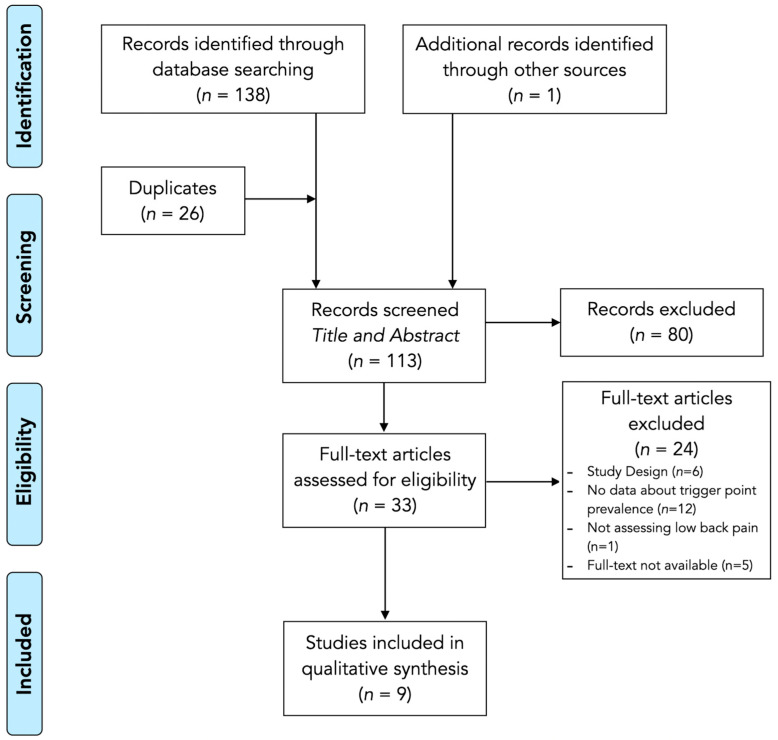
Muscle tissues are a common source of symptoms related to low back pain (LBP), with myofascial trigger points (MTrPs) being a significant contributor. Since previous meta-analyses support interventions targeting MTrPs for reducing pain and improving functional disability in patients with LBP, this review aimed to synthesize current knowledge on the prevalence of MTrPs in LBP patients. : To conduct this systematic review, data were collected from PubMed, Cochrane, and Web of Science. Published articles at any time up to February 2025 that comprised descriptive, observational, or experimental studies in English/Spanish language reporting the prevalence of active or latent MTrPs in patients with LBP were eligible. After assessing the methodological quality, a structured and qualitative synthesis was conducted using a standardized form that captured participant characteristics, evaluated muscles, the number or percentage of active and latent MTrPs in each group, clinical features, summarized results, and conclusions. : Nine articles with acceptable methodological quality were included. The prevalence of active MTrPs in patients with LBP was quadratus lumborum (ranging from 30% to 55%), gluteus medius (from 34% to 45%), piriformis (42%), psoas (from 5% to 10%), and lumbar iliocostalis (from 33% to 38%). Latent MTrPs were most common in the gluteus medius (74%) and quadratus lumborum (14-17%), with the piriformis, psoas, and lumbar iliocostalis also affected. : Active and latent MTrPs are common in muscles such as the quadratus lumborum, gluteus medius, and iliocostalis in individuals with LBP, with prevalence varying by pain chronicity and etiology. MTrPs in the gluteal region are more frequent in lumbosacral radiculopathy, suggesting a neurogenic-like component. Since the subjectivity of manual palpation and study heterogeneity limit generalizability of the results, future research should standardize diagnostic criteria of MTrPs to ensure the consistency of results.
肌肉组织是与腰痛(LBP)相关症状的常见来源,肌筋膜触发点(MTrP)是一个重要因素。由于先前的荟萃分析支持针对MTrP的干预措施可减轻LBP患者的疼痛并改善功能障碍,本综述旨在综合当前关于LBP患者中MTrP患病率的知识。:为进行这项系统综述,从PubMed、Cochrane和科学网收集数据。截至2025年2月的任何时间发表的英文/西班牙文描述性、观察性或实验性研究文章,报告LBP患者中活跃或潜伏MTrP的患病率均符合要求。在评估方法学质量后,使用标准化表格进行结构化和定性综合分析,该表格记录了参与者特征、评估的肌肉、每组中活跃和潜伏MTrP的数量或百分比、临床特征、总结结果和结论。:纳入了9篇方法学质量可接受的文章。LBP患者中活跃MTrP的患病率在腰方肌中为30%至55%,臀中肌中为34%至45%,梨状肌中为42%,腰大肌中为5%至10%,腰髂肋肌中为33%至38%。潜伏MTrP在臀中肌中最为常见(74%),在腰方肌中为14%至17%,梨状肌、腰大肌和腰髂肋肌也会受到影响。:活跃和潜伏MTrP在LBP个体的腰方肌、臀中肌和髂肋肌等肌肉中很常见,患病率因疼痛慢性程度和病因而异。臀肌区域的MTrP在腰骶神经根病中更常见,提示存在类似神经源性的成分。由于手法触诊的主观性和研究的异质性限制了结果的可推广性,未来研究应规范MTrP的诊断标准以确保结果的一致性。