Hong Yifeng, He Xiaoyan, Wu Dan, Ye Jian, Zhang Yuxing, Wu Zhenfang, Tan Cheng
College of Animal Science and National Engineering Research Center for Breeding Swine Industry, South China Agricultural University, Guangzhou 510642, China.
State Key Laboratory of Swine and Poultry Breeding Industry, Guangzhou 510640, China.
Animals (Basel). 2025 Jun 11;15(12):1724. doi: 10.3390/ani15121724.
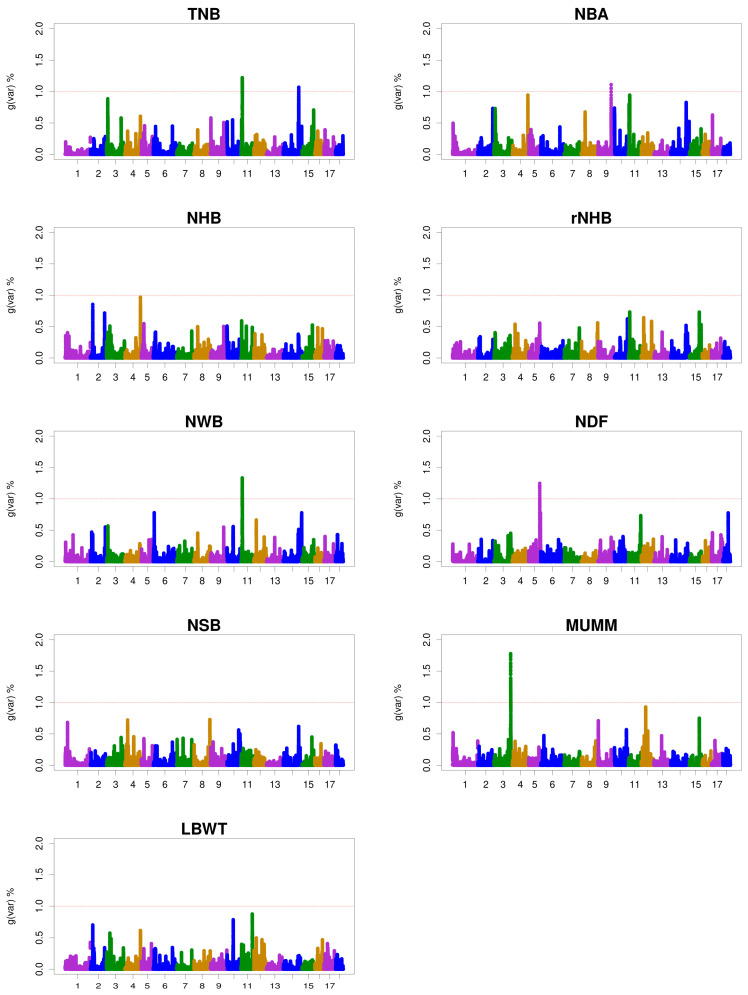
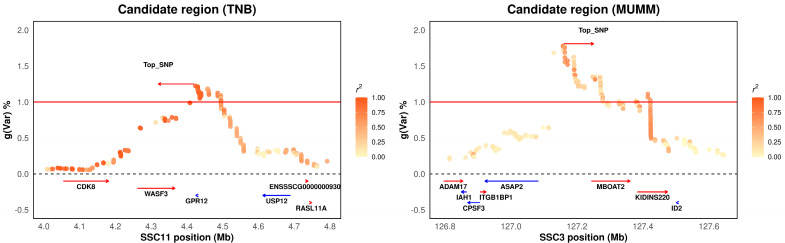
(1) Background: Litter size traits are critical for pig breeding efficiency but pose challenges due to low heritability and sex-limited influences. This study aimed to elucidate the genetic architecture and identify candidate genes for these traits in Large White pigs using genomic selection (GS) and genome-wide association analyses (GWAS). (2) Methods: This study utilized phenotypic data from nine litter size traits in Large White sows. Genotyping-by-sequencing (GBS) was performed to obtain genotype data, retaining 153,782 high-quality SNPs after quality control. Genetic evaluation was conducted using single-step genomic best linear unbiased prediction (ssGBLUP), with genetic parameters (heritability and genetic correlations) estimated via an animal model (repeatability model). To assess prediction accuracy, 10-fold cross-validation was employed to compare traditional BLUP with ssGBLUP. Furthermore, a single-step genome-wide association study (ssGWAS) integrated genomic information and pedigree-based relationship matrices to screen for significant SNPs associated with litter size traits across the genome. Functional analysis of key candidate genes was subsequently conducted based on ssGWAS results. (3) Results: Heritabilities for litter traits ranged from 0.01 to 0.06. ssGBLUP improved genomic prediction accuracy by 6.38-13.33% over BLUP. Six genomic windows explaining 1.07-1.77% of genetic variance were identified via ssGWAS, highlighting on SSC11 as a key candidate gene linked to oocyte development. (4) Conclusions: This study demonstrates the efficacy of ssGBLUP for low-heritability traits and identifies GPR12 as a pivotal gene for litter size. Prioritizing NHB and LBWT in breeding programs could enhance genetic gains while mitigating adverse effects on piglet health. These findings advance genomic strategies for improving reproductive efficiency in swine.
(1) 背景:产仔数性状对猪的育种效率至关重要,但由于遗传力低和性别限制影响而带来挑战。本研究旨在利用基因组选择(GS)和全基因组关联分析(GWAS)阐明大白猪这些性状的遗传结构并鉴定候选基因。(2) 方法:本研究利用了大白母猪九个产仔数性状的表型数据。通过简化基因组测序(GBS)获得基因型数据,质量控制后保留153,782个高质量单核苷酸多态性(SNP)。使用单步基因组最佳线性无偏预测(ssGBLUP)进行遗传评估,通过动物模型(重复性模型)估计遗传参数(遗传力和遗传相关性)。为评估预测准确性,采用10倍交叉验证比较传统最佳线性无偏预测(BLUP)与ssGBLUP。此外,单步全基因组关联研究(ssGWAS)整合基因组信息和基于系谱的关系矩阵,以筛选全基因组范围内与产仔数性状相关的显著SNP。随后基于ssGWAS结果对关键候选基因进行功能分析。(3) 结果:产仔数性状的遗传力范围为0.01至0.06。ssGBLUP比BLUP将基因组预测准确性提高了6.38 - 13.33%。通过ssGWAS鉴定出六个解释1.07 - 1.77%遗传变异的基因组窗口,突出显示11号染色体(SSC11)上的一个关键候选基因与卵母细胞发育相关。(4) 结论:本研究证明了ssGBLUP对低遗传力性状的有效性,并鉴定出GPR12为产仔数的关键基因。在育种计划中优先考虑初生重(NHB)和断奶体重(LBWT)可提高遗传进展,同时减轻对仔猪健康的不利影响。这些发现推进了提高猪繁殖效率的基因组策略。