Silpe Justin E, Damian-Medina Karla, Bassler Bonnie L
Department of Molecular Biology, Princeton University, Princeton, NJ 08544, USA.
Howard Hughes Medical Institute, Chevy Chase, MD 20815, USA.
Foods. 2025 Jun 7;14(12):2018. doi: 10.3390/foods14122018.
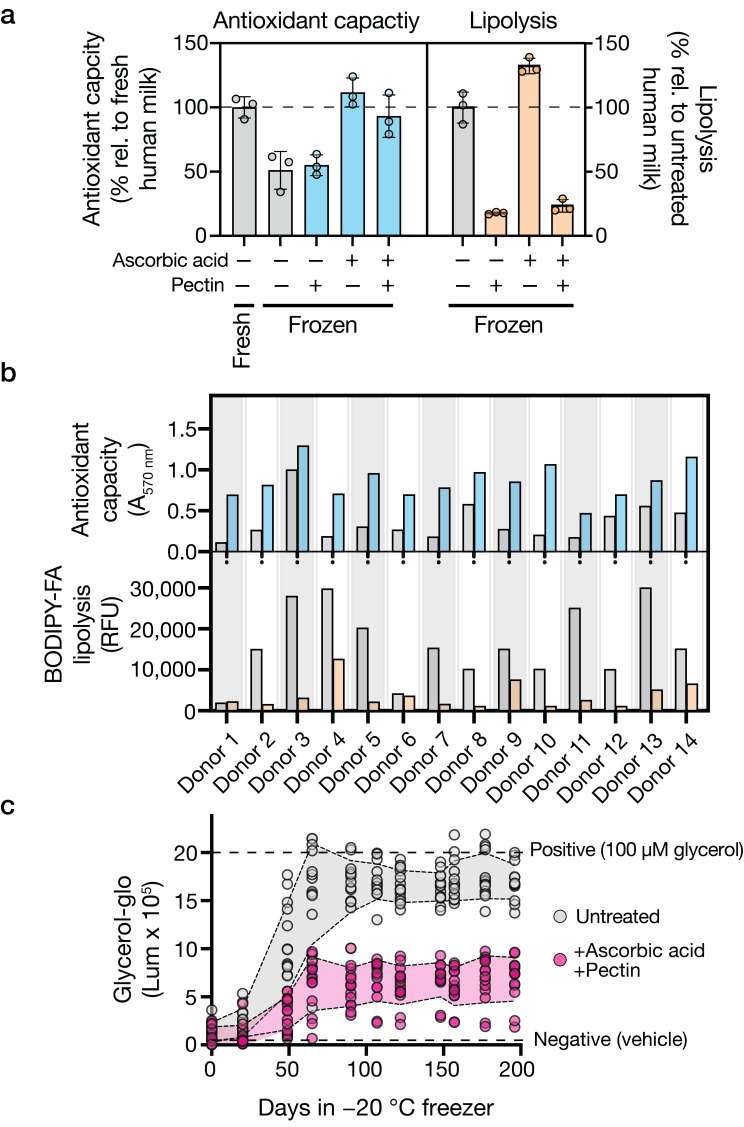
Breastmilk is known to provide optimal nutrition for infant growth and development. A cross-sectional analysis of nationally representative US data from 2016 to 2021 revealed that >90% of lactating mothers reported using breast pumps to express milk. We conducted a survey of = 1049 lactating or recently lactating individuals from a US nationally representative population to explore breastmilk storage practices among this group. The data revealed that 83% of respondents store breastmilk in their homes, with 68% using freezers to do so for >1 month. The lowest available temperature in most household freezers is -20 °C, a temperature that is inadequate to maintain human milk's emulsified structure, leading to separation, degradation of fats, loss of key vitamins, and changes in palatability. We developed a first-of-its-kind high-throughput screening platform to identify food-derived compounds and combinations of compounds that, when added to human breastmilk, preserve fat content, retain antioxidant capacity, and reduce production of rancid-associated free fatty acids during extended freezer storage. Our screening identified pectin (0.5% /) and ascorbic acid (100 μg/mL) as optimal preservation agents. Compared to untreated controls, this formulation reduced glycerol production by approximately 60% and maintained antioxidant capacity after 6 months of storage at -20 °C. Lysozyme and protease activity were maintained at >75% of the levels in fresh breastmilk. This formulation represents a lead for the development of safe and affordable frozen breastmilk shelf-life extenders for at-home use to increase the longevity of stored breastmilk.
众所周知,母乳能为婴儿的生长发育提供最佳营养。一项对2016年至2021年具有全国代表性的美国数据进行的横断面分析显示,超过90%的哺乳期母亲报告使用吸奶器挤奶。我们对来自美国全国代表性人群的1049名哺乳期或近期哺乳期个体进行了一项调查,以探究该群体中母乳储存的做法。数据显示,83%的受访者在家中储存母乳,其中68%使用冰箱储存超过1个月。大多数家用冰箱的最低可用温度为-20°C,这个温度不足以维持母乳的乳化结构,导致分离、脂肪降解、关键维生素流失以及口感变化。我们开发了首个高通量筛选平台,以识别食品衍生化合物以及化合物组合,这些化合物添加到母乳中后,在延长的冷冻储存期间能够保持脂肪含量、保留抗氧化能力并减少与酸败相关的游离脂肪酸的产生。我们的筛选确定果胶(0.5%/)和抗坏血酸(100μg/mL)为最佳防腐剂。与未处理的对照相比,该配方在-20°C下储存6个月后,甘油产量降低了约60%,并保持了抗氧化能力。溶菌酶和蛋白酶活性维持在新鲜母乳水平的75%以上。该配方为开发安全且经济实惠的家用冷冻母乳保质期延长剂以延长储存母乳的寿命带来了希望。