Geiger Philipp, Gmeiner Raphael, Schön Victoria, Petr Ondra, Thomé Claudius, Pinggera Daniel
Department for Neurosurgery, Medical University of Innsbruck, 6020 Innsbruck, Austria.
J Clin Med. 2025 Jun 9;14(12):4078. doi: 10.3390/jcm14124078.
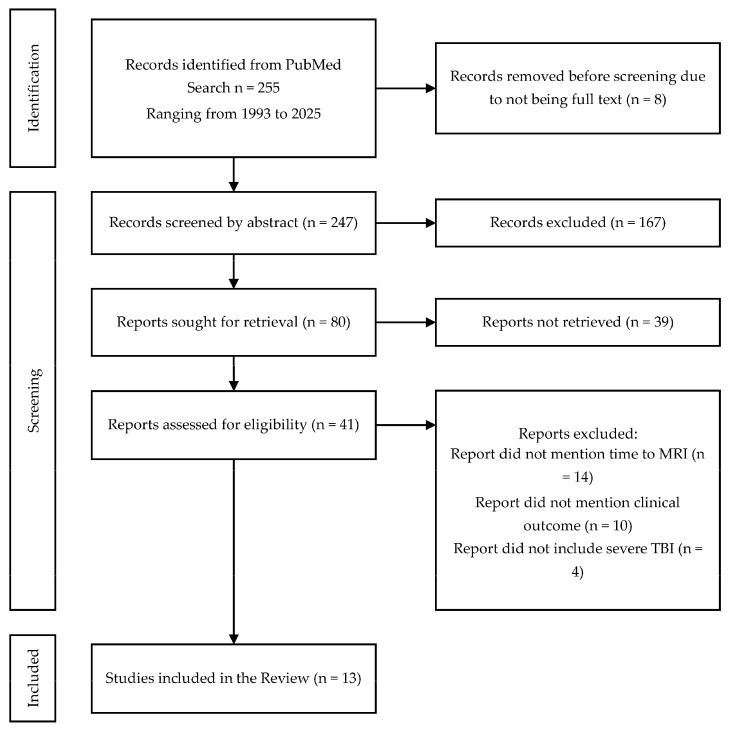
: Traumatic brain injury (TBI) remains a significant global health concern with a substantial socioeconomic impact. Although computed tomography (CT) is the primary initial neuroimaging technique, magnetic resonance imaging (MRI) offers a superior detection of subtle brain injuries. However, the ideal timing for MRI in critically ill patients with TBI remains unclear. : This systematic literature review focused on the timing and utility of MRI in moderate and severe TBI in the early treatment phase. A comprehensive search was conducted using PubMed, employing specific search terms related to MRI timing and prognostication in TBI. The mean duration from admission to first MRI was examined in the conducting medical center for reference. : Early MRI, within 72 h post-injury, demonstrated a prognostic value compared with later scans. Diffusion tensor imaging (DTI) performed within 48 to 72 h captured critical pathophysiological changes. The presence of bilateral traumatic axonal injury in the brainstem or thalami on MRI served as a significant predictor of outcome in severe TBI. In pediatric TBI, most institutions performed MRI between seventy-two hours and two weeks post-injury, highlighting variability in practices. The mean interval until the first MRI at the conducting center was 16 days. : MRI appears to be a valuable tool for prognostication in moderate to severe TBI, offering additional insights beyond those provided by CT. However, the optimal timing and modality for accurate diagnostic and prognostic utility remain uncertain. Current evidence suggests that MRI performed within 72 h after injury in ICU-treated patients with moderate and severe TBI offers valuable prognostic insights compared with delayed MRI, although further research is needed to establish standardized timing protocols and confirm the clinical impact.
创伤性脑损伤(TBI)仍然是一个重大的全球健康问题,具有重大的社会经济影响。尽管计算机断层扫描(CT)是主要的初始神经成像技术,但磁共振成像(MRI)在检测细微脑损伤方面具有更高的灵敏度。然而,对于重症TBI患者进行MRI检查的理想时机仍不明确。
本系统文献综述聚焦于MRI在中重度TBI早期治疗阶段的时机和效用。使用PubMed进行了全面检索,采用了与TBI中MRI时机和预后相关的特定检索词。在进行研究的医疗中心,对从入院到首次MRI检查的平均时长进行了考察以供参考。
与后期扫描相比,伤后72小时内进行的早期MRI显示出预后价值。在伤后48至72小时内进行的扩散张量成像(DTI)捕捉到了关键的病理生理变化。MRI显示脑干或丘脑存在双侧创伤性轴索损伤是重度TBI预后的重要预测指标。在儿童TBI中,大多数机构在伤后72小时至两周内进行MRI检查,这突出了实践中的差异。在进行研究的中心,首次MRI检查的平均间隔时间为16天。
MRI似乎是中重度TBI预后评估的一种有价值的工具,能提供CT之外的更多信息。然而,准确诊断和预后评估的最佳时机和方式仍不确定。目前的证据表明,与延迟MRI相比,在ICU治疗的中重度TBI患者伤后72小时内进行MRI检查可提供有价值的预后信息,不过仍需进一步研究以建立标准化的检查时机方案并确认其临床影响。