Moffa Adriano H, Nikolin Stevan, Martin Donel, Loo Colleen, Boonstra Tjeerd W
School of Psychiatry, University of New South Wales & Black Dog Institute, Hospital Rd, Randwick, Sydney, NSW, 2031, Australia.
Faculty of Psychology and Neuroscience, Maastricht University, Maastricht, Netherlands.
Neuroimage Rep. 2022 Jun 21;2(3):100115. doi: 10.1016/j.ynirp.2022.100115. eCollection 2022 Sep.
Transcranial magnetic stimulation (TMS) with simultaneous electroencephalography (EEG) is a novel method for assessing cortical properties outside the motor region. Theta burst stimulation (TBS), a form of repetitive TMS, can non-invasively modulate cortical excitability and has been increasingly used to treat psychiatric disorders by targetting the dorsolateral prefrontal cortex (DLPFC). The TMS-evoked potentials (TEPs) and local mean field power (LMFP) analyses have been used to evaluate local cortical excitability changes after TBS. However, it remains unclear whether TEPs can detect the neuromodulatory effects of TBS.
To confirm the reliability of TEP components and LMFP within and between sessions and to measure changes in neural excitability induced by intermittent (iTBS) and continuous TBS (cTBS) applied to the left DLPFC.
Test-retest reliability of TEPs/LMFP and TBS-induced changes in cortical excitability were assessed in twenty-four healthy participants by stimulating the DLPFC in five separate sessions, once with sham and twice with iTBS and cTBS. EEG responses were recorded of 100 single TMS pulses before and after TBS, and the reproducibility measures were quantified with the concordance correlation coefficient (CCC).
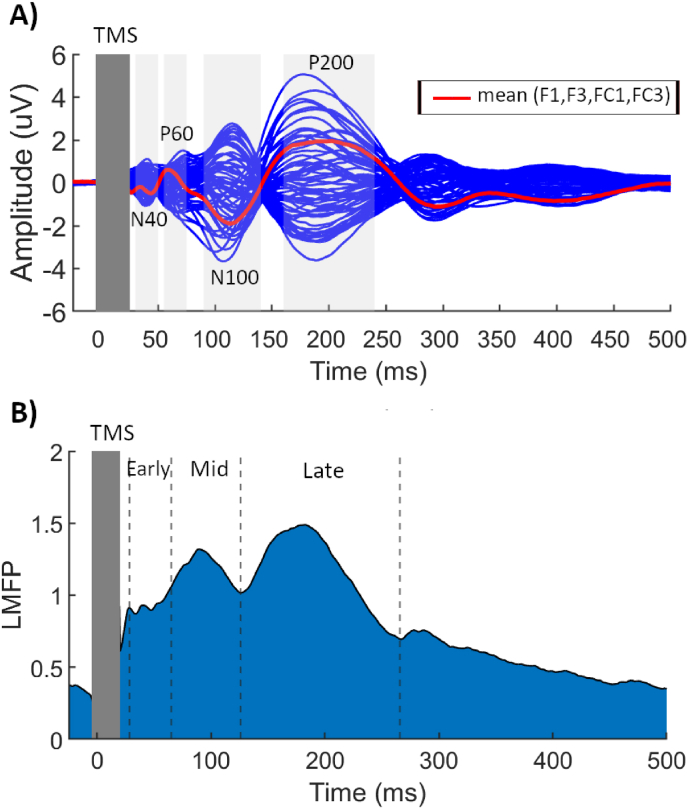
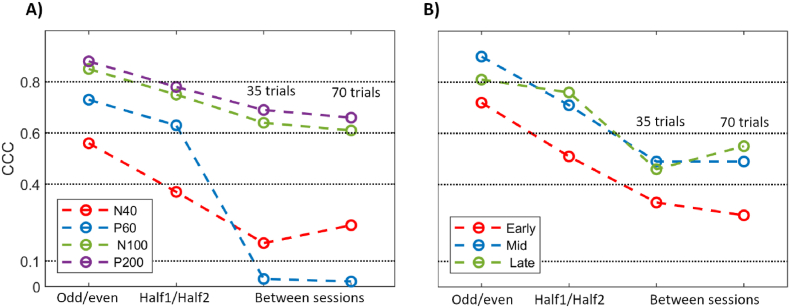
The N100 and P200 components presented substantial reliability within the baseline block (CCCs>0.8) and moderate concordance between sessions (CCC> 0.6). Both N40 and P60 TEP amplitudes showed little concordance between sessions. Similar results were achieved using LMFP responses. Changes in TEP amplitudes after iTBS were marginally reliable for N100 (CCC = 0.52), P200 (CCC = 0.47) and P60 (CCC = 0.40), presenting only fair levels of concordance at specific time points. LMFP changes showed poor reproducibility after iTBS and cTBS.
The present findings show that only the N100 and P200 components had good concordance between sessions. The reliability of earlier TEP components and LMF responses may have been affected by a sub-optimal removal of TMS-related artefacts. The poor reliability in detecting changes in neural excitability induced by TBS indicates that TEPs/LMFP do not provide a precise estimate of the changes in excitability in the DLPFC or, alternatively, that TBS did not induce consistent changes in neural excitability.
经颅磁刺激(TMS)与同步脑电图(EEG)相结合是一种评估运动区以外皮质特性的新方法。theta爆发刺激(TBS)是重复TMS的一种形式,可无创调节皮质兴奋性,并且越来越多地用于通过靶向背外侧前额叶皮质(DLPFC)治疗精神疾病。TMS诱发电位(TEP)和局部平均场功率(LMFP)分析已用于评估TBS后局部皮质兴奋性的变化。然而,TEP是否能检测到TBS的神经调节作用仍不清楚。
确认TEP成分和LMFP在各时段内及各时段间的可靠性,并测量应用于左侧DLPFC的间歇性(iTBS)和连续性TBS(cTBS)所诱导的神经兴奋性变化。
通过在五个不同时段刺激DLPFC,对24名健康参与者评估TEP/LMFP的重测信度以及TBS诱导的皮质兴奋性变化,其中一次为假刺激,两次为iTBS和cTBS。在TBS前后记录100个单次TMS脉冲的EEG反应,并使用一致性相关系数(CCC)对可重复性指标进行量化。
N100和P200成分在基线时段内具有较高的可靠性(CCC>0.8),且各时段间具有中等一致性(CCC>0.6)。N40和P60的TEP波幅在各时段间的一致性较差。使用LMFP反应也得到了类似结果。iTBS后N100(CCC = 0.52)、P200(CCC = 0.47)和P60(CCC = 0.40)的TEP波幅变化仅在特定时间点具有一般水平的一致性,可靠性一般。iTBS和cTBS后LMFP变化的可重复性较差。
目前的研究结果表明,只有N100和P200成分在各时段间具有良好的一致性。早期TEP成分和LMF反应的可靠性可能受到TMS相关伪迹去除不充分的影响。检测TBS诱导的神经兴奋性变化的可靠性较差,这表明TEP/LMFP不能精确估计DLPFC兴奋性的变化,或者表明TBS没有诱导神经兴奋性的一致变化。