Ayele Habtamu Semagne, Mengesha Assefa Kebad, Geremew Gebremariam Wulie, Lakew Abriham Adane, Alemayehu Tekletsadik Tekleslassie, Getachew Demis, Beyna Alemante Tafese
Department of Pharmacology, University of Gondar, College of Medicine and Health Sciences, Gondar, Ethiopia.
Department of Clinical Pharmacy, University of Gondar, College of Medicine and Health Sciences, Gondar, Ethiopia.
SAGE Open Nurs. 2025 Jun 24;11:23779608251352392. doi: 10.1177/23779608251352392. eCollection 2025 Jan-Dec.
Due to the rapid spread of monkeypox (Mpox), raising public awareness, ensuring effective information dissemination, and early monitoring of public health are crucial in controlling its transmission.
The aim of this study was to assess knowledge, attitude, and associated factors towards Mpox infection among residents.
A community-based cross-sectional study was conducted from August 17 to September 15, 2024, targeting local residents using a simple random sampling technique. A total sample size of 403 was calculated using a single population proportion formula. Data on Mpox-related knowledge, attitudes, and various socio-demographic factors were collected from the participants. Binary and multivariate logistic regression analyses were employed to identify factors associated with knowledge and attitudes toward Mpox.
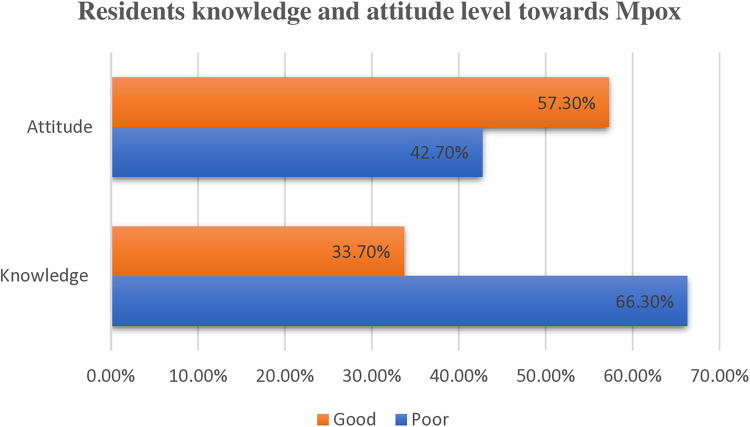
A total of 403 subjects were recruited for this study, with a mean age of 39.73 ± 11.22 (SD) years. Among the participants, 33.7% demonstrated good knowledge of Mpox, while 57.3% exhibited positive attitudes toward the disease. Key factors were identified which significantly affect the knowledge of residents including age (adjusted odds ratio (AOR):0.262, confidence interval (CI):0.100-0.685, = 0.006), level of education (AOR:0.603, CI: 0.328-1.108, = 0.001), marital status (AOR:1.151, CI:0.357-3.758, = 0.029), and source of information (AOR: 1.164, CI:0.543 -2.495, = 0.043). In same vein, the variables include, occupation, sex and educational status were significantly influencing resident's attitude.
This study revealed that overall knowledge about Mpox among residents was low. However, reasonable level of public attitude was identified. Overall, equitable public health interventions are needed to enhance public understanding and attitudes toward Mpox.
由于猴痘(Mpox)的迅速传播,提高公众意识、确保有效信息传播以及对公共卫生进行早期监测对于控制其传播至关重要。
本研究旨在评估居民对猴痘感染的知识、态度及相关因素。
2024年8月17日至9月15日进行了一项基于社区的横断面研究,采用简单随机抽样技术针对当地居民。使用单总体比例公式计算出的总样本量为403。从参与者那里收集了与猴痘相关的知识、态度以及各种社会人口学因素的数据。采用二元和多变量逻辑回归分析来确定与对猴痘的知识和态度相关的因素。
本研究共招募了403名受试者,平均年龄为39.73±11.22(标准差)岁。在参与者中,33.7%对猴痘有良好的了解,而57.3%对该疾病持积极态度。确定了显著影响居民知识的关键因素,包括年龄(调整后的优势比(AOR):0.262,置信区间(CI):0.100 - 0.685,P = 0.006)、教育程度(AOR:0.603,CI:0.328 - 1.108,P = 0.001)、婚姻状况(AOR:1.151,CI:0.357 - 3.758,P = 0.029)以及信息来源(AOR:1.164,CI:0.543 - 2.495,P = 0.043)。同样,职业、性别和教育状况等变量对居民的态度有显著影响。
本研究表明居民对猴痘的总体了解程度较低。然而,确定了公众态度处于合理水平。总体而言,需要公平的公共卫生干预措施来提高公众对猴痘的理解和态度。