Parthasarathi P, Alshahrani Haya Mesfer, Venkatachalam K, Cho Jaehyuk
Department of Computer Science and Engineering, Bannari Amman Institute of Technology, Erode, India.
Department of Information Systems, College of Computer and Information Sciences, Princess Nourah bint Abdulrahman University, Saudi Arabia.
PeerJ Comput Sci. 2025 Apr 17;11:e2789. doi: 10.7717/peerj-cs.2789. eCollection 2025.
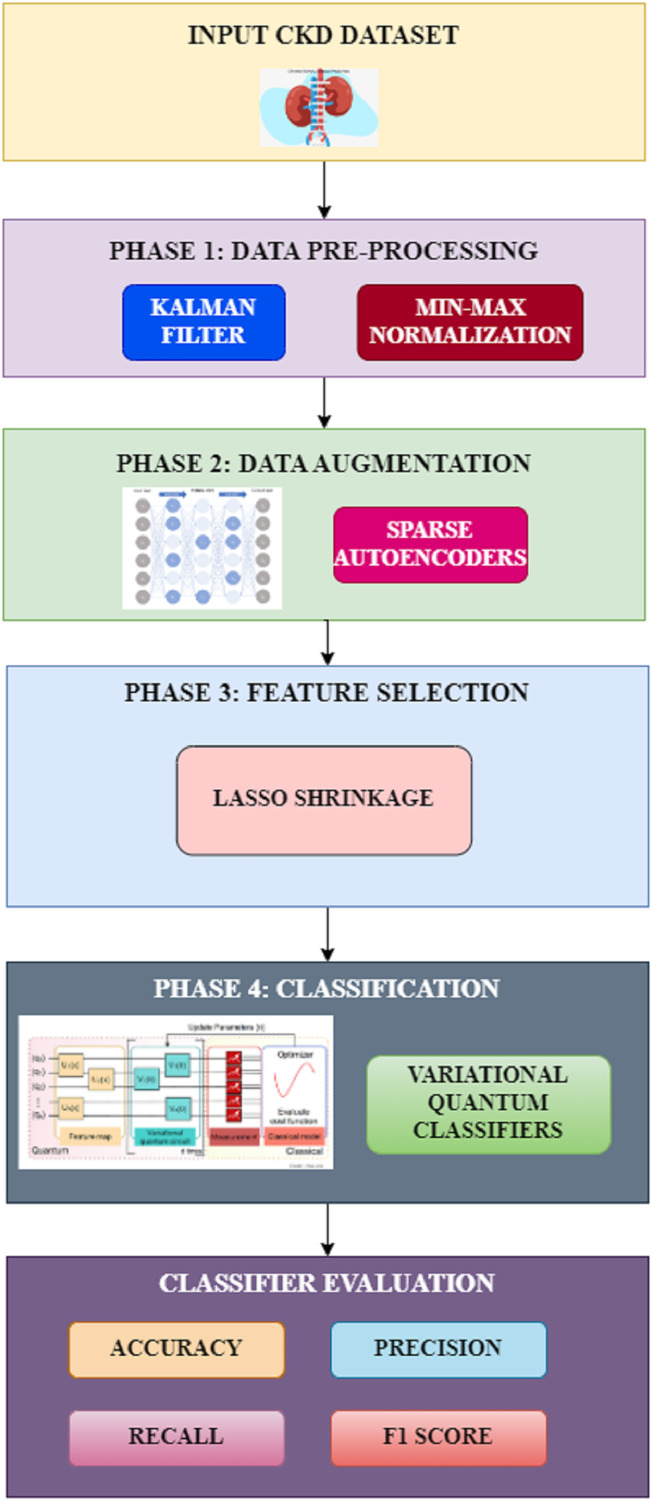
The two leading causes of chronic kidney disease (CKD) are excessive blood pressure and diabetes. Researchers worldwide utilize the rate of globular filtration and kidney inflammation biomarkers to identify chronic kidney disease that gradually reduces renal function. The mortality rate for CKD is high, and thus, a person with this illness is more likely to pass away at a younger age. Healthcare professionals must diagnose the various illnesses connected to this deadly disease as promptly as possible to lighten the impact of CKD. A quantum machine learning (QML) based technique is presented in this research to help with the early diagnosis and prognosis of CKD. The proposed research comprises four phases: data pre-processing, data augmentation, feature selection, and classification. In the first phase, Kalman filter and data normalization techniques are applied to handle the missing and noisy data. In the second phase, data augmentation uses sparse autoencoders to balance the data for smaller classes. In the third phase, LASSO shrinkage is used to select the significant features in the dataset. Variational Quantum classifiers, a supervised QML technique, are employed in the classification phase to classify chronic kidney diseases. The proposed system has been evaluated on the UCI dataset, which comprises 400 CKD patients in the early stages with 25 attributes. The suggested system was assessed using F1-score, precision, recall, and accuracy as evaluation metrics. With a 99.2% classification accuracy, it was found that this model performed better than the other traditional classifiers used for chronic kidney disease classification.
慢性肾脏病(CKD)的两大主要病因是高血压和糖尿病。世界各地的研究人员利用肾小球滤过率和肾脏炎症生物标志物来识别逐渐降低肾功能的慢性肾脏病。CKD的死亡率很高,因此,患有这种疾病的人更有可能在年轻时去世。医疗保健专业人员必须尽快诊断出与这种致命疾病相关的各种病症,以减轻CKD的影响。本研究提出了一种基于量子机器学习(QML)的技术,以帮助早期诊断和预测CKD。所提出的研究包括四个阶段:数据预处理、数据增强、特征选择和分类。在第一阶段,应用卡尔曼滤波器和数据归一化技术来处理缺失和噪声数据。在第二阶段,数据增强使用稀疏自动编码器来平衡较小类别的数据。在第三阶段,使用LASSO收缩来选择数据集中的重要特征。在分类阶段采用变分量子分类器(一种监督式QML技术)对慢性肾脏病进行分类。所提出的系统已在UCI数据集上进行评估,该数据集包括400名处于早期阶段的CKD患者,具有25个属性。使用F1分数、精确率、召回率和准确率作为评估指标对所建议的系统进行评估。结果发现,该模型的分类准确率为99.2%,比用于慢性肾脏病分类的其他传统分类器表现更好。