Ismail Alaa, Abdelsalam Mohamed Ayman, Shahin Mustafa H, Ahmed Yusuf, Bahcecioglu Ibrahim Halil, Yalniz Mehmet, Tawheed Ahmed
Faculty of Medicine, Helwan University, Cairo 11795, Al Qāhirah, Egypt.
Department of Gastroenterology, Firat University, Elazig 23119, Türkiye.
World J Gastrointest Pathophysiol. 2025 Jun 22;16(2):107599. doi: 10.4291/wjgp.v16.i2.107599.
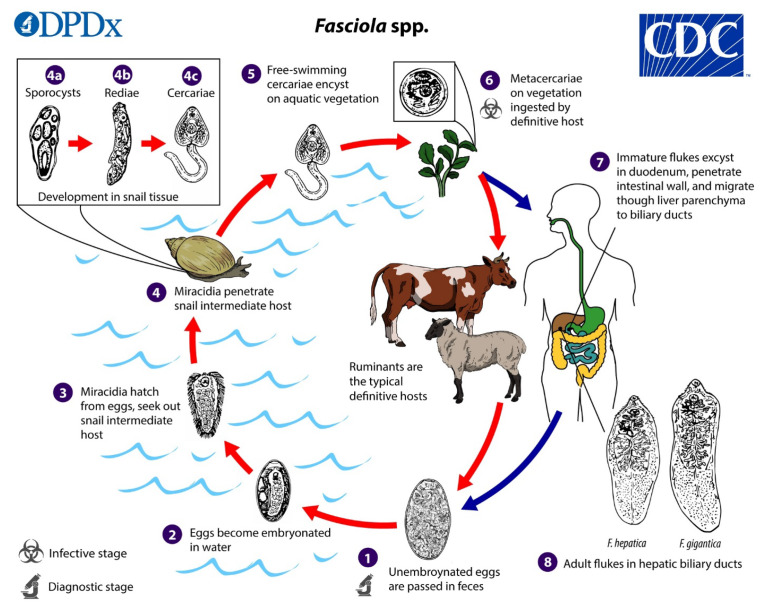
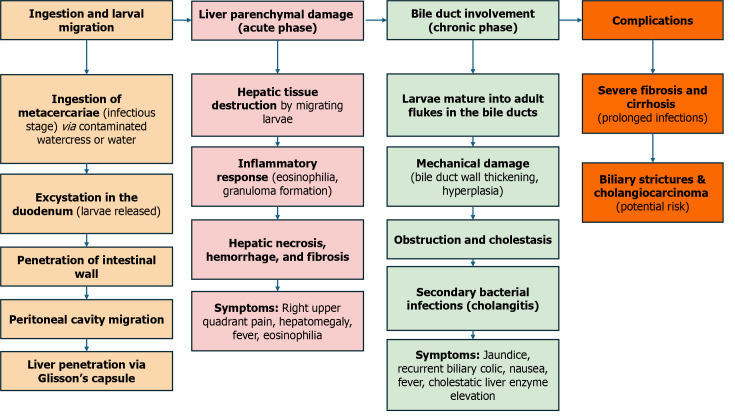
Hepatobiliary fascioliasis is a neglected but re-emerging parasitic disease caused by . Humans become infected by consuming contaminated water or aquatic plants, allowing the parasite to enter the digestive tract. From there, immature flukes penetrate the intestinal wall and migrate through the liver, triggering inflammation, fibrosis, and biliary complications. Over time, this can lead to cholangitis, biliary obstruction, and long-term liver damage. Due to its vague clinical symptoms and the limitations of current diagnostic methods, fascioliasis could be easily missed. Stool analysis is still used to detect eggs in diagnosis. However, this method is unreliable due to the inconsistency of the egg shedding. Also, serological tests are often linked to false positives due to the cross-reactions with other parasites. Imaging techniques such as ultrasound, computed tomography, and magnetic resonance imaging can reveal its complications, especially in the biliary phase, yet this is not specific. Molecular tests like polymerase chain reaction (PCR) have higher sensitivity and specificity and allow earlier diagnosis, but they are still not widely available, especially in low-resource settings. Triclabendazole is the only recommended medical treatment, yet it is not widely available. In addition, the emerging reports of resistance represent a potential threat in managing this infection. Other modalities could be needed in addition to triclabendazole, such as endoscopic retrograde cholangiopancreatography in patients with biliary complications. All the previously mentioned challenges necessitate the urgent need to make the newly developed diagnostic methods, such as PCR, available, especially in areas where fascioliasis is endemic. Additionally, new medical treatments and therapeutic options should be considered to provide a second line of management, particularly in light of emerging reports of resistance.
肝胆片形吸虫病是一种被忽视但又重新出现的寄生虫病,由……引起。人类因饮用受污染的水或食用水生植物而感染,使寄生虫进入消化道。从那里,未成熟的吸虫穿透肠壁并迁移至肝脏,引发炎症、纤维化和胆道并发症。随着时间的推移,这可能导致胆管炎、胆道梗阻和长期肝脏损害。由于其临床症状模糊以及当前诊断方法的局限性,片形吸虫病很容易被漏诊。粪便分析仍用于诊断中检测虫卵。然而,由于虫卵排出的不一致性,这种方法并不可靠。此外,血清学检测由于与其他寄生虫的交叉反应,常常出现假阳性。超声、计算机断层扫描和磁共振成像等影像学技术可以揭示其并发症,尤其是在胆道期,但这并不具有特异性。像聚合酶链反应(PCR)这样的分子检测具有更高的敏感性和特异性,能够实现早期诊断,但它们仍然没有广泛应用,特别是在资源匮乏的地区。三氯苯达唑是唯一推荐的药物治疗,但它也没有广泛供应。此外,出现的耐药性报告对这种感染的治疗构成了潜在威胁。除了三氯苯达唑之外,可能还需要其他治疗方式,例如对有胆道并发症的患者进行内镜逆行胰胆管造影。上述所有挑战都迫切需要推广新开发的诊断方法,如PCR,特别是在片形吸虫病流行的地区。此外,应考虑新的药物治疗和治疗选择,以提供二线治疗方案,特别是鉴于出现的耐药性报告。