Kessler Roman, Rusch Kristin M, Wende Kim C, Schuster Verena, Jansen Andreas
Laboratory for Multimodal Neuroimaging, Department of Psychiatry and Psychotherapy, University of Marburg, Germany.
Center for Mind, Brain and Behavior, University of Marburg and University of Giessen, Germany.
Neuroimage Rep. 2021 Aug 17;1(4):100045. doi: 10.1016/j.ynirp.2021.100045. eCollection 2021 Dec.
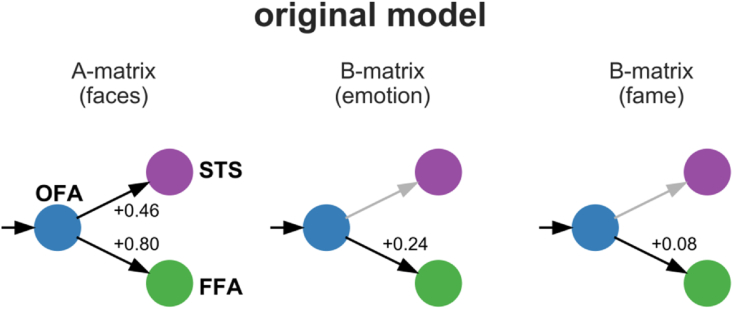
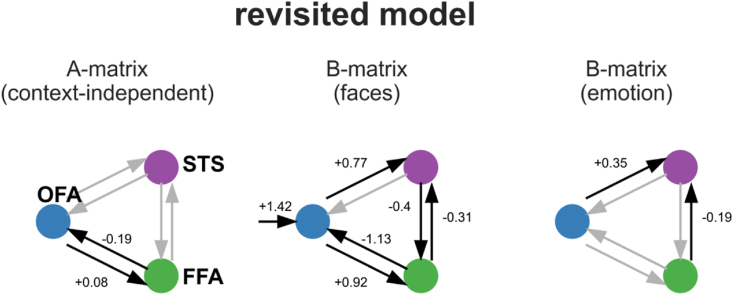
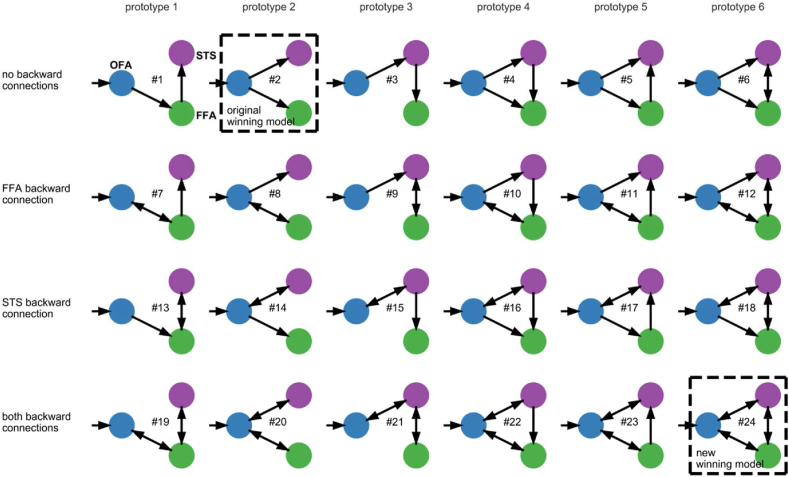
The classical core system of face perception consists of the occipital face area (OFA), fusiform face area (FFA), and posterior superior temporal sulcus (STS). The functional interaction within this network, more specifically the effective connectivity, was first described by Fairhall and Ishai (2007) using functional magnetic resonance imaging and dynamic causal modeling. They proposed that the core system is hierarchically organized; information is processed in a parallel and predominantly feed-forward fashion from the OFA to downstream regions such as the FFA and STS, with no lateral connectivity, i.e., no connectivity between the two downstream regions (FFA and STS). Over a decade later, we conducted a conceptual replication of their model using four different functional magnetic resonance imaging data sets. The effective connectivity within the core system was assessed with contemporary versions of dynamic causal modeling. The resulting model of the core system of face perception was densely interconnected. Using hierarchical linear modeling, we identified several significant forward, backward, and lateral connections in the core system of face perception across the data sets. Face perception increased the forward connectivity from the OFA to the FFA and OFA to the STS and increased the inhibitory backward connectivity from the FFA to the OFA, as well as the lateral connectivity between the FFA and STS. Emotion perception increased forward connectivity between the OFA and STS and decreased the lateral connectivity between the FFA and STS. Face familiarity did not significantly alter these connections. Our results revise the 2007 model of the core system of face perception. We discuss the potential meaning of the resulting model parameters and propose that our revised model is a suitable working model for further studies assessing the functional interaction within the core system of face perception. Our work further emphasizes the general importance of conceptual replications.
面部感知的经典核心系统由枕叶面部区(OFA)、梭状回面部区(FFA)和颞上沟后部(STS)组成。Fairhall和Ishai(2007年)首次使用功能磁共振成像和动态因果模型描述了该网络内的功能相互作用,更具体地说是有效连接性。他们提出核心系统是分层组织的;信息以并行且主要是前馈的方式从枕叶面部区处理到下游区域,如梭状回面部区和颞上沟后部,没有横向连接,即两个下游区域(梭状回面部区和颞上沟后部)之间没有连接。十多年后,我们使用四个不同的功能磁共振成像数据集对他们的模型进行了概念性复制。使用当代版本的动态因果模型评估核心系统内的有效连接性。由此产生的面部感知核心系统模型紧密相连。通过分层线性建模,我们在跨数据集的面部感知核心系统中识别出了几个显著的正向、反向和横向连接。面部感知增加了从枕叶面部区到梭状回面部区以及从枕叶面部区到颞上沟后部的正向连接,并增加了从梭状回面部区到枕叶面部区的抑制性反向连接,以及梭状回面部区和颞上沟后部之间的横向连接。情绪感知增加了枕叶面部区和颞上沟后部之间的正向连接,并减少了梭状回面部区和颞上沟后部之间的横向连接。面部熟悉度并未显著改变这些连接。我们的结果修正了2007年的面部感知核心系统模型。我们讨论了所得模型参数的潜在意义,并提出我们修正后的模型是用于进一步研究评估面部感知核心系统内功能相互作用的合适工作模型。我们的工作进一步强调了概念性复制的普遍重要性。