• 文献检索
  • 文档翻译
  • 深度研究
  • 学术资讯
  • Suppr Zotero 插件Zotero 插件
  • 邀请有礼
  • 套餐&价格
  • 历史记录
应用&插件
Suppr Zotero 插件Zotero 插件浏览器插件Mac 客户端Windows 客户端微信小程序
定价
高级版会员购买积分包购买API积分包
服务
文献检索文档翻译深度研究API 文档MCP 服务
关于我们
关于 Suppr公司介绍联系我们用户协议隐私条款
关注我们

Suppr 超能文献

核心技术专利:CN118964589B侵权必究
粤ICP备2023148730 号-1Suppr @ 2026

文献检索

告别复杂PubMed语法,用中文像聊天一样搜索,搜遍4000万医学文献。AI智能推荐,让科研检索更轻松。

立即免费搜索

文件翻译

保留排版,准确专业,支持PDF/Word/PPT等文件格式,支持 12+语言互译。

免费翻译文档

深度研究

AI帮你快速写综述,25分钟生成高质量综述,智能提取关键信息,辅助科研写作。

立即免费体验

红肉摄入量与基于转化生长因子-β通路的多基因风险评分相互作用,影响结直肠癌风险:一种构建多基因风险评分新方法的应用

Red meat intake interacts with a TGF-β-pathway-based polygenic risk score to impact colorectal cancer risk: Application of a novel approach for polygenic risk score construction.

作者信息

Mendez Joel Sanchez, Queme Bryan, Fu Yubo, Morrison John, Lewinger Juan P, Kawaguchi Eric, Mi Huaiyu, Obón-Santacana Mireia, Moratalla-Navarro Ferran, Martín Vicente, Moreno Victor, Lin Yi, Bien Stephanie A, Qu Conghui, Su Yu-Ru, White Emily, Harrison Tabitha A, Huyghe Jeroen R, Tangen Catherine M, Newcomb Polly A, Phipps Amanda I, Thomas Claire E, Conti David V, Wang Jun, Platz Elizabeth A, Keku Temitope O, Newton Christina C, Um Caroline Y, Kundaje Anshul, Shcherbina Anna, Murphy Neil, Gunter Marc J, Dimou Niki, Papadimitriou Nikos, Bézieau Stéphane, van Duijnhoven Franzel Jb, Männistö Satu, Rennert Gad, Wolk Alicja, Hoffmeister Michael, Brenner Hermann, Chang-Claude Jenny, Tian Yu, Le Marchand Loïc, Cotterchio Michelle, Tsilidis Konstantinos K, Bishop D Timothy, Melaku Yohannes Adama, Lynch Brigid M, Buchanan Daniel D, Ulrich Cornelia M, Ose Jennifer, Peoples Anita R, Pellatt Andrew J, Li Li, Devall Matthew Am, Campbell Peter T, Albanes Demetrius, Weinstein Stephanie J, Berndt Sonja I, Gruber Stephen B, Ruiz-Narvaez Edward, Song Mingyang, Joshi Amit D, Drew David A, Petrick Jessica L, Chan Andrew T, Giannakis Marios, Hsu Li, Peters Ulrike, Gauderman W James, Stern Mariana C

机构信息

Department of Population and Public Health Sciences & USC Norris Comprehensive Cancer Center, Keck School of Medicine, University of Southern California, Los Angeles, California, USA.

Division of Biostatistics, Department of Population and Public Health Sciences, University of Southern California, Los Angeles, California, USA.

出版信息

medRxiv. 2025 Jun 16:2025.06.13.25329599. doi: 10.1101/2025.06.13.25329599.

DOI:10.1101/2025.06.13.25329599
PMID:40568668
原文链接:https://pmc.ncbi.nlm.nih.gov/articles/PMC12191096/
Abstract

BACKGROUND

High intake of red and/or processed meat are established colorectal cancer (CRC) risk factors. Genome-wide association studies (GWAS) have reported 204 variants (G) associated with CRC risk. We used functional annotation data to identify subsets of variants within known pathways and constructed pathway-based Polygenic Risk Scores (pPRS) to model pPRS x environment (E) interactions.

METHODS

A pooled sample of 30,812 cases and 40,504 CRC controls of European ancestry from 27 studies were analyzed. Quantiles for red and processed meat intake were constructed. The 204 GWAS variants were annotated to genes with AnnoQ and assessed for overrepresentation in PANTHER-reported pathways. pPRS's were constructed from significantly overrepresented pathways. Covariate-adjusted logistic regression models evaluated pPRSxE interactions with red or processed meat intake in relation to CRC risk.

RESULTS

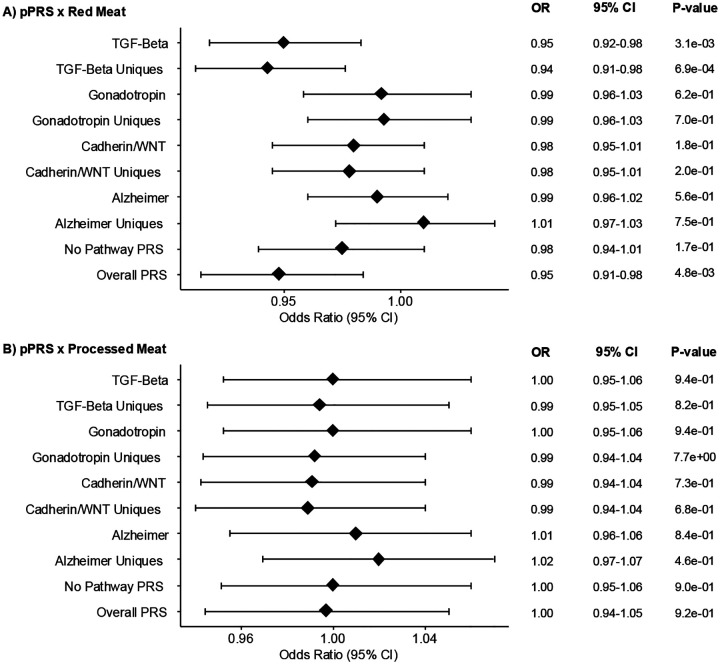
A total of 30 variants were overrepresented in four pathways: Alzheimer disease-presenilin, Cadherin/WNT-signaling, Gonadotropin-releasing hormone receptor, and TGF-β signaling. We found a significant interaction between TGF-β-pPRS and red meat intake (p = 0.003). When variants in the TGF-β pathway were assessed, significant interactions with red meat for rs2337113 (intron gene, Chr18), and rs2208603 (intergenic region , Chr6) (p = 0.013 & 0.011, respectively) were observed. We did not find evidence of pPRS x red meat interactions for other pathways or with processed meat.

CONCLUSIONS

This pathway-based interaction analysis revealed a significant interaction between variants in the TGF-β pathway and red meat consumption that impacts CRC risk.

IMPACT

These findings shed light into the possible mechanistic link between CRC risk and red meat consumption.

摘要

背景

大量摄入红肉和/或加工肉类是已确定的结直肠癌(CRC)风险因素。全基因组关联研究(GWAS)报告了204个与CRC风险相关的变异(G)。我们使用功能注释数据来识别已知途径内的变异子集,并构建基于途径的多基因风险评分(pPRS)以模拟pPRS与环境(E)的相互作用。

方法

对来自27项研究的30812例欧洲血统的CRC病例和40504例对照的汇总样本进行分析。构建红肉和加工肉类摄入量的分位数。使用AnnoQ将204个GWAS变异注释到基因,并评估其在PANTHER报告的途径中的过度代表性。从显著过度代表性的途径构建pPRS。协变量调整的逻辑回归模型评估pPRS与红肉或加工肉类摄入量与CRC风险的相互作用。

结果

共有30个变异在四个途径中过度代表性:阿尔茨海默病-早老素、钙黏蛋白/WNT信号传导、促性腺激素释放激素受体和TGF-β信号传导。我们发现TGF-β-pPRS与红肉摄入量之间存在显著相互作用(p = 0.003)。当评估TGF-β途径中的变异时,观察到rs2337113(内含子基因,Chr18)和rs2208603(基因间区域,Chr6)与红肉有显著相互作用(分别为p = 0.013和0.011)。我们未发现其他途径或与加工肉类的pPRS与红肉相互作用的证据。

结论

这种基于途径的相互作用分析揭示了TGF-β途径中的变异与红肉消费之间的显著相互作用,这会影响CRC风险。

影响

这些发现揭示了CRC风险与红肉消费之间可能的机制联系。

https://cdn.ncbi.nlm.nih.gov/pmc/blobs/f7ab/12191096/d33ea7c1da03/nihpp-2025.06.13.25329599v1-f0003.jpg
https://cdn.ncbi.nlm.nih.gov/pmc/blobs/f7ab/12191096/cbb379c936ff/nihpp-2025.06.13.25329599v1-f0001.jpg
https://cdn.ncbi.nlm.nih.gov/pmc/blobs/f7ab/12191096/569cd913ba33/nihpp-2025.06.13.25329599v1-f0002.jpg
https://cdn.ncbi.nlm.nih.gov/pmc/blobs/f7ab/12191096/d33ea7c1da03/nihpp-2025.06.13.25329599v1-f0003.jpg
https://cdn.ncbi.nlm.nih.gov/pmc/blobs/f7ab/12191096/cbb379c936ff/nihpp-2025.06.13.25329599v1-f0001.jpg
https://cdn.ncbi.nlm.nih.gov/pmc/blobs/f7ab/12191096/569cd913ba33/nihpp-2025.06.13.25329599v1-f0002.jpg
https://cdn.ncbi.nlm.nih.gov/pmc/blobs/f7ab/12191096/d33ea7c1da03/nihpp-2025.06.13.25329599v1-f0003.jpg

相似文献

1
Red meat intake interacts with a TGF-β-pathway-based polygenic risk score to impact colorectal cancer risk: Application of a novel approach for polygenic risk score construction.红肉摄入量与基于转化生长因子-β通路的多基因风险评分相互作用,影响结直肠癌风险:一种构建多基因风险评分新方法的应用
medRxiv. 2025 Jun 16:2025.06.13.25329599. doi: 10.1101/2025.06.13.25329599.
2
Genome-Wide Gene-Environment Interaction Analyses to Understand the Relationship between Red Meat and Processed Meat Intake and Colorectal Cancer Risk.全基因组基因-环境交互作用分析,以了解摄入红肉和加工肉与结直肠癌风险之间的关系。
Cancer Epidemiol Biomarkers Prev. 2024 Mar 1;33(3):400-410. doi: 10.1158/1055-9965.EPI-23-0717.
3
Pathway Polygenic Risk Scores (pPRS) for the Analysis of Gene-environment Interaction.用于基因-环境相互作用分析的通路多基因风险评分(pPRS)
bioRxiv. 2024 Dec 19:2024.12.16.628610. doi: 10.1101/2024.12.16.628610.
4
Pathway polygenic risk scores (pPRS) for the analysis of gene-environment interaction.用于基因-环境相互作用分析的通路多基因风险评分(pPRS)。
PLoS Genet. 2025 Aug 5;21(8):e1011543. doi: 10.1371/journal.pgen.1011543. eCollection 2025 Aug.
5
Estimated effects of reductions in processed meat consumption and unprocessed red meat consumption on occurrences of type 2 diabetes, cardiovascular disease, colorectal cancer, and mortality in the USA: a microsimulation study.美国减少加工肉类和未加工红肉消费对 2 型糖尿病、心血管疾病、结直肠癌和死亡率发生的估计影响:一项微观模拟研究。
Lancet Planet Health. 2024 Jul;8(7):e441-e451. doi: 10.1016/S2542-5196(24)00118-9.
6
Cost-effectiveness of using prognostic information to select women with breast cancer for adjuvant systemic therapy.利用预后信息为乳腺癌患者选择辅助性全身治疗的成本效益
Health Technol Assess. 2006 Sep;10(34):iii-iv, ix-xi, 1-204. doi: 10.3310/hta10340.
7
Association between red meat consumption and colon cancer: A systematic review of experimental results.红肉消费与结肠癌之间的关联:实验结果的系统综述
Exp Biol Med (Maywood). 2017 Apr;242(8):813-839. doi: 10.1177/1535370217693117. Epub 2017 Jan 1.
8
Association between red and processed meat consumption and colorectal cancer risk: a comprehensive meta-analysis of prospective studies.红肉及加工肉类消费与结直肠癌风险之间的关联:前瞻性研究的综合荟萃分析
Geroscience. 2025 Apr 10. doi: 10.1007/s11357-025-01646-1.
9
Nutritional interventions for survivors of childhood cancer.儿童癌症幸存者的营养干预措施。
Cochrane Database Syst Rev. 2016 Aug 22;2016(8):CD009678. doi: 10.1002/14651858.CD009678.pub2.
10
Guaiac-based faecal occult blood tests versus faecal immunochemical tests for colorectal cancer screening in average-risk individuals.基于愈创木脂的粪便潜血试验与粪便免疫化学试验用于一般风险人群结直肠癌筛查。
Cochrane Database Syst Rev. 2022 Jun 6;6(6):CD009276. doi: 10.1002/14651858.CD009276.pub2.

本文引用的文献

1
Pathway polygenic risk scores (pPRS) for the analysis of gene-environment interaction.用于基因-环境相互作用分析的通路多基因风险评分(pPRS)。
PLoS Genet. 2025 Aug 5;21(8):e1011543. doi: 10.1371/journal.pgen.1011543. eCollection 2025 Aug.
2
Developing an optimal stratification model for colorectal cancer screening and reducing racial disparities in multi-center population-based studies.在多中心基于人群的研究中开发用于结直肠癌筛查的优化分层模型并减少种族差异。
Genome Med. 2024 Jun 13;16(1):81. doi: 10.1186/s13073-024-01355-y.
3
Genome-Wide Gene-Environment Interaction Analyses to Understand the Relationship between Red Meat and Processed Meat Intake and Colorectal Cancer Risk.
全基因组基因-环境交互作用分析,以了解摄入红肉和加工肉与结直肠癌风险之间的关系。
Cancer Epidemiol Biomarkers Prev. 2024 Mar 1;33(3):400-410. doi: 10.1158/1055-9965.EPI-23-0717.
4
High intake of cruciferous vegetables reduces the risk of gastrointestinal cancers: results from observational studies.大量摄入十字花科蔬菜可降低胃肠道癌症风险:观察性研究结果
Crit Rev Food Sci Nutr. 2024;64(23):8493-8499. doi: 10.1080/10408398.2023.2271070. Epub 2023 Dec 5.
5
Ensembl 2024.Ensembl 2024.
Nucleic Acids Res. 2024 Jan 5;52(D1):D891-D899. doi: 10.1093/nar/gkad1049.
6
Pathway-specific polygenic scores for Alzheimer's disease are associated with changes in brain structure in younger and older adults.阿尔茨海默病的特定通路多基因评分与年轻人和老年人的脑结构变化相关。
Brain Commun. 2023 Aug 25;5(5):fcad229. doi: 10.1093/braincomms/fcad229. eCollection 2023.
7
Vegetarian diets and the risk of gastrointestinal cancers: a meta-analysis of observational studies.素食饮食与胃肠道癌症风险:观察性研究的荟萃分析。
Eur J Gastroenterol Hepatol. 2023 Nov 1;35(11):1244-1252. doi: 10.1097/MEG.0000000000002643. Epub 2023 Sep 18.
8
BMP5 contributes to hepcidin regulation and systemic iron homeostasis in mice.BMP5 有助于调控小鼠的血红素肽和全身铁稳态。
Blood. 2023 Oct 12;142(15):1312-1322. doi: 10.1182/blood.2022019195.
9
The Effect of Direct and Indirect Barbecue Cooking on Polycyclic Aromatic Hydrocarbon Formation and Beef Quality.直接烧烤和间接烧烤烹饪对多环芳烃形成及牛肉品质的影响
Foods. 2023 Mar 23;12(7):1374. doi: 10.3390/foods12071374.
10
PRSet: Pathway-based polygenic risk score analyses and software.PRSet:基于通路的多基因风险评分分析及软件。
PLoS Genet. 2023 Feb 7;19(2):e1010624. doi: 10.1371/journal.pgen.1010624. eCollection 2023 Feb.