Schakel Olivia F, Fritts Ryan K, Zmuda Anthony J, Setayeshgar Sima, McKinlay James B
Department of Biology, Indiana University, Bloomington, IN 47405, United States.
Department of Molecular, Cellular and Developmental Biology and Cooperative Institute for Research in Environmental Sciences, University of Colorado Boulder, Boulder, CO 80309, United States.
ISME J. 2025 Jan 2;19(1). doi: 10.1093/ismejo/wraf131.
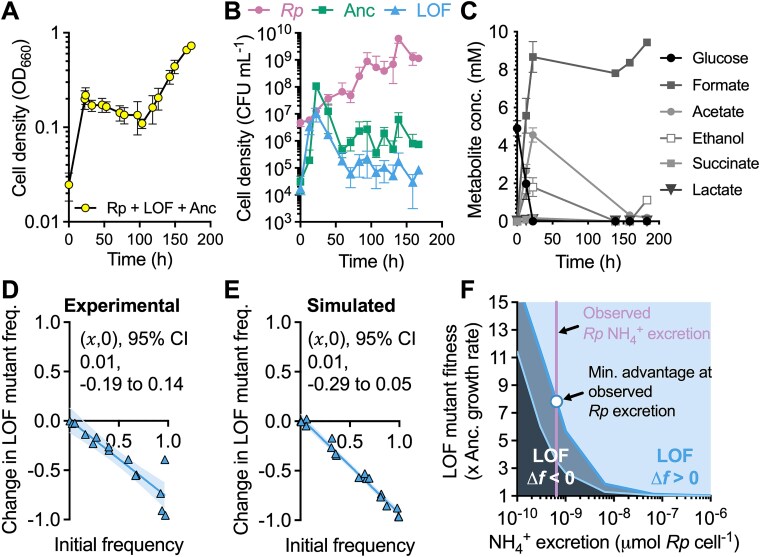
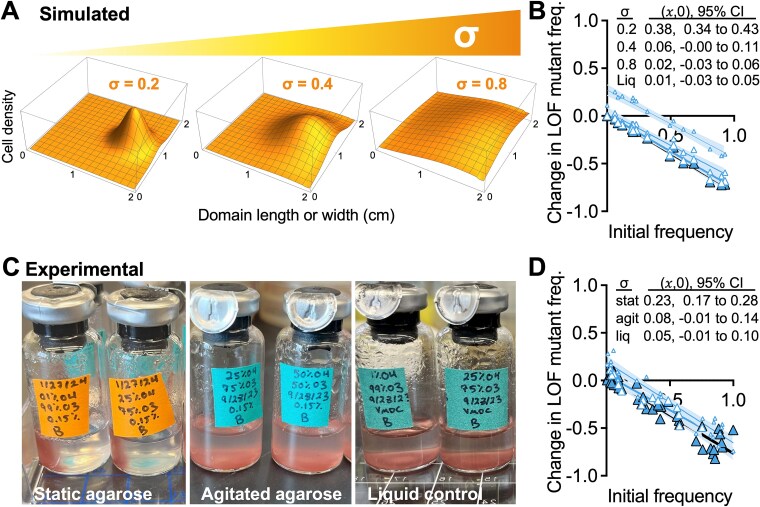
Microbial gene loss is hypothesized to be beneficial when gene function is costly, and the gene product can be replaced via cross-feeding from a neighbor. However, cross-fed metabolites are often only available at low concentrations, limiting the growth rates of gene-loss mutants that are dependent on those metabolites. Here we define conditions that support a loss of function mutant in a three-member bacterial community of (i) N2-utilizing Rhodopseudomonas palustris as an NH4+-excreting producer, (ii) N2-utilizing Vibrio natriegens as the ancestor, and (iii) a V. natriegens N2-utilizaton mutant that is dependent on the producer for NH4+. Using experimental and simulated cocultures, we found that the ancestor outcompeted the mutant due to low NH4+ availability under uniform conditions where both V. natriegens strains had equal access to nutrients. However, spatial structuring that increasingly segregated the mutant from the ancestor, while maintaining access to NH4+ from the producer, allowed the mutant to avoid extinction. Counter to predictions, mutant enrichment under spatially structured conditions did not require a growth rate advantage from gene loss and the mutant coexisted with its ancestor. Thus, cross-feeding can originate from loss-of-function mutations that are otherwise detrimental, provided that the mutant can segregate from a competitive ancestor.
当基因功能成本高昂且基因产物可通过从邻居处交叉喂养来替代时,微生物基因丢失被认为是有益的。然而,交叉喂养的代谢产物通常仅以低浓度存在,这限制了依赖这些代谢产物的基因丢失突变体的生长速率。在这里,我们定义了在一个由三成员组成的细菌群落中支持功能丧失突变体的条件:(i)利用N2的沼泽红假单胞菌作为排泄NH4+的生产者,(ii)利用N2的嗜盐弧菌作为祖先,以及(iii)一个依赖生产者提供NH4+的嗜盐弧菌N2利用突变体。通过实验和模拟共培养,我们发现,在均匀条件下,当两种嗜盐弧菌菌株都能平等获取营养时,由于NH4+可用性低,祖先菌株胜过了突变体。然而,空间结构逐渐将突变体与祖先菌株隔离开来,同时保持从生产者那里获取NH4+的途径,这使得突变体能够避免灭绝。与预测相反,在空间结构化条件下突变体的富集并不需要基因丢失带来的生长速率优势,并且突变体与其祖先共存。因此,只要突变体能够与竞争性祖先隔离开来,交叉喂养就可以源自原本有害的功能丧失突变。