Rezk Rasha, Basar Fikret, Mediavillo John, Donaldson Rebecca, Watts Colin, Franze Kristian, Kabla Alexandre J
Department of Biology, York Biomedical Research Institute, University of York, York, UK.
Department of Engineering, University of Cambridge, Cambridge, UK.
Clin Exp Med. 2025 Jun 26;25(1):220. doi: 10.1007/s10238-025-01736-6.
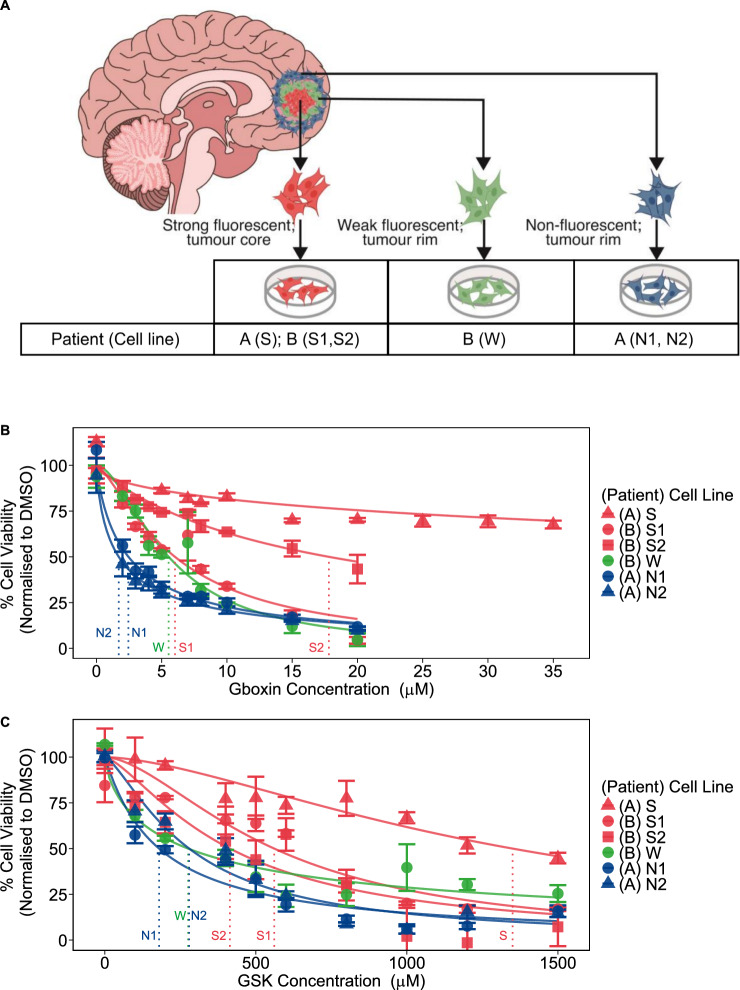
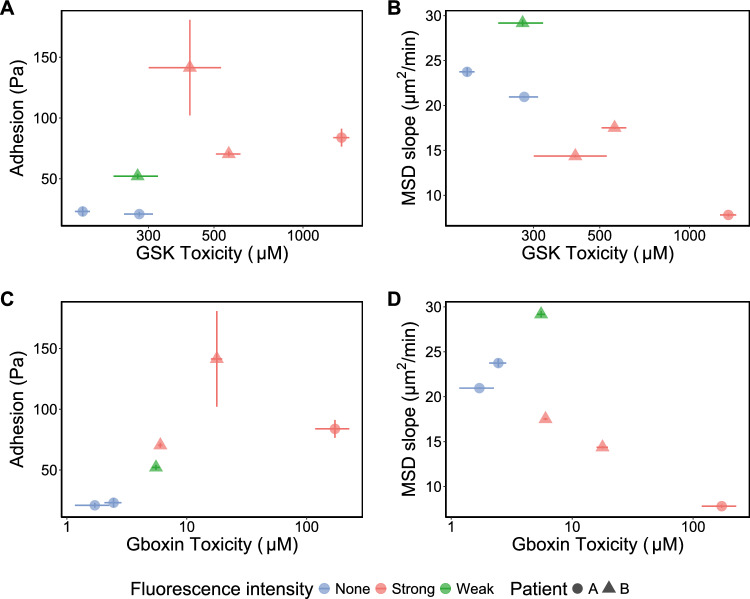
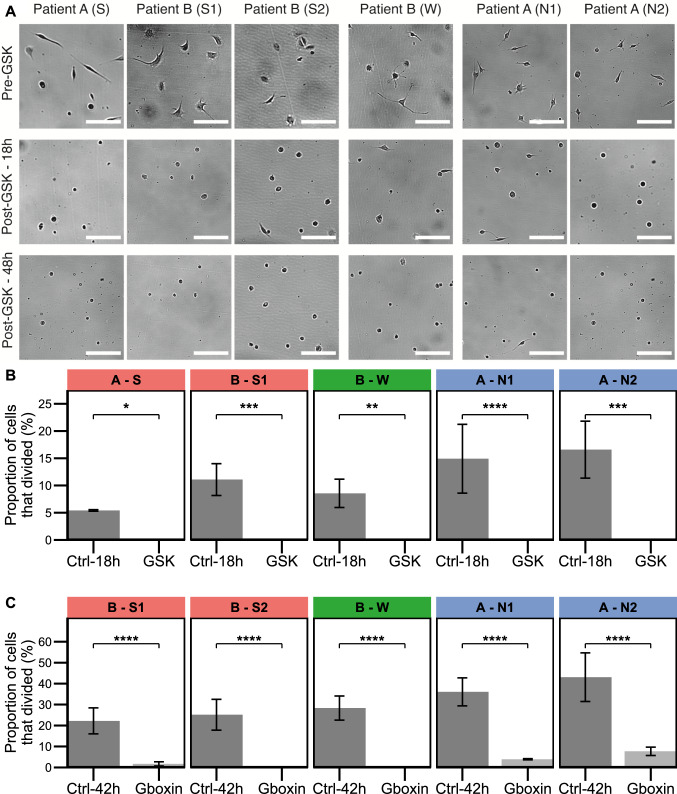
This study aims to investigate the cellular response of Glioblastoma (GBM) to adhesion and metabolic inhibitors, focusing on cell migration and matrix adhesion properties. GBM is the most common incurable brain tumor. Despite decades of research into GBM's chemical and molecular classification, identifying mechanisms of drug resistance has been challenging. Studies on inhibitors targeting cancer cell migration and proliferation rarely consider the heterogeneous migration properties among cells, which may impact patient responses to treatment. In this work, tissue samples were obtained from spatially distinct locations with different 5-aminolevulinic acid (5-ALA) fluorescent intensities-including strongly fluorescent tumor cores, a weakly fluorescent tumor rim, and non-fluorescent tumor margins. These samples were previously shown to be associated with significantly different motility and adhesion properties. We tested the response of tumor cells to adhesion and metabolic inhibitors using metabolic MTT and Cell Titer Glo viability assays, respectively. We also monitored cell survival using time-lapse microscopy, while culturing them on low-modulus polydimethylsiloxane (representing the stiffness of brain tissue). Metabolic viability assays revealed substantial heterogeneity in drug potency across cells from different regions of the tumor. Highly fluorescent tumor core cells were significantly more resistant to an F0F1 ATP synthase inhibitor (Gboxin), and a FAK inhibitor (GSK2256098), while their proliferation ceased post-treatment in vitro. In contrast, cells derived from non-fluorescent tumor margins exhibited higher potency for the ATP synthase inhibitor (Gboxin), but their proliferation persisted post-treatment. Our study demonstrates a correlation between the adhesive and migration properties of cells and their sensitivity to therapeutics in different regions of the tumor within individual patients and between patients with GBM.
本研究旨在调查胶质母细胞瘤(GBM)对黏附抑制剂和代谢抑制剂的细胞反应,重点关注细胞迁移和基质黏附特性。GBM是最常见的无法治愈的脑肿瘤。尽管对GBM进行了数十年的化学和分子分类研究,但确定耐药机制一直具有挑战性。针对癌细胞迁移和增殖的抑制剂研究很少考虑细胞间的异质迁移特性,而这可能会影响患者的治疗反应。在这项工作中,从具有不同5-氨基乙酰丙酸(5-ALA)荧光强度的空间不同位置获取组织样本,包括强荧光肿瘤核心、弱荧光肿瘤边缘和非荧光肿瘤边缘。这些样本先前已显示与显著不同的运动性和黏附特性相关。我们分别使用代谢MTT和细胞活力检测法测试肿瘤细胞对黏附抑制剂和代谢抑制剂的反应。我们还在低模量聚二甲基硅氧烷(代表脑组织硬度)上培养细胞时,使用延时显微镜监测细胞存活情况。代谢活力检测揭示了来自肿瘤不同区域的细胞在药物效力方面存在显著异质性。高荧光肿瘤核心细胞对F0F1 ATP合酶抑制剂(Gboxin)和黏着斑激酶抑制剂(GSK2256098)的耐药性明显更强,而它们在体外治疗后增殖停止。相比之下,来自非荧光肿瘤边缘的细胞对ATP合酶抑制剂(Gboxin)的效力更高,但它们在治疗后仍持续增殖。我们的研究表明,个体患者肿瘤不同区域以及GBM患者之间,细胞的黏附与迁移特性与其对治疗的敏感性之间存在相关性。