Cheng M C F, Welford M R V, Zamora L N, Delorme N J, Ragg N L C, Hickey A J R, Dunphy B J
School of Biological Sciences, University of Auckland, Private Bag 92019, Auckland, 1142, New Zealand.
Cawthron Institute, Private Bag 2, Nelson, 7042, New Zealand.
Metabolomics. 2025 Jun 26;21(4):91. doi: 10.1007/s11306-025-02289-1.
Survival and quality of Green-lipped mussels (Perna canaliculus) exported live could be further improved through enhanced post-harvest handling, aiming to reduce the physiological stress associated with transport out of water. Addressing these issues requires identifying treatments to reduce post-harvest stress and understanding underpinning molecular mechanisms.
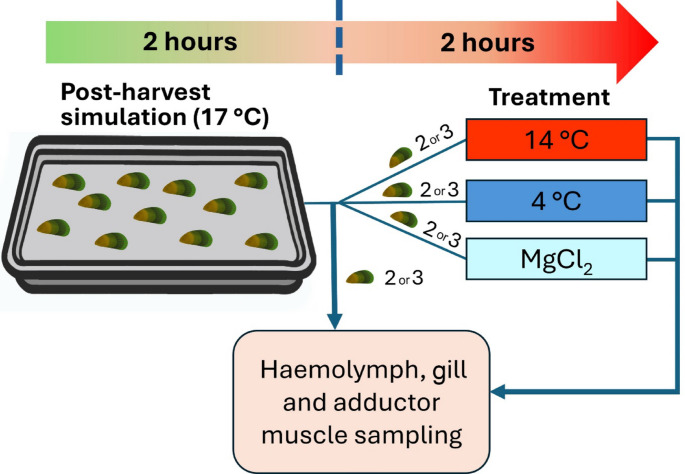
This study aimed to evaluate treatments (low temperature and MgCl anaesthetic baths) to mitigate post-harvest handling stress in mussels.
We analysed metabolomic profiles using gas chromatography-mass spectrometry (GC/MS), anaerobic enzyme activity in gill and adductor muscle, and haemolymph biochemistry (pH, antioxidant capacity and osmolality) in mussels subjected to 14 °C, 4 °C or MgCl water-bath treatments after simulated harvest.
Metabolomic analyses revealed post-harvest mussels experienced increased anaerobic activity, osmotic and oxidative stress, reduced pH (Δ0.31), and lower polyunsaturated fatty acids (PUFA). Mussels immersed in 14 °C seawater recovered from anaerobiosis but had a strong indication of oxidative stress. Although mussels in 4 °C immersion had increased levels of PUFA, implying depressed lipid oxidation, the treatment did not improve recovery from anaerobiosis, indicated by reduced pH (Δ0.38). Mussels treated with MgCl showed some recovery from anaerobic handling stress, with decreased anaerobic end product accumulation and a more modest haemolymph pH decline (Δ0.16) compared to controls. While anaerobic enzyme activities showed tissue-specific responses, they did not exhibit the pronounced differences among treatments shown by their products in metabolic profiling.
Among the proposed re-immersion treatments, immersing mussels in seawater containing 40 g L MgCl seemed to be the most effective treatment to alleviate post-harvest metabolic stress, therefore potentially increasing shelf-life of mussels destined for live export.
通过加强收获后处理,可进一步提高出口活绿唇贻贝(Perna canaliculus)的存活率和品质,旨在减少与离水运输相关的生理应激。解决这些问题需要确定减轻收获后应激的处理方法,并了解其潜在的分子机制。
本研究旨在评估处理方法(低温和MgCl麻醉浴)对减轻贻贝收获后处理应激的效果。
我们使用气相色谱-质谱联用(GC/MS)分析代谢组学图谱,检测模拟收获后经14°C、4°C或MgCl水浴处理的贻贝鳃和闭壳肌中的厌氧酶活性,以及血淋巴生化指标(pH值、抗氧化能力和渗透压)。
代谢组学分析表明,收获后的贻贝厌氧活性增加、渗透压和氧化应激增加、pH值降低(Δ0.31),多不饱和脂肪酸(PUFA)含量降低。浸入14°C海水中的贻贝从厌氧状态恢复,但有明显的氧化应激迹象。尽管浸入4°C海水中的贻贝PUFA水平升高,这意味着脂质氧化受到抑制,但该处理并未改善厌氧恢复情况,pH值降低(Δ0.38)表明了这一点。用MgCl处理的贻贝在厌氧处理应激后有一定恢复,与对照组相比,厌氧终产物积累减少,血淋巴pH值下降幅度较小(Δ0.16)。虽然厌氧酶活性表现出组织特异性反应,但在代谢谱分析中,它们并未表现出处理组之间其产物所显示的明显差异。
在所提出的再浸入处理方法中,将贻贝浸入含40 g/L MgCl的海水中似乎是减轻收获后代谢应激的最有效处理方法,因此可能会延长用于活出口贻贝的保质期。